
Features
Why Choose Xinxiangrui Webbing?
Source Factory
Direct wholesale production from our own plant in Dongguan, not a trading desk. Weaving, dyeing, printing, hardware assembly and packing all run in house, with no middleman margin in the price.
Full Customization
OEM and ODM work starts from your drawing: width, weave, colour, hardware and retail packaging. We match Pantone, send a physical sample before bulk, and keep every change on one work order.
Strict QA & ISO Standards
Every batch is checked for width, thickness, break strength and colour fastness before it ships, and the plant runs to ISO 9001 and ISO 14001. Test reports for your batch travel with the goods.
Proven Track Record
Fifteen years of narrow fabric since 2011, 200+ active partners and shipments to 50+ markets. Long-run programmes are what this factory is built for, which is why most customers reorder.

We Have The Best Solutions for Your Business
Xinxiangrui has made narrow fabric in Dongguan, China since 2011. Our 8,000 m² plant weaves, dyes, prints, cuts and sews under one roof, supplying 200+ active partners in 50+ markets. We produce polyester, nylon, cotton, elastic, reflective and bio-based webbing, ribbon, lanyards, pet leashes, bags and luggage components, from yarn and reflective tape to finished straps and handles.
Because every step stays in one plant, a widening range does not cost tolerance. Our laboratory tests to 2000N+ break strength, 50,000+ Martindale cycles and 1,000+ hours of UV exposure, and every batch carries its own figures rather than a catalogue sample. We work to OEKO-TEX, CPSIA, REACH, RoHS, ISO 9001, ISO 14001 and GRS. Send us your spec sheet and target quantity, and we will recommend the construction that fits.
Pet Leashes: Width, Load and the Dog in Front of You
Width is the first decision and it is made twice: once for the animal and once for the hand. The table below is the version worth carrying into a product meeting.
| Width | Animal | Hand feel | Where it disappoints |
|---|---|---|---|
| Narrow | Toy breeds, cats, indoor use | Light, unobtrusive, cuts into a hand under a pull | A strong dog on a long walk |
| Standard | Most dogs up to a medium build | The compromise most products sit at | A puller, and any handle left unpadded |
| Wide | Large and strong breeds | Spreads load across the palm, feels substantial | The hardware, which is often not upgraded with it |
Where the 2000N figure belongs: a 25 mm webbing band of the kind used for heavy leashes clears 2000N, and that number describes the band alone. A finished leash is rated by its assembly, and the assembly fails at the stitch or the hook long before the webbing reaches anything like that load. Quote the band figure as material evidence and test the assembly separately.
Hardware: The Part That Fails
The snap hook, and what separates a good one
A snap hook is a spring-loaded gate in a metal body, and the two properties that matter are the gate's return force and the body's resistance to bending. A cheap hook opens under a surprising load because the spring is light, and it deforms at the eye because the metal is thin. Both failures are invisible on a sample card and obvious after a month with a strong dog.
The ring and the swivel
A swivel exists to stop a leash twisting into a rope, and its quality is measured in how freely it turns under load rather than when hanging loose. A swivel that turns freely unloaded but locks under a pull will still twist the band, and a twisted band concentrates wear on one edge. On a large dog, that single part decides whether the leash wears evenly or in a spiral.
The handle, which is a comfort decision
A leash is held for an hour at a time and the handle is where that hour is spent. A narrow band folded into a loop makes a thin edge that presses into the fingers; a widened or padded section spreads the same pull over a larger area. A second handle near the clip, for traffic control, changes how the product is used and costs almost nothing at the cutting stage.
Stitching: Where the Strength Is Decided
A leash end is folded back on itself and stitched, and the stitch pattern is the whole of the assembly's strength. A single straight row concentrates the load on one line and tears through the webbing at the end of the run. A box-X pattern distributes it across four lines and a diagonal, which is why it is the default on anything load-bearing. A bar-tack added across the fold doubles the cycles before the first sign of wear at that point.
Thread matters as much as the pattern. A bonded nylon thread with the right size for the webbing will outlast a cheaper one by a wide margin, and the needle size has to match the thread or the stitch will sit proud and abrade. None of this appears on a finished leash, and all of it shows in the first month of use.
There is one more variable that decides how a leash feels in use and it is rarely written down: where the fold sits. A handle formed by folding the full width of the band produces a flat loop with two hard edges; a handle formed by folding a narrower strap onto a wider one produces a rounded grip that sits in the fingers instead of against them. The difference is a pattern change and a few seconds of sewing, and it is the single most noticeable upgrade a buyer can make to a product that is otherwise identical, at a cost measured in seconds on a machine that is already running.
Six Lines a Leash Brief Should Carry
- The finished length — measured from the clip to the end of the handle, since the two ends are not always what a buyer pictures.
- The width and the colour — with the base shade named separately from any print, because a dark base changes how every other colour reads.
- The hardware type and finish — snap hook, trigger clip or carabiner, in a named finish, matched or contrasted deliberately.
- The stitch pattern and thread — box-X or bar-tack, with the thread size stated, since this is the assembly's real strength.
- The handle configuration — single loop, padded section, or a second traffic handle, drawn rather than described.
- The labelling requirement — where the brand sits, whether there is a size or care label, and whether the band carries a reflective element.
Four Checks Before a Bulk Order
- Pull the assembly, not the band. Anchor the clip and pull the handle to the load the product is sold for. The stitch is what you are testing, and it is the part that has never been measured.
- Open and close the hook two hundred times. The gate's return force is a spring and springs relax. The hook that feels crisp when new may open under a lunge by the end of a season.
- Hold the handle for ten minutes. Not a glance: ten minutes with a weight attached. A handle that is comfortable in a shop is often not comfortable at the end of a walk.
- Wash one and check the hardware. A leash is washed by owners. Plated fittings can discolour and a swivel can seize, and both are cheap to avoid if they are known before the order.
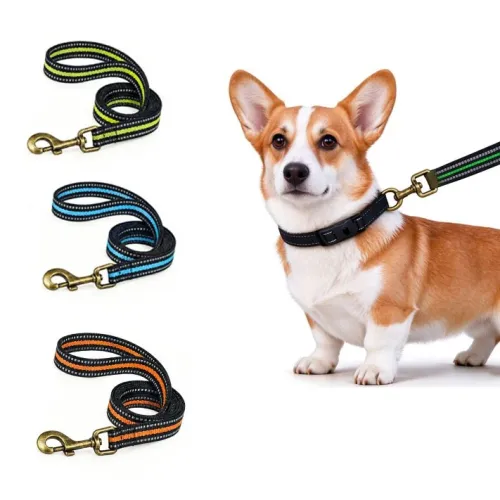
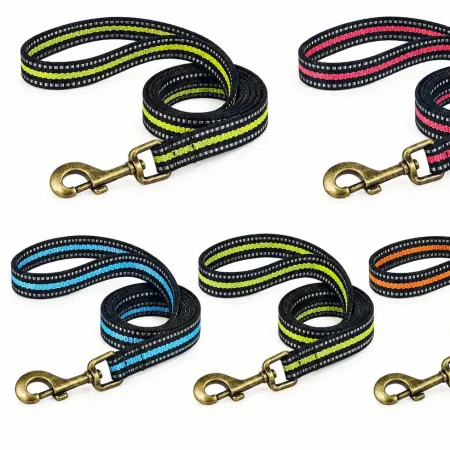
The pet leashes line is built from the pet webbing woven on site and assembled with the hardware that also serves the pet harness range, which means a colour and a fitting can be matched across a set rather than ordered twice. A 25 mm band in that family clears 2000N, and the leash itself is designed so that the stitch, not the band, is the part with a known limit.
Two Mistakes That Break a Leash
A single row of stitching at the clip
One straight seam across a folded end is the fastest way to close a leash and the least reliable. The load sits on one line of thread, the webbing either side is unsupported, and the tear begins at the point where the stitch run stops. Changing to a box-X costs a few seconds at the machine and changes the failure mode from a tear to a gradual wear that can be seen before it matters.
Hardware that was not upgraded with the width
A product widened for a large dog often keeps the fitting chosen for the small one, because the fitting is the last line of the brief. The result is a leash that looks proportionate and fails at the clip. When the width moves up, the hook, the ring and the swivel move with it, and the specification should say so in the same sentence.
Pet leashes are an assembly, and the assembly is what gets tested. Specify the width for the animal, the handle for the hand, and the stitch pattern for the load, and the product behaves the way the sample promised.
Why Xinxiangrui for Pet Leashes
A leash is judged by its stitching, and pet leashes leave this Dongguan plant with the band, the sew line and the hardware handled by one team, so a pattern can be changed and re-tested without shipping samples between suppliers. We have run narrow fabric since 2011 and pull every assembly to the load the customer names rather than to the band's own figure. Tell us the dog, the length and the handle you want, and a matched leash comes back to you.
Featured Products
Collection about Xinxiangrui Webbing
User Reviews
What users say about Xinxiangrui Webbing
Frequently Asked Question
Do you have any question?
The assembly, not the band. A leash is rated by its weakest link, which is the stitch holding the snap hook, the hook itself, or the point where a hand grips a narrow strip. A buyer who specifies only the webbing has specified about a third of the product.
Fifteen millimetres for toy breeds and cats, twenty for most dogs up to a medium build, twenty-five for large and strong breeds. Width is decided twice, once for the animal and once for the hand, because a narrow band concentrates its weight on a small area and cuts in.
A single straight row concentrates the whole load on one line of thread and the tear begins where the stitch run stops. A box-X pattern distributes it across four lines and a diagonal, and a bar-tack across the fold roughly doubles the cycles before the first sign of wear.
Two properties decide it: the gate's return force and the body's resistance to bending. A cheap hook opens under a surprising load because the spring is light, and it deforms at the eye because the metal is thin. Both are invisible on a sample card and obvious after a month with a strong dog.