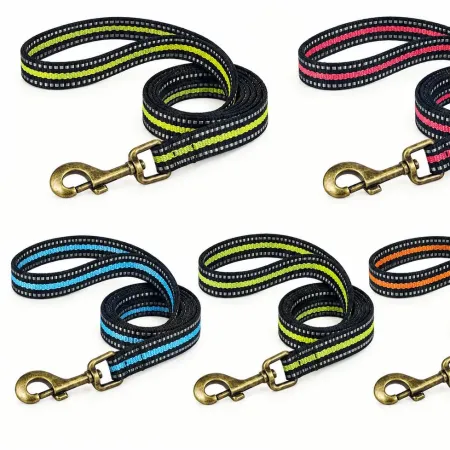
Adjustable Pet Dog Leashes: Test the Longest Setting
An adjustable pet dog leashes product is almost always described by one number, and that number is usually the wrong one. A lead sold as "1.5 metres" is a lead whose shortest usable setting is 1.5 metres and whose longest is perhaps 2.4, and the setting that gets pulled hardest in service is the long one, where the doubled band has the least overlap and the load lands furthest from the hand. Reading the label as a specification is the first mistake in this category.
This guide covers the three parts of an adjustable lead that move as it is lengthened, why the doubled section creeps at the adjuster, why a test at one setting describes only that setting, six lines an adjustable brief should carry, and the two judgements buyers make with their hands that no report replaces.
Adjustable Pet Dog Leashes: Three Things That Move
An adjustable lead is not a fixed lead with extra holes. Three relationships change together as the length changes, and each of them changes the load path rather than merely the geometry.
- The anchor point — the D-ring or the fixed loop at the hand end, which moves relative to the body as the lead shortens and changes the angle at which the load arrives.
- The overlap in the adjuster — two layers of band sliding through a ring or a buckle, and the length of that doubled section is what resists creep.
- The hand position — where the grip sits on the band, and therefore how much of the lead hangs free to swing against a leg when the dog is not pulling.
| Setting | Doubled overlap | What the lead does |
|---|---|---|
| Shortest | Longest, often half the band | Stiff, close control, most of the mass in the hand |
| Middle | Moderate, the usual walking position | Balanced, and where most of the life is spent |
| Longest | Shortest, the weak setting | Soft, wide arc, and the setting a lunging dog reaches |
| Beyond the marked range | Almost nothing | Creeps in minutes, and the owner calls it a fault |
The band is not the limiting part
A 25 mm band clears 2000N on a bare tensile test, and no domestic dog on a lead comes close to that figure. The number is worth having because it removes the band from the argument: once the base is effectively unbreakable, the only variables left are the adjuster, the stitching and the hardware, which is exactly where a long setting loads the product.
Three Places an Adjustable Lead Behaves Differently
The label length is the shortest setting
A lead described as 1.5 metres is usually 1.5 metres at the short end, because that is the length of the finished product when the band is doubled furthest through the slider. The long end is whatever the slide travel allows, and it is almost never printed. Two suppliers can both sell a "1.5 metre adjustable lead" where one extends to 1.9 metres and the other to 2.5, and the difference is invisible until the customer walks a dog on grass.
The doubled band creeps at the adjuster
Two layers of webbing through a ring hold each other by friction, and friction depends on surface, tension and how square the band sits in the frame. A band that is slightly softer than the sample, or slightly narrower than the frame's internal width, will walk. It does not fail; it shortens or lengthens under load, and the owner experiences that as the lead "not staying where I put it". A wider frame, a rougher weave on the reverse and a proper keeper all reduce it.
One test at one setting describes one setting
A pull report on an adjustable lead that names a single figure is nearly always taken at the short setting, where the doubled section is longest and the assembly is stiffest. That is the strongest configuration and the least used. A report worth reading shows the longest setting, the middle, and what happened at the adjuster during the pull, because a joint that holds and then slips two centimetres has passed the test and failed the product.
Six Lines for an Adjustable Brief
- Short and long, in millimetres — both ends of the travel, not the nominal figure, since the long end is where the product is stressed.
- The adjuster type — slider, ring, buckle or cam, because each grips by a different mechanism and each has its own creep behaviour.
- The band width and the frame width — a band 1 mm narrower than the frame is a lead that slides, and this pair matters more than either figure alone.
- The number of settings — infinite slide, discrete eyelets or a fixed plus extension, which decides how precisely a customer can match a walking style.
- The docked end — a floating D-ring for an accessory, a second loop for a hands-free attachment, or a plain end, and where it sits at each setting.
- The keeper and the tail — how the loose end is held after adjustment, because an unheld tail swings, frays at the cut and reads as unfinished.
The sixth line is the one most often missing and the one a customer notices within a week. After the slide is set, some length of band hangs free, and if nothing holds it the tail whips against a leg at every step, catches on the cut end and starts to fray. A keeper loop, a folded tab or a magnetic clip costs very little at the making stage and cannot be added later without re-stitching the assembly.
The base for an adjustable lead is usually a nylon webbing band between 20 mm and 25 mm, because nylon's stretch softens a lunge and its surface grips well in a slider. A polyester webbing alternative is stiffer and holds colour longer in sun, and it grips differently in the same frame, so the adjuster should be chosen after the fibre rather than before. Either way the test report should name the setting it was taken at, and a development sample should be walked before the specification is closed.
Two Judgements Made by Hand
Whether the slide moves under a thumb
An adjuster can hold perfectly under a static pull and still be awkward to set, because setting it is a two-handed operation with a dog pulling on the other end. If the slider needs more force than a thumb can apply while the lead is loaded, the owner stops adjusting and leaves the lead at one length, at which point the feature has been paid for and abandoned. Ten samples in a row, set by hand, tell you this in a minute.
Whether the lead still hangs straight when wet
Nylon takes up water, and a doubled section that has taken up water behaves differently in the frame: it swells slightly, grips harder, and dries into a set if it is left doubled. A lead walked in rain and hung up wet will show a soft kink at the adjuster within a season, and the kink sits exactly where the band slides. Comparing a lead dried flat with one dried doubled is a two-sample test that predicts this without an accelerated aging rig.
FAQ: Adjustable Pet Dog Leashes
Should the length be quoted as a range?
Yes, both ends. A single figure hides which end it describes, and buyers compare two products on a number that may be measuring different things.
Why does my lead shorten while walking?
The doubled band is walking through the frame. A band slightly narrower than the frame, a smooth reverse face or a worn slider all cause it, and a keeper reduces it.
Is a slider or a buckle better?
A slider gives continuous length and grips by friction; a buckle gives discrete positions and grips by geometry. Buckles are more predictable, sliders are more comfortable in the hand.
What width for an adjustable lead?
20 mm is the common middle, 25 mm for a strong dog. Above 25 mm the doubled section becomes bulky in the frame and the adjuster needs to be larger to match.
Can the tail be trimmed after purchase?
It can, but a heat-sealed or bound end is needed afterwards, since a cut nylon end unravels quickly. Trimming before the end treatment is the better order.
An adjustable pet dog leashes specification is two lengths, one adjuster, one band width and one keeper. Written that way, the long setting is a number you chose rather than a number that arrived, and the report describes the configuration a dog actually pulls against.
Why Xinxiangrui for Adjustable Pet Dog Leashes
An adjustable lead is decided by friction and stitching, and both are measured in-house rather than assumed. The on-site laboratory runs tensile pulls on the sewn assembly, Martindale abrasion past 50,000 cycles and UV exposure beyond 1,000 hours with a colour shift held under ΔE 5, so the figure that comes back describes the band on your order and the setting it was tested at, not a catalogue sample from another year. Tell us the short and long length and a matched construction comes back to you.