Luxury Pet Leashes: Five Details That Carry the Word
Luxury pet leashes are rarely separated from ordinary ones by the band. At a metre the difference between a good lead and an expensive one is small, and at arm's length it is decided by five details a customer meets in a fixed order: the edge under the thumb, the stitch along the band, the plating on the fitting, the lining against the palm and the box it arrives in. Each is a manufacturing decision, and each can be changed without changing the weave.
This guide covers the five details that carry a premium, why the edge is judged before the colour, why plating is the only element that fails visibly, six lines a premium brief should carry, and the two sensory judgements that decide a sale in a shop and never appear on a specification.
Luxury Pet Leashes: Five Details That Do the Work
A premium product is not one expensive component. It is several ordinary components finished to a standard that a hand can feel, and the five below are the ones a customer notices without being told.
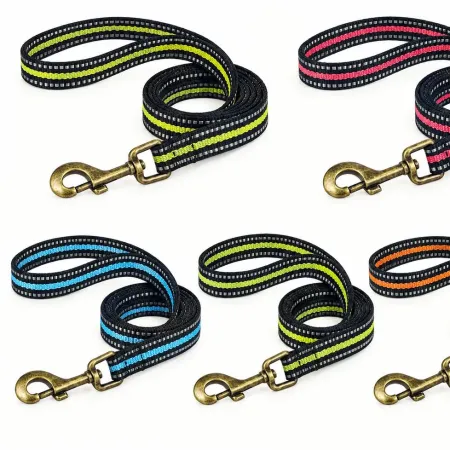
- The edge — cut, folded, bound or painted, and the first surface a thumb touches when a lead is picked up.
- The stitch — thread size, colour and spacing, which is the most legible signal of care on a plain band.
- The plating — polished, brushed, matte or two-tone on the hook and ring, and the one part that shows wear in public.
- The lining — a doubled inner face at the handle, which is what makes a lead feel weighted rather than flat.
- The presentation — a box, a pouch or a sleeve, which frames the product before it is touched.
| Detail | Signals | Change difficulty |
|---|---|---|
| Painted edge | Hand-finished, and it catches light along the whole length | A new step, and it needs drying space |
| Contrast stitch | Deliberate construction, and a steady hand | A thread change and a tension reset |
| Plating finish | Weight and consistency of tone across the range | A supplier change, planned early |
| Doubled handle | Substance, and a lead that hangs rather than flutters | A second band and two more stitch runs |
Premium finishing sits on an ordinary band
None of the five details requires a stronger base, because a 25 mm band already clears 2000N and a lead never approaches that load. What a premium programme buys is surface and assembly quality on a construction that is already adequate, which is a useful thing to say plainly: the money goes into finishing, not into a hidden structural upgrade.
Three Places Premium Work Gets Hard
The edge is judged before the colour
A hand picks a lead up at the handle end and runs along the edge before the eye has settled on a shade. A raw cut edge, however fine the weave, reads as unfinished at that moment; a painted or bound edge reads as considered. This is why edge treatment, not colour, is the first place a premium budget should go, and it is also the detail most often omitted because it appears as a line item rather than as a design feature.
Plating is the only part that fails in public
A band that fades wears gradually and privately. A hook whose plating dulls or pits is on display at the end of a lead, catching light in a way that draws the eye, and a two-tone finish that loses its contrast looks damaged rather than used. Plating quality is therefore disproportionate in a premium product, and a supplier change here is worth more scrutiny than a colour change.
Handwork and consistency pull apart
Painted edges, hand-set studs and hand-stitched handles all look better and all vary more. A range of two hundred pieces with hand-painted edges will have visible differences between the first and the last, and a customer who buys two will see them. The workable compromise is to hand-finish the details that read as individual and machine-finish the ones that must match, and to decide which is which before the first sample rather than after the first complaint.
Presentation has its own schedule and its own supplier, and it is the detail most often left to the last week. A rigid box, a printed sleeve and a tissue wrap are three different items with three different lead times, and the tissue has to be matched to the band rather than to the box. A programme that treats the box as packaging instead of as part of the product usually ends up air-freighting cartons that were ordered late.
Six Lines for a Premium Brief
- The edge treatment — cut, folded, bound or painted, and the colour of the edge relative to the face.
- The thread — size, fibre and colour, with the stitch length given in millimetres rather than described as fine.
- The plating — finish and colour, plus the standard the plating should meet for tarnish and wear.
- The handle build — single, doubled or padded, and whether the lining is visible at the end.
- The brand mark — a woven label, an embossed plate or a metal tag, positioned so it is read when the lead is held.
- The presentation — box, pouch or sleeve, and whether the lead is coiled with a band or laid flat.
The fifth line is where a premium range usually finds its most economical gain. A woven label costs little and sits on the band where a hand rests; a metal tag costs more and adds a small weight that reads as quality. Either way the position matters more than the material, because a mark placed near the hook is seen when the lead is attached and a mark near the handle is seen for the whole walk.
A premium band is still a nylon webbing or polyester webbing base, and the difference from a standard lead is entirely in the finishing and the assembly. Colour matching to a supplied reference, edge treatment and hardware finishing are all handled through the development route, and because the first piece is built on production settings the sample arrives with the edge and the stitch it will ship with. The abrasion and fastness results should be read alongside the finish, since a painted edge that rubs away is a premium detail that has stopped working.
Two Judgements Made in the Hand
Whether it has weight
A premium lead is expected to have mass, and mass comes from three places: a doubled handle, a heavier fitting and a slightly thicker band. None of them is necessary for strength, which is why the decision belongs to the design rather than to engineering. A lead that is too light feels like a sample; one that is too heavy is tiring on a long walk, and the acceptable window is narrower than it looks.
How the hardware sounds
A snap hook with a firm spring closes with a solid click, and a light one with a thin tick. Customers do not describe this, and they notice it: the sound is repeated every time the lead is attached, which is several times a day for years. Judging hardware by ear at the sample stage is unusual and effective, and it distinguishes two fittings that measure identically.
FAQ: Luxury Pet Leashes
What makes a lead look expensive?
A finished edge, an even stitch line and consistent plating. The band itself matters less than these three at the distance a customer sees it.
Is a thicker band worth it?
For feel and for mass, yes. For strength, no: the load is already covered many times over at 25 mm, so thickness is a design choice rather than a safety one.
Does a painted edge wear off?
It wears at the fold and where the lead rubs on the ground. A folded or bound edge lasts longer; a painted one looks sharper when new.
Should the collar match exactly?
Yes, including the edge and the thread. A set that matches in colour and differs at the edge reads as two products rather than one.
Is a metal tag a good idea?
It adds weight and a lasting mark, and it must be attached so it cannot rotate into the stitching. A small plate sewn flat is safer than a hanging tag.
Luxury pet leashes are five finishing decisions on an ordinary band: the edge, the stitch, the plating, the handle and the box. Specify all five, and the premium is something a hand can find rather than something a label claims.
Why Xinxiangrui for Luxury Pet Leashes
A premium lead is bought on the sample, so the sample has to show the finish rather than describe it. Free samples, Pantone matching and development from a reference are standard here, and with weaving, dyeing, printing and hardware assembly on one site the first piece carries the edge and the stitch it will ship with instead of a bench approximation. Tell us your lead spec and a matched construction comes back to you.