1 Inch Polyester Webbing: One Width, Six Finished Products
A 1 inch polyester webbing is the width that carries the largest share of the narrow fabric trade, and the reason is not that it is the best at anything. It is that 25 mm is the smallest width that still has room for a proper face, a workable thickness range and a hardware family on both sides of it. From that one base come lanyards, bag straps, pet harness parts, luggage trim, outdoor fittings and industrial ties, each of which pulls a different property to the front.
This guide covers the six products that leave from a 25 mm base, the three points where they diverge, the figures that decide which one you are buying, six lines a brief should carry, and the two ways a 25 mm band limits what a product can be.
1 Inch Polyester Webbing: Six Products and the One Property Each Needs
The base is the same. What changes is which figure the buyer will test first, and that figure determines the construction rather than the other way round.
| Finished product | Property tested first | What moves on the loom |
|---|---|---|
| Lanyard | Surface and print, then the pull at the clip | Weave face and thickness, so a print sits flat |
| Bag strap | Load at the stitch line, then hand and drape | Pick density, so the needle does not split yarn |
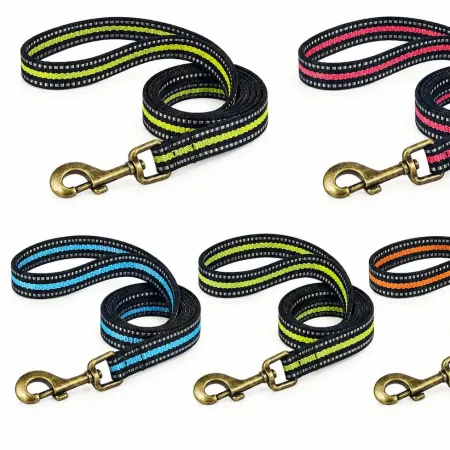
| Pet harness part | Edge softness, then resistance to chewing and wet | Selvage type and finish, so the edge is not sharp |
| Luggage trim | Colour match against coated fabric | Dye depth, so it reads the same as the panel |
| Outdoor fitting | Strength after wet and after sun | Twist and heat setting, so it does not creep |
| Industrial tie | Load held over time, then abrasion | Warp count, so the section carries the figure |
Read down the third column and the point becomes clear: the loom is being asked six different things, and a mill that runs one house construction for all six will be right for one customer and slightly wrong for the other five. The differences are small in words and visible on a bench.
What the 2000N figure belongs to
A 25 mm polyester construction that clears 2000N is the reference point for this whole width, and every product in the table above is built on it or on something close. It is a reading at one width, one thickness and one gauge length, and it does not travel to other widths by arithmetic. When a product needs more, the answer is a different construction rather than a wider label.
Three Places the Six Products Diverge
At the finish, not at the warp
Almost every 25 mm product starts from a plain weave of the same order. What separates a lanyard from a luggage trim is what happens afterwards: one is printed, one is dyed to a panel, one is calendered to a flatter hand. Because those steps sit in the same plant here, the divergence happens in a single pass through the building rather than across three suppliers.
At the hardware interface
A 25 mm band meets a 25 mm slot, and the fold that goes through it doubles the thickness. This is the single most common source of a failed sample: the band is approved flat, then the assembled item binds or the fold sits proud. Hardware assembly in the same building does not remove the problem, but it does mean the fold is tested on the actual band rather than on a stand-in.
At the colour card
Pet products and outdoor gear are bought against a fastness standard; luggage trim is bought against a panel. Both are colour questions and neither is answered by a Pantone chip alone, because the chip is ink and the band is dyed yarn. The useful reference is a dyed strip next to the material it will sit beside, in the light where it will be seen.
Thickness is the figure that quietly decides the product. Two 25 mm bands at 1.2 mm and 1.8 mm are the same width and behave like different materials: the thin one folds into a buckle and drapes; the thick one holds a shape, resists a crease and refuses to go through a narrow slot. A brief that names only the width has left the most consequential number blank.
Six Lines for a 25 mm Brief
- Which of the six it is — naming the finished product tells a mill which property to protect and which to trade away.
- Thickness alongside width — the figure that decides hand, buckle fit and how a fold behaves.
- The load and where it is applied — a bar-tack, a sewn loop and a buckle each load the band differently.
- The hardware it threads — slot width, and whether the fold has been tested through it.
- The standard the colour is judged by — a fastness class or a panel, but named rather than assumed.
- The end finish — hot cut, sewn, folded or tipped, since the end is where a 25 mm band first looks tired.
The sixth line is usually omitted and always visible. A hot-cut end seals and darkens slightly; a sewn end adds a bulk that may not pass a buckle; a folded and bar-tacked end is the strongest and the most expensive in labour. On a lanyard the end is in the customer's hand all day, which is why it deserves a line of its own.
- Fold the band before approving it — a flat sample hides the behaviour that matters.
- Thread the real buckle — and pull, because binding shows under load and not under inspection.
- Compare thickness, not weight — two rolls can weigh the same and sew completely differently.
- Look at the edge in raking light — a wandering selvage is invisible from above.
All six finished products start from the same polyester webbing base here, and the range around it covers webbing lanyards, bags and pet goods on one site, which is why a 25 mm band can be followed from loom to assembly without leaving the building. A 25 mm base that clears 2000N is the anchor figure; a lanyard is judged on how it feels in a hand and how the print survives a season of use.
Two Ways the Width Limits the Product
It cannot carry a wide product's visual weight
On a large bag or a piece of luggage, 25 mm reads as a thin line and the hardware has to shrink to match. Brands sometimes specify a 25 mm band on a product where 38 mm would look correct, because the fittings are already tooled for the narrower size. The result is structurally sound and visually wrong, and no test will catch it.
It leaves little room for a seam allowance
A 25 mm band with a 6 mm seam on each side loses nearly half its width to the join. That is acceptable when the seam is at an end and ruinous when it runs along the length. Where a long seam is unavoidable, the band is usually widened rather than the seam narrowed, which is why a 25 mm design sometimes arrives as a 38 mm specification after the first prototype.
FAQ: 1 Inch Polyester Webbing
Is 1 inch exactly 25 mm?
One inch is 25.4 mm. The 25 mm figure is the metric equivalent used in trade, and the 0.4 mm difference matters only where a slot is machined to one of them.
Can one 25 mm construction serve all six products?
It can be sold to all six, and it will be ideal for one. The differences are thickness, edge and finish rather than width, and they show up in use.
What thickness is usual at 25 mm?
Roughly 1.2 mm to 2 mm, and the choice is driven by the buckle slot and the load rather than by the width.
Does a 25 mm band hold 2000N?
A construction built to clear it does. The figure is a property of a specific construction at a specific thickness, not of the width by itself.
Why does the same width feel different between suppliers?
Because pick density, yarn twist and finishing differ, and none of them appear in a width. The hand is the sum of those three.
A 1 inch polyester webbing is not one product with six uses. It is six products that happen to share a width, and the width is the least informative thing about them. Name the finished item, the thickness and the hardware, and the rest of the construction follows.
Why Xinxiangrui for 1 Inch Polyester Webbing
One width becoming six products is a question of what happens after the loom, and that is how the range here is organised: three product lines across seventeen categories, so a 1 inch polyester webbing can leave as a lanyard, a bag strap or a pet harness without a second supplier. Send us the drawing, the width and the target market — we reply with a construction.