
Features
Why Choose Xinxiangrui Webbing?
Source Factory
Direct wholesale production from our own plant in Dongguan, not a trading desk. Weaving, dyeing, printing, hardware assembly and packing all run in house, with no middleman margin in the price.
Full Customization
OEM and ODM work starts from your drawing: width, weave, colour, hardware and retail packaging. We match Pantone, send a physical sample before bulk, and keep every change on one work order.
Strict QA & ISO Standards
Every batch is checked for width, thickness, break strength and colour fastness before it ships, and the plant runs to ISO 9001 and ISO 14001. Test reports for your batch travel with the goods.
Proven Track Record
Fifteen years of narrow fabric since 2011, 200+ active partners and shipments to 50+ markets. Long-run programmes are what this factory is built for, which is why most customers reorder.

We Have The Best Solutions for Your Business
Xinxiangrui has made narrow fabric in Dongguan, China since 2011. Our 8,000 m² plant weaves, dyes, prints, cuts and sews under one roof, supplying 200+ active partners in 50+ markets. We produce polyester, nylon, cotton, elastic, reflective and bio-based webbing, ribbon, lanyards, pet leashes, bags and luggage components, from yarn and reflective tape to finished straps and handles.
Because every step stays in one plant, a widening range does not cost tolerance. Our laboratory tests to 2000N+ break strength, 50,000+ Martindale cycles and 1,000+ hours of UV exposure, and every batch carries its own figures rather than a catalogue sample. We work to OEKO-TEX, CPSIA, REACH, RoHS, ISO 9001, ISO 14001 and GRS. Send us your spec sheet and target quantity, and we will recommend the construction that fits.
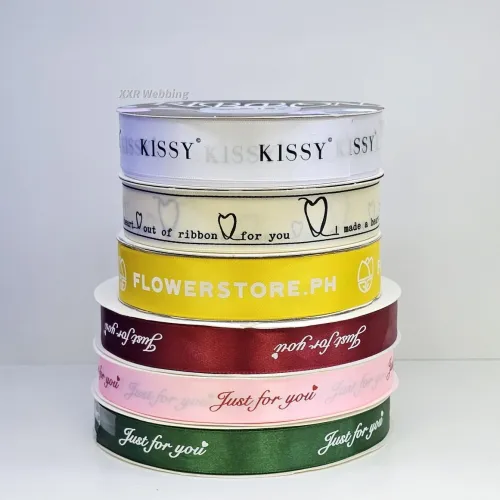
Polyester Ribbon: Three Weaves and How They Read
The weave is visible from across a room, long before anyone reads a label, and it predicts most of what a buyer will say about the product.
| Weave | Surface | How it behaves | Where it suits |
|---|---|---|---|
| Satin | Glossy face, matte reverse | Directional shine, soft hand, marks with handling | Bows, gift wrap, corsage work |
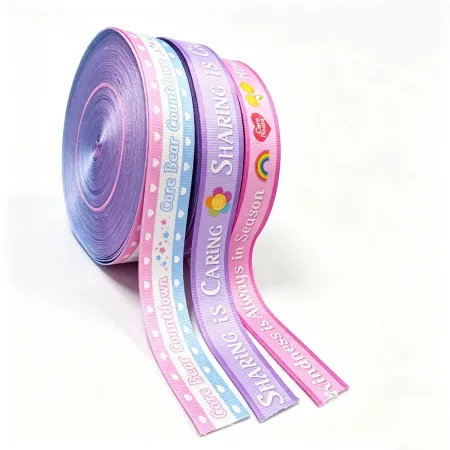
| Grosgrain | Ribbed crosswise, matte | Holds a knot, resists creasing, reads as tailored | Labels, trim, packaging, menswear |
| Sheer or organza | Open, crisp, translucent | Stiff, holds a loop, frays at a cut edge | Volume in a bow, floral work, favour bags |
Two figures that belong to different products: a decorative ribbon is not the article that carries a 2000N load figure. That number belongs to a 25 mm webbing band of the same fibre, where the weave is dense and the warp straight. Ribbon is specified by width, weave, colour and finish, and judging it against a load figure it was never built for only produces a heavier, stiffer ribbon that no longer ties well.
Float Length Is What Makes Satin Shine
The mechanism, in one paragraph
In a satin weave the warp ends pass over several weft picks before going under one, and the length of that run is called the float. A long float means the surface is mostly uninterrupted filament, which reflects light as a sheet rather than scattering it at every interlacing point. That is the whole of the lustre effect: not a coating, not a calendering step, but the distance between the places where the yarn disappears underneath. A satin with short floats looks flat no matter how bright the fibre.
Why the shine has a direction
Because the floats run in one direction, the surface reflects differently depending on how it is turned. That is what gives a satin ribbon its shifting quality, and it is also why a bow can look uneven: two loops cut from the same roll and tied at different orientations catch light differently. A designer who knows this plans the cut direction; a programme that ignores it produces bows that look mismatched in a photograph and identical in a hand.
The fragility that comes with it
A long float is a yarn that is not held down, which means it can be pulled, snagged or rubbed out of place. A satin ribbon that is folded sharply shows a crease that does not recover, and a pin dragged across the face leaves a mark that cannot be brushed out. This is not a defect in manufacture; it is the direct consequence of the property that makes the product desirable, and it belongs in the care instructions.
The Wire Edge and What It Buys
A wired ribbon carries two thin filaments inside the selvedges, woven in as the band forms rather than inserted afterwards. The wire lets a bow hold a shape after the hand lets go, which is the entire reason the product exists in decoration and gift work. Three things have to be chosen together and are often chosen separately: the wire gauge, which decides how much shape it holds and how heavy the bow feels; the fold-over at each edge, which encloses the wire so it cannot work its way out; and the heat setting that stabilises the band after the wire is in.
A wire that is too fine lets a bow sag within an hour; one that is too heavy makes a stiff loop that will not sit naturally and leaves a permanent kink where it was folded. The correct gauge is decided by the width and the weight of the ribbon rather than by preference, and the test is simple: tie a bow, set it down, and look at it the next morning.
Storage is the last detail and the one that costs the most in a warehouse. A satin roll stored on its side under pressure develops flat spots that never come out, and a wired roll compressed in a carton takes a permanent wave in the wire. Storing rolls upright, on a core, in a cool dry place keeps both properties intact, and it is a sentence in the packing instruction rather than an expense.
Six Lines a Ribbon Brief Should Carry
- The width in millimetres — with the tolerance, since a ribbon that measures under its nominal width will not fill the slot it was bought for.
- The weave — satin, grosgrain or sheer, because the surface is the product and cannot be substituted after sampling.
- The colour reference and its sheen — a shade card plus the finish, since the same colour on a matte and a glossy ground reads as two different products.
- The edge treatment — woven selvedge, cut and heat sealed, or wired, with the wire gauge stated if there is one.
- The put-up — length per roll, core size and whether the roll is labelled for retail, because these decide how the product is handled before it is used.
- The print requirement — if there is one, the route and the repeat, since a repeat that does not divide the cut length produces a broken motif at every cut.
Four Checks Before a Bulk Order
- Tie a bow and leave it overnight. Shape retention is the property being bought in a wired ribbon, and it is only visible after the material has had time to relax.
- Turn the roll in the light. Shine with a direction is satin; shine without one is usually a coating. Both are legitimate and they age differently.
- Fold it hard and look at the crease. A satin that whitens at the fold will whiten on every bow, and a bowed product is mostly folds.
- Cut an end and rub it. A heat-sealed edge should not fray; a cut edge on a sheer weave will, and knowing which one is being supplied prevents a complaint at the packing table.
The ribbon range runs on the same looms as the polyester webbing beside it, which means a programme can move between a decorative band and a structural one without changing supplier or colour system. Where a project needs its own colour, width and put-up, the OEM and ODM service covers the development route from a shade reference to a finished roll.
Two Mistakes That Turn Decoration into Defect
A print laid on a surface that moves
A satin face is a field of loose floats, and an ink film laid across it has nothing to grip. The print looks crisp on the roll and cracks at the first fold, because the yarn underneath slides while the ink does not. Printing a matte ground, or printing on the reverse where the weave is tighter, or choosing a dye-based route that enters the fibre, all avoid the problem; a heavier ink film makes it worse.
A width chosen from a photograph
Ribbon is the one product where a millimetre changes the design: a bow tied in a narrow ribbon and one tied in a wide ribbon of the same colour are different objects. Approving a width from a screen, without a physical sample at the finished size, is how a programme ends up with a bow that will not sit on the box it was designed for.
Polyester ribbon is a surface product bought for how it behaves in a hand and in a photograph. Choose the weave for the surface, the float for the shine and the edge for the job, and the product does what the sample promised on the table.
Why Xinxiangrui for Polyester Ribbon
Lustre is set by the reed and the harness long before a roll is inspected, and polyester ribbon woven here is produced on the same Dongguan site as the dyehouse that colours it, so a shade and a float length are agreed together rather than in sequence. The plant has run narrow fabric since 2011 and keeps a retained length of every approved colour. Tell us the width, the bow it has to make and the colour reference, and a matched roll comes back to you.
Featured Products
Collection about Xinxiangrui Webbing
User Reviews
What users say about Xinxiangrui Webbing
Frequently Asked Question
Do you have any question?
Satin has a glossy face with long floats that reflect light as a sheet, and a matte reverse. Grosgrain has a crosswise rib, a matte surface and holds a knot firmly, which is why it reads as tailored and is used for labels and trim. The two are chosen for the surface rather than for durability.
Because of float length. In a satin weave the warp passes over several weft picks before going under one, so most of the surface is uninterrupted filament that reflects light as a sheet rather than scattering it at every interlacing point. Short floats look flat no matter how bright the fibre.
Because the shine has a direction. Floats run one way, so the surface reflects differently depending on orientation. Two loops cut and tied at different angles catch light differently, which is why cut direction is a design decision rather than a detail.
Two thin filaments are woven into the selvedges as the band forms, letting a bow hold its shape after the hand lets go. Wire gauge, fold-over and heat setting are chosen together: too fine a wire sags within an hour, too heavy makes a stiff loop with a permanent kink.