Cotton Baby-Friendly Soft Webbing: What the Fibre Decides for You
Cotton baby-friendly soft webbing is chosen for reasons that never appear on a specification sheet: it feels warm rather than slick against a baby's skin, it takes a soft shade the way a fabric does, and it does not look like a seatbelt. Those are real advantages. They also come with three consequences — shrinkage, moisture uptake and a narrower window for dye selection — that a polyester programme never has to manage.
This guide covers where cotton genuinely wins, how it behaves differently from polyester on the measurements that matter, why shrinkage is a design decision rather than a defect, and when a cotton face over a polyester core is the better answer than either fibre alone.
What Cotton Baby-Friendly Soft Webbing Does Better
Four properties make cotton worth the extra care, and all of them are about the person wearing the product rather than the machine making it.
- Hand feel at body temperature — cotton does not have the cool, slick quality of a filament yarn, so a strap sitting against a neck or a thigh feels neutral rather than foreign. On a 20 mm harness strap this is the difference between a product that is tolerated and one that is not noticed.
- Reactive dye depth in soft shades — the muted, dusty tones that dominate infant palettes are easier to hit on cotton than on polyester, where achieving a soft shade without a grey cast takes more work in the bath.
- Breathability under a pad — where webbing is trapped beneath padding against a child's back, a cellulose fibre manages moisture better than a synthetic one, which matters on a carrier used in summer.
- An honest sustainability story — organic cotton with chain-of-custody documentation is a claim customers understand, where recycled synthetics require more explanation at the point of sale.
The comparison below is deliberately unflattering to cotton in places. A supplier who tells you cotton wins on every line is selling, not specifying.
| Property | Cotton | Polyester |
|---|---|---|
| Hand feel | Soft, warm, slightly matte | Smooth, cool, can feel slick |
| Shrinkage after washing | Real, and it keeps happening over several washes | Low and predictable after heat setting |
| Elongation under load | Higher; a strap can creep under sustained weight | Lower; holds the length a parent sets |
| Abrasion | Softer surface wears faster at a rub point | More resistant; the usual choice at a clip or joint |
| Moisture behaviour | Absorbs and releases; can smell if packed damp | Repels; dries fast, no musty risk |
| UV colour stability | Good with reactive dyes, weaker on pale shades | Strong, especially with solution-dyed yarn |
Shrinkage Is a Design Decision, Not a Defect
Cotton webbing shrinks when it is washed, and it does not finish shrinking in one cycle. That behaviour is predictable, which means it can be designed around — but only if it is measured and allowed for before the cutting plan is written.
Pre-shrinking moves the problem upstream
A washed or heat-set cotton roll arrives shorter than it was woven and stays closer to that length afterwards. The cost is a slightly reduced yield; the benefit is a strap that does not shorten into a different product after the customer's first wash. For infant goods, which are washed constantly and at temperature, pre-shrinking is usually the right trade.
Cut length must assume the final length
A harness strap cut to the drawing will be shorter than the drawing after five washes. Ask for the shrinkage figure measured after the actual wash cycle your product will face, then cut long by that allowance. A supplier who quotes a generic two per cent without a test behind it is guessing on your behalf.
The wash test that settles a cotton argument
Cut three one-metre lengths, wash them five times at the temperature your care label will state, dry them the way the customer will, then measure. The variation between the three is as informative as the average — a wide spread means the weave or the finishing is inconsistent, and no allowance will fix that.
Dye Class Decides How Cotton Behaves on Skin
Cotton takes dye differently from polyester, and the difference is not only visual. It decides what happens when a strap meets saliva, sweat and a washing machine.
Reactive dyes bond; that is the point
Reactive dyes form a chemical bond with cellulose, which is why a reactive-dyed cotton strap holds its shade through washing far better than a pigment-dyed one. For infant products, the question to ask is not only which colour but which dye class, because colourfastness to saliva and perspiration depends on it. A cheap pigment route can look identical in the sample bag and behave very differently in a mouth.
Organic cotton is a chain-of-custody claim
Organic cotton is only organic if the fibre can be traced from the field through the spinner and the weaver to your carton. That means a transaction certificate covering the specific shipment, not a logo on a website. Where the claim matters commercially, ask for the certificate that names the quantity and the date, and check that the volume is plausible against what you are buying.
The Blend Worth Considering: Cotton Face, Polyester Core
Most infant programmes that want cotton do not want pure cotton, because the load path needs the properties cotton lacks. A woven construction with a cotton face and a polyester ground lets the strap present one fibre to the child and use another for the work.
- Skin side gets the hand feel — the visible face is cotton, so the strap looks and feels like fabric against a neck or a thigh.
- Load path gets the stability — the polyester ground holds length and resists abrasion where the strap passes through an adjuster, which is also where a 2000N+ break strength figure is measured on carrier grades.
- Shrinkage becomes asymmetric — and that is the catch. A blended strap can shrink differently on each face, which shows up as curl. Ask for the shrinkage of the finished construction, not of the cotton alone.
How Xinxiangrui Weaves Cotton for Infant Goods
Cotton rewards a supplier who controls the whole route, because most of its problems appear after weaving rather than during it.
- Weaving and dyeing in one plant — computerized high-speed needle looms and a continuous high-temperature dye line sit in the same Dongguan building, so shrinkage and shade are handled as one process rather than two handoffs.
- Finishing specified per article — a solvent-free route where the strap touches skin, with residual softener treated as a measurable rather than a feel.
- Data on the finished construction — colourfastness to washing and rubbing, abrasion and dimensional change reported on the webbing as supplied, not on the yarn or the greige.
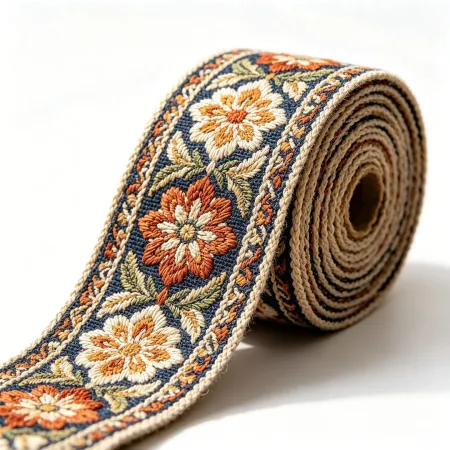
Cotton builds sit in the cotton webbing range, including plain woven natural cotton webbing and twill cotton in a heavier build. Infant articles made from the same fibre include organic cotton drool bibs, and OEM and ODM development covers blends built to a brand's own construction.
FAQ: Cotton Baby-Friendly Soft Webbing
Is cotton strong enough for a carrier strap?
Strength is rarely the problem; elongation is. A pure cotton strap can be woven to a high break figure and still creep under a sleeping child's weight, because the fibre extends more than polyester under sustained load. That is why load-bearing positions usually use a polyester ground with a cotton face.
How much does cotton webbing shrink?
Enough to matter, and the figure depends on the weave, the finishing route and the wash temperature. Ask for it measured on the finished article after the wash cycle your care label specifies, and expect a range rather than a single number. Untested shrinkage claims are the most common source of a strap that no longer fits.
What does organic mean on a cotton strap?
That the fibre came from certified organic agriculture and can be traced through the supply chain to your goods. It says nothing about dyes or finishing, which are covered by a separate chemistry standard such as OEKO-TEX Class I. A complete claim usually needs both documents.
Why does a cotton strap smell after shipping?
Moisture plus time in a sealed carton. Cotton takes up water from humid air, and a container crossing a climate band gives it weeks to develop a musty note. Conditioning goods before packing, adding desiccant and using a lined carton all reduce it, and none of them is expensive.
Can cotton be printed with a logo?
Yes, but not by the same route as polyester. Dye sublimation needs a synthetic surface, so a cotton face takes a different print method or a jacquard woven logo instead. Decide which you want before sampling, because the two options have different artwork requirements and different durability.
Cotton earns its place on the straps that touch a child and gives ground on the straps that carry the load. A specification that acknowledges both — measured shrinkage, a named dye class, and a blend where the load path needs one — is what makes cotton baby-friendly soft webbing a deliberate choice rather than a sentimental one.
Why Xinxiangrui for Baby-Friendly Soft Webbing
Woven in Dongguan since 2011, Xinxiangrui narrow goods now reach 50+ markets and 200+ active partners, with cotton, polyester, nylon, GRS recycled PET and bio-based yarns running on the same floor. Shrinkage, colourfastness and abrasion are reported on the finished article rather than the greige. Send us the drawing, the width and the target market, and a construction comes back to you.