
Features
Why Choose Xinxiangrui Webbing?
Source Factory
Direct wholesale production from our own plant in Dongguan, not a trading desk. Weaving, dyeing, printing, hardware assembly and packing all run in house, with no middleman margin in the price.
Full Customization
OEM and ODM work starts from your drawing: width, weave, colour, hardware and retail packaging. We match Pantone, send a physical sample before bulk, and keep every change on one work order.
Strict QA & ISO Standards
Every batch is checked for width, thickness, break strength and colour fastness before it ships, and the plant runs to ISO 9001 and ISO 14001. Test reports for your batch travel with the goods.
Proven Track Record
Fifteen years of narrow fabric since 2011, 200+ active partners and shipments to 50+ markets. Long-run programmes are what this factory is built for, which is why most customers reorder.

We Have The Best Solutions for Your Business
Xinxiangrui has made narrow fabric in Dongguan, China since 2011. Our 8,000 m² plant weaves, dyes, prints, cuts and sews under one roof, supplying 200+ active partners in 50+ markets. We produce polyester, nylon, cotton, elastic, reflective and bio-based webbing, ribbon, lanyards, pet leashes, bags and luggage components, from yarn and reflective tape to finished straps and handles.
Because every step stays in one plant, a widening range does not cost tolerance. Our laboratory tests to 2000N+ break strength, 50,000+ Martindale cycles and 1,000+ hours of UV exposure, and every batch carries its own figures rather than a catalogue sample. We work to OEKO-TEX, CPSIA, REACH, RoHS, ISO 9001, ISO 14001 and GRS. Send us your spec sheet and target quantity, and we will recommend the construction that fits.
Baby-Friendly Soft Webbing: What the Words Actually Promise
Four properties sit behind the phrase, and each one can be measured on a bench rather than argued about in a meeting. The table below is the version of the phrase that belongs in a specification.
| Property | What it means in use | How it is read | Where it fails first |
|---|---|---|---|
| Hand | How the band bends over a wrist without standing away | Bending length on a fixed overhang | A finish that stiffens after washing |
| Edge | Whether the selvedge scratches or prints on skin | Profile under a low-angle light, plus a thumb drag | A cut edge used where a woven edge was approved |
| Stability | Whether the width and length survive repeated washing | Dimensional change after a stated wash cycle | The first hot wash with a tumble dry |
| Fastness | Whether colour moves onto a collar or a cheek | Rubbing against a wet white cloth, then reading the stain | Deep shades, where the dye load is highest |
A test anyone can run in ten seconds: fold the band into a loop and let it hang from one finger. A soft band collapses into an oval and drapes over the finger; a stiff one holds a circle and stands off the hand. Do it before and after a wash. If the loop stands up on the second try, the finish — not the yarn — is what the buyer will feel.
Three Constructions That Deliver Softness
Knitted, where stretch and softness arrive together
A knitted band is built from interlocking loops rather than crossed threads, so it bends in every direction and has no stiff juncture where a weft turns back. That makes it the softest of the three at the same weight, and the one that needs the least finishing to feel right. The trade is dimensional: a knit stretches under load and recovers slowly, so a band specified for a fixed circumference should be measured after a wash rather than on the roll.
Brushed woven, where the face is raised on purpose
A woven band can be softened after weaving by brushing the face with a roller set with fine wire, which lifts fibres into a nap that feels like flannel and hides the weave structure underneath. Brushing is a surface treatment, so it survives as long as the fibre does: a band brushed from a long-staple cotton keeps its nap through many washes, while one brushed from a short-staple fibre pills and goes bald at the fold. The selvedge is usually left unbrushed, which is why the edge of a brushed band still needs its own approval.
Tubular, where there is no edge at all
A tubular band is woven as a flattened tube, so both sides are face and the only edges are folds. That removes the selvedge problem entirely, which is why tubular constructions appear on products that sit against a neck or a wrist for hours. The compromise is that a tube flattens under tension and its width changes with the load, so a tubular band should be specified by its flat width and its width under a stated pull, not by one number alone.
Six Lines a Baby Webbing Brief Should Carry
- The construction — knitted, brushed woven or tubular, because each one answers a different question about stretch and edge.
- The width with its tolerance — a nominal figure plus the range it may occupy, since a band that measures a millimetre wide will not thread the slot it was designed for.
- The fibre and its blend — including the share of anything recycled, because that share decides which documentation the order needs.
- The wash routine it must survive — temperature, detergent type and whether a tumble dryer is involved, since the dryer is what turns a stable band into a short one.
- The fastness targets by colour — a pale shade and a deep shade rarely share a result, so the target belongs beside the colour reference rather than in a general clause.
- The document set — which certificate, which report, and which of them has to name the lot rather than the site.
A brief that carries these six lines answers most of the questions a factory would otherwise ask in three separate emails. It also makes the sample round shorter, because a sample can only be judged against a target, and a target that was never written down becomes a matter of taste at the approval meeting.
Four Checks Before a Bulk Order
- Wash three pieces, not one. Keep one unwashed as a reference, wash one at the stated temperature and wash one at the temperature a household will actually use. The gap between the second and third is the number that predicts complaints.
- Rub the edge on wet white cloth. The selvedge carries more dye than the face and releases it first, which is why a band that passes a face test can still mark a collar.
- Measure the width at three points along a metre. Variation along the length is more common than variation between rolls, and it is invisible on a short sample.
- Sew one finished part. A band that feels soft on a roll can stiffen at a seam, where two layers and a row of stitches meet. The product is the seam, not the roll.
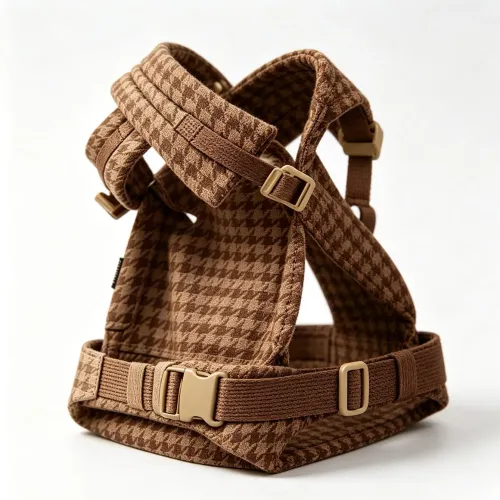
The range around this article is wider than a single band. A pram organiser, a bib tape and a high-chair harness are three different products made from the same baby products family, and each one loads its tape differently. The cotton webbing beside it is the natural reference for hand, while the 25 mm band that carries a packed organiser is a structural article and clears 2000N — a bib tape does not need that figure and should not be judged by it.
Two Mistakes That Reach a Parent
Softness read as weakness
A buyer who has been told that a band must be soft will sometimes reject the sample that holds its shape, on the assumption that a firmer hand means a harsher product. The two properties are independent: softness comes from the yarn, the construction and the finish, while strength comes from the density of the weave and the fibre. A band can be both supple and strong, and the versions that fail are usually the ones where softness was bought by thinning the weave rather than by choosing a kinder construction.
The edge nobody measured
Almost every complaint about a baby band traces to an edge rather than a face. A cut edge has a raw profile of several hundred microns, and under a thumb it feels like a fine file. A woven edge is rounded by the weft turning back, which is why it costs more and is worth it. When a programme is moved from a woven edge to a cut edge to save a step, the face still passes every test the buyer wrote, and the product still marks a wrist.
Softness in this category is not a finish applied at the end of a line. It is a decision made when the construction is chosen and the edge is formed, and it survives only if the brief names the wash routine it has to survive. Name the construction, the edge, the wash cycle and the document set, and the sample that comes back can be judged on evidence rather than on how it felt in a hand.
Why Xinxiangrui for Baby-Friendly Soft Webbing
Hand is set where the yarn is chosen, not where the roll is inspected, and this site has been setting that choice since 2011 with weaving, dyeing, finishing and sewing under one roof in Dongguan. A baby-friendly soft webbing order leaves here with the construction, the edge type and the wash result written on the same sheet, so the band a parent touches is the band that was approved. Tell us the width, the wash routine and the edge you want, and a matched sample comes back to you.
Featured Products
Collection about Xinxiangrui Webbing
User Reviews
What users say about Xinxiangrui Webbing
Frequently Asked Question
Do you have any question?
Three things measured together: a soft hand that bends over a wrist without standing away, a woven edge that does not scratch, and dimensional stability after repeated washing. A band that is only soft is half a product, because a stiff edge or a shrinking tape will still mark a baby even when the face feels pleasant.
Bending length is the usual method: a strip is pushed out over a fixed edge and the overhang at which it droops is recorded. The shorter the overhang, the softer the band. A ten-second version anyone can run is to fold the band into a loop and let it hang from one finger; a soft band collapses into an oval, a stiff one holds a circle.
A knitted band is softest at the same weight because interlocking loops bend in every direction and have no stiff point where the weft turns back. A brushed woven band is second and gains a flannel-like nap. A tubular band removes the edge problem entirely, which is why it appears on products worn against a neck or wrist for hours.
It can, and the dryer is what decides. A cotton or cotton-blend band may lose one to three per cent in length in a warm wash and more with tumble drying. Specify the wash routine it must survive, then cut oversize or buy pre-shrunk. Both work; discovering the change after cutting does not.