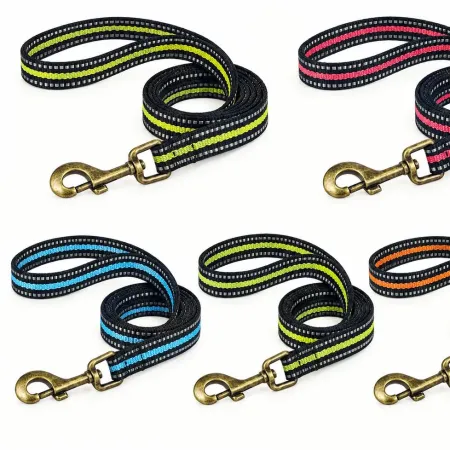
Nylon Webbing for Dog Collars: The File Behind the Buckle
Nylon webbing for dog collars looks like a simple material decision and is really a documentation one. The band touches an animal for hours a day, the metal fitting touches the same animal at the same place, and if a complaint ever arrives the batch has to be traceable back to a yarn lot. Pet products carry fewer harmonised rules than children's products, which sounds like less work and is actually more, because the standard then becomes whatever the buyer wrote down.
This guide covers the four things a collar file has to prove, the tests that prove them, why the absence of one global pet standard changes the job, six lines a collar brief should carry, and the two safety questions that decide a design before any colour is chosen.
Nylon Webbing for Dog Collars: Four Things a File Has to Cover
Each of the four belongs to a different supplier in most programmes, which is why a file assembled at the last minute usually has a gap in the middle of it.
- The dye — a declaration covering the colourants used, because a collar is in prolonged contact with an animal that grooms itself.
- The metal — nickel release limits apply in some markets to items in prolonged skin contact, and a buckle is exactly that item.
- The small parts — rivets, keepers and clips that could detach, which is a safety question as much as a quality one.
- The traceability — a batch code that connects a finished collar to a yarn lot and a dye lot, which is what makes a recall possible rather than total.
| Risk | What to ask for | What it proves |
|---|---|---|
| Colourant contact | A dye declaration naming the class used | The band was not dyed with a restricted family |
| Metal against skin | A nickel release result on the finished fitting | The buckle is suitable for prolonged contact |
| Detachable parts | A pull test on rivets and keepers | Nothing comes away under a realistic pull |
| A bad batch | A batch code on the collar, not only the carton | A problem can be isolated to a lot rather than a season |
No single global standard means the buyer's own standard applies
Pet accessories are regulated unevenly across markets, and the gap is filled by whatever the brand decided to require. That is a real opportunity for a buyer and a real risk: a supplier can be entirely honest and still miss a requirement that was never written down. The practical answer is to convert the brand's own promise into a short list of tests, put it in the purchase order, and keep the results with the batch.
Three Questions That Decide the Design
What happens when the band is chewed
A collar is chewed by the dog wearing it and by any other dog that reaches it, and the behaviour of a chewed band matters more than its strength. A dense weave with fine yarns frays into soft fibre; a coarse one comes apart in strands that can be swallowed. That is a reason to specify a tighter construction than the load requires, and to test a cut and chewed end rather than only a clean one.
What the metal does in wet weather
A collar is worn through rain, swims and baths, so a plated fitting will eventually show its base metal. That is not only cosmetic: a worn plating exposes a surface that was never assessed for release, which is exactly the condition the limit exists to prevent. A solid or properly passivated fitting, or a plastic side-release buckle, avoids the question entirely, and for a small dog the plastic option also solves the safety one below.
Whether it releases under load
A collar that cannot come off is a hazard if it catches on a branch or a fence, and a buckle that releases under a moderate pull is a deliberate design choice rather than a defect. This is a conversation the buyer has to have with the band supplier even though the band does nothing here, because the choice of buckle determines the band width, the keeper and the stitching. Getting the order of decisions right saves a redesign.
Six Lines for a Collar Brief
- The size range and the adjustment — neck measurements, not breed names, and how much take-up the design allows.
- The fastening and whether it releases — buckle, clip or breakaway, decided before the band width is fixed.
- The dye declaration requirement — stated as a document you expect, not as a question you hope the answer to.
- The metal and its finish — solid, plated or plastic, with the release question answered for the finish chosen.
- The pull test on fittings — what load, applied where, on the finished collar rather than on the components.
- The batch marking — where the code goes on the collar, so a query can be narrowed to a lot.
The sixth line is the one that turns a complaint into an investigation instead of a recall. If every collar in a season carries the same code, an isolated problem cannot be isolated, and the safe response is to take back everything. If the code identifies the yarn lot and the dye lot, the same problem can be traced in days and limited to the affected pieces, which is cheaper for everyone and much better for the brand.
The band itself is the easiest part of the file to document, and it should be documented on the same sheet as the metal. A 1 inch nylon webbing base clears 2000N, far beyond what a collar is asked to hold, so the test report is more useful for its dye and fastness results than for its break figure. Where the collar will be swum in, a polyester webbing version holds colour and strength in water better, and custom development can put the batch code into the weave or the print rather than on a separate label.
Two Documents Worth Asking For
A declaration, not a certificate of general conformity
A general statement that a product complies tells a buyer nothing they can check. A declaration naming the dye class, the fibre and the batch is a document that can be compared with the goods, and it is the only kind that survives a query from a retailer's compliance team. Ask for the specific form and expect the specific answer; a supplier who can produce it has the information, and one who cannot is improvising.
A result on the finished assembly
A pull test on a rivet and a pull test on a finished collar are different tests, and the second is the one that describes what a customer receives. The same applies to nickel release: a result on a loose buckle is not a result on a buckle that has been plated, assembled and worn. Testing the assembly costs one extra step and removes the gap between what was approved and what was sold.
FAQ: Nylon Webbing for Dog Collars
What width is usual for a dog collar?
20 mm for small dogs, 25 mm for medium and large, 38 mm for a wide statement collar. The width follows the buckle, so choose the fastening first.
Do pet products need certificates?
Requirements vary by market and are less harmonised than for children's goods. In practice the brand's own standard applies, so write it down and ask for results against it.
Is a metal or plastic buckle safer?
A plastic side-release is lighter and can be designed to release under load, which suits small dogs. Metal is stronger and more durable, and needs a finish that tolerates wet weather.
Why does the colour rub off on a pale dog?
Unfixed surface dye, made worse by a dark shade and a wet collar. Ask for a wet rub result and for the dye to be washed off after dyeing.
Can the collar be machine washed?
Hand washing is safer for the plating and for the weave. A machine wash is possible in a bag on a cool cycle, and it will shorten the life of a plated fitting.
Nylon webbing for dog collars is a small band with a real file behind it. Name the dye requirement and the metal finish, decide whether the collar releases, and put a batch code on the piece. The documents then describe the product rather than the hope.
Why Xinxiangrui for Nylon Webbing for Dog Collars
A collar is a small item with an unusually wide set of documents behind it, because the band touches an animal, the metal touches the same animal, and the batch has to be traceable if a complaint arrives. Dyeing sits inside the same site as weaving, so the certificate numbers match the yarn and the dye house actually used, and a nylon webbing for dog collars lot can be followed from yarn to finished piece. Share the market and the fitting with us, and the file is assembled against both.