OEM Pet Reflective Webbing: From Drawing to Approval
An OEM order is not a purchase of a product; it is a purchase of the same product, repeatedly, under someone else's name. OEM pet reflective webbing is therefore judged less on the first delivery than on the fourth, when a brand's promise is being kept by goods that nobody at the brand has touched. The work that makes that possible is paperwork: a construction sheet, an approved sample and a rule about what happens when something has to change.
This guide covers the three documents an OEM band actually runs on, why an approved sample matters more than an approved photograph, how change notification works when a yarn or a coating has to be substituted, six lines an OEM brief should carry, and the two things that only show up once a brand's logo is on the packaging.
OEM Pet Reflective Webbing: Three Documents, Not One Sample
A development project produces a sample. An OEM relationship produces a file, and the sample is one page in it. The distinction matters because a sample answers "can you make this", while the file answers "will the fifth order be the same", which is the question a brand is really paying for.
| Document | What it fixes | Who holds it |
|---|---|---|
| Construction sheet | Yarn, weave, width, thickness, coating weight, colour reference and the test figures | Both sides, with a revision number |
| Approved sample | The physical answer to every question the sheet leaves open | Factory keeps one sealed, brand keeps one sealed |
| Change notice | What may be substituted, when, and who signs off before it ships | Agreed at the first order, invoked rarely |
The third document is the one that gets skipped and later regretted. Every long relationship eventually faces a yarn that is discontinued, a dye house that closes or a film that changes its carrier, and the choice at that moment is between a phone call made before the goods ship and a complaint made after they arrive. A change-notice clause converts the first into a procedure, and it costs nothing to write while everything is going well.
A sealed sample beats a photograph
Photographs of a reflective band are unreliable in a specific way: a camera held still for a second gathers more light than an eye, so the band looks brighter in the file than in the hand, and colour balance shifts a silver face towards blue or cream. Two sealed samples, one at each end of the relationship, settle disputes that a photo album only prolongs.
Three Things an OEM File Has to Nail Down
What "same" means, in numbers
A construction sheet that says 25 mm and silver is a description, not a specification. The version that survives a reorder names the tolerance on the width, the yarn count, the weave, the coating weight, the shade against a physical reference and the coefficient with its angles. It also names what may vary, because a sheet with no tolerance band on the shade is a sheet that will produce an argument at some point in the second year.
Who owns the artwork
A brand's mark on a header card, a woven label or a print on the band is a piece of intellectual property passing through a factory, and the file should say who supplied it, at what resolution, and who is allowed to change it. The practical risk is smaller than the legal one: a logo file re-drawn by a printer because the original was a screenshot produces a card that a brand will reject, and the cost of that rejection lands on the delivery date rather than on the supplier who redrew it.
Which end of the range is fixed
Most OEM ranges grow: a collar becomes a collar plus a lead, then a harness, then a matching set in a second colour. The file should say which of those was engineered and which is only a variation, because a second colourway on the same construction is a dye-lot exercise while a second width is a new weave. Knowing which is which at the enquiry stage is what keeps a range extension from becoming a new development project.
Six Lines for an OEM Brief
- The brand and the channel — whether the goods go to a chain, a distributor or a web store, since each expects a different packing stage.
- The construction, with tolerances — width, thickness, weave, coating and shade, each with the range that will be accepted.
- The test figures that matter — the coefficient with its geometry and the tensile value, stated so a later lot can be compared with the first.
- The label and the artwork — files supplied in a usable format, with the approval step named.
- The retention period — how long a sealed sample of each lot is kept, which sets how far back a complaint can be investigated.
- The change rule — what may be substituted without notice, what needs written approval, and how much notice is enough.
The fifth line is cheap and quietly valuable. A complaint that arrives eleven months after delivery is only investigable if a sealed sample of that lot still exists, and the difference between a file that resolves it and one that cannot is a shelf in a storeroom. Retention is also a discipline: a lot with a retained sample tends to be a lot that was checked, because somebody knew it would be looked at again.
- A reference that can be touched — the sealed sample, not a rendered image, because a reflective face cannot be reviewed on a screen.
- A revision number — so that a sheet printed last year can be identified as superseded rather than argued over.
- A named signatory — one person on each side whose approval is the approval, so a change cannot be half-agreed.
- A date — every approval carries one, which is what makes a later comparison possible at all.
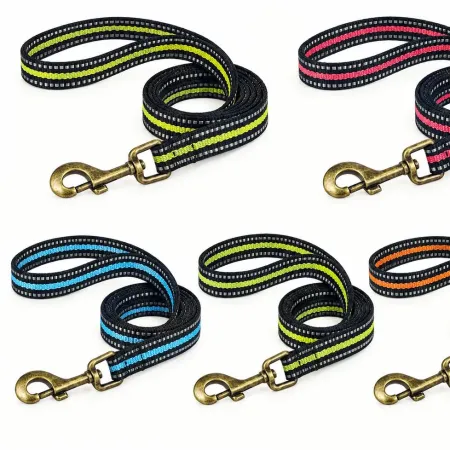
The band itself is the easy part. A 25 mm base clears 2000N, and the reflective layer is applied to it on a line that runs in the same plant, so the technical content of an OEM file is settled early and the rest is bookkeeping. The constructions are listed on the pet reflective webbing page, the base options on polyester webbing, and the OEM process sets out what a drawing has to contain before a sample is opened.
Two Things That Appear Once a Logo Is On the Box
The packing line is a second production line
Band in a roll is one product; band cut, carded, bagged and boxed with a brand on it is another, and the second one has a labour content that does not shrink with repetition. A brand that adds a hang tag in the second season without telling anyone has added a step to a line that was planned without it, and the delay appears as a missed date rather than as a cost. Naming the packing stage at the first order, and re-opening the file when it changes, is what keeps the two lines in step.
The logo hides the defect
A printed mark, a woven label or a card stapled through the band covers a few square centimetres of the reflective face, and those square centimetres are often where the coating is thinnest. Nothing fails because of it, and the product reads as slightly duller than the sample in exactly the area a customer holds up to the light. Placing the mark over the plain part of the band rather than over the optical stripe is a design decision that costs nothing and prevents a whole class of complaint, and it belongs in the artwork file rather than in a conversation after the first delivery.
FAQ: OEM Pet Reflective Webbing
What is the difference between OEM and custom?
Custom develops a product; OEM repeats it under a brand's name. The first needs a sampling process, the second needs a file that keeps every repeat identical.
Do I need to supply artwork?
Yes, in a format that can be printed without redrawing. A screenshot or a web image will be rebuilt by whoever prepares the file, and the result is usually not what the brand intended.
How long is a sample retained?
The period is agreed at the first order, and a year is a common figure. It should be long enough to cover the season in which a complaint is likely to arrive.
What happens if a yarn is discontinued?
It is a change notice rather than a surprise, provided the rule exists. The substitution is proposed with its effect on shade and figures, and it ships after approval.
Can the range be extended later?
Usually yes. A new colour on the same construction is a dye exercise; a new width or a new product is a new development, and the file should already say which is which.
OEM pet reflective webbing is a file rather than a sample. Write the construction with its tolerances, seal a sample at each end, and agree what a change has to pass through, and the fourth order arrives looking like the first.
Why Xinxiangrui for OEM Pet Reflective Webbing
An OEM band has to be repeatable, and repeatability comes from four processes living in one place: yarn, loom, dye line and lab inside an 8,000+ m² plant in Dongguan, with the hardware bench that finishes the piece. A construction sheet written here describes equipment the same company runs, so a reorder is a re-run rather than a redevelopment, and a change notice can be measured before it is signed. Tell us your OEM spec and a matched construction comes back to you.