Pet Reflective Webbing for Dogs: One Phrase, Six Products
The word dogs in a search box covers six products, and the reflective layout differs in each. Pet reflective webbing for dogs is a family term: it can mean a collar, a harness, a lead, a coat trim, a backpack strap or a set of boot straps, and a buyer who uses it usually has one of those in mind and no way of saying which. A supplier takes that phrase and turns it into a specification by asking four questions, and the answers move the reflective material to a different place on the animal every time.
This guide covers the six products the phrase covers, the four dimensions that decide which one is being asked for, why the same band serves all six without being the same product, six lines a family brief should carry, and the two things that only appear when a range is sold in more than one country.
Pet Reflective Webbing for Dogs: The Six Products
Every product in the family is the same woven band in a different place, and the place decides which failure a buyer will complain about.
| Product | Where the reflection goes | What fails first |
|---|---|---|
| Collar | All round the neck, if the pattern allows it | Rotation, and hardware covering the optics |
| Harness | Chest panel and both sides | The chest-to-girth joint under load |
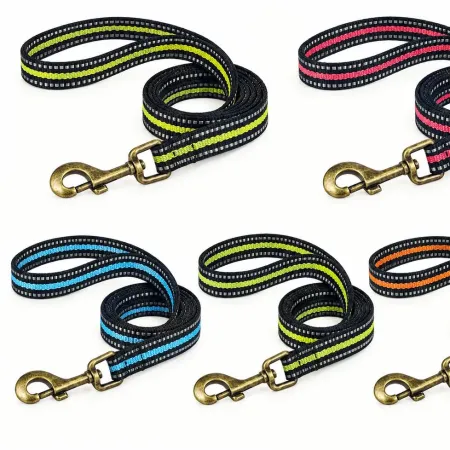
| Lead | A long run, sometimes one edge only | Coating wear where it drags, and the handle fold |
| Coat trim | Hem, cuffs and a back panel | Repeated washing, and the band stiffening at a hem |
| Backpack strap | Shoulder straps and a rear loop for a light | Abrasion against a saddle bag or a car seat |
| Boot straps | A narrow band across each boot | Ground contact, mud and constant flexing |
The last two rows are the ones a first enquiry usually omits. A coat trim and a boot strap are accessories for a walk rather than restraint devices, so they carry no load, and they are also the two that live closest to the ground and to washing. Specifying them with the same band as a collar is fine; specifying them with the same expectations is not.
One band, six products, one strength figure
A 25 mm base band clears 2000N in every one of these applications, and only two of them will ever approach it. The strength is a platform rather than a specification: it means the same roll can be cut for a collar or a boot strap without a decision about whether the material is adequate, which is what makes a family range practical.
Four Dimensions That Decide Which One
The size of the dog
A 25 mm band on a 4 kg dog is a wide strap on a narrow neck, and it will not lie flat; it stands away and rotates. The same band on a 40 kg dog is proportionate and sits still. Width therefore follows weight before it follows fashion, and a range that starts at 25 mm is a range for medium and large dogs with a small-dog version bolted on later, which is the wrong order for most markets.
The way the dog is walked
A city dog on a short lead at a kerb needs side visibility, because the risk comes from the road beside it. A country dog on a long line needs rear and front visibility, because the risk comes along the path. Both are "reflective dog products" and the patterns that serve them are different: a collar with a stripe repeated all round for one, a harness with a bright chest panel for the other.
The climate it lives in
A product used through a wet winter meets mud, salt and repeated washing, and a product used in a dry climate meets dust and ultraviolet. Both degrade a reflective band, and they attack different layers: water and detergent work at the edges and the seams, while sun and dust work at the face. A single construction sold into both climates will be over-specified for one and under-specified for the other, which is a decision worth making explicitly.
The shelf it is sold from
A product sold from a hook needs a header card and a hanging loop; one sold in a box needs neither and benefits from a coiled pack; one sold online needs to survive a postal bag. Three channels, three packagings, and the same band underneath. Buyers who sell through more than one channel often discover this at the packing stage, when the goods are already cut.
Six Lines for a Family Brief
- Which products — named item by item, because a family order quoted as one line hides which pieces were engineered and which were assumed.
- The size range in kilograms — the weights each product must suit, which decides the widths more reliably than a breed list.
- The walking pattern — kerb, path or both, since that decides whether side or forward visibility is the priority.
- The climate and the wash count — how wet, how sunny, and how often the piece goes into a machine.
- The channel — hook, box or postal bag, and whether a card is punched through the product.
- The shared elements — which shade, weave and pattern run across the whole family, so the range looks like a range rather than six orders.
The sixth line is what buyers notice last and customers notice first. A family that shares a shade and a repeat reads as a considered set on a shelf; one where the collar is a slightly different silver from the lead reads as leftovers. Since all six products come off the same beam, sharing is the default and divergence is the thing that has to be arranged, which is worth stating plainly in the brief.
- Two widths, not four — 20 mm and 25 mm cover most of the family, and every extra width fragments the dye lots.
- One repeat across the set — scaled per product, so a collar and a lead bought together look like a pair.
- One coating grade — unless a product genuinely needs more, since two grades across a family creates two spare parts.
- One test file — because a family sold on one construction should be documented once, not six times.
The family is built from one pet reflective webbing construction, on a base from the polyester webbing line, cut to a collar, a harness, a lead or a trim. The assembled pieces are described on the pet harness and pet leashes pages, and a family order can be quoted as one construction with six cut lists.
Two Things That Only Appear Across Countries
The priority flips
In one market the reflective product is bought for winter darkness and the buyer asks about return values; in another it is bought as a fashion accessory with a safety feature and the buyer asks about the shade and the packaging. Both are selling "reflective webbing for dogs", and the same family can serve both if the emphasis is adjustable: the same construction with a different colour card, a different card and a different first paragraph on the listing. What does not work is assuming the second market will accept the first market's plain functional presentation.
The size curve differs
Dog populations are not the same shape everywhere, and a range built on a European size curve can be the wrong curve for a market where small breeds dominate. That has a direct effect on width: if most of the volume is small dogs, the 20 mm band is the main product and 25 mm is the tail of the range, which inverts the usual ordering. Discovering this after a first shipment is expensive, and asking for the intended size distribution in the first email is free.
FAQ: Pet Reflective Webbing for Dogs
What is the difference between this and collar webbing?
The band can be identical. What differs is the cut length, the pattern repeat and the hardware, so a family range is one construction with several cut lists.
Which width suits which dog?
Weight is the better guide than breed: 20 mm for small dogs and 25 mm from medium upwards. A wide band on a small neck stands away and rotates.
Can one range serve several countries?
Usually yes, with a different colour card and packaging. What changes is the presentation and the size curve, not necessarily the construction.
Do coat trim and boot straps need the same grade?
They carry no load, so strength is not the issue. They do meet mud and washing more often, so the coating and the stitch density matter more than the tensile figure.
Can a family be extended later?
Yes, and it is easier if the shared shade and repeat were fixed at the start. A new product on an existing construction is a cut list, not a development project.
Pet reflective webbing for dogs is a family term that becomes a specification through four questions: how heavy, how walked, how wet, and sold how. Answer those and the six products become one construction with six cut lists.
Why Xinxiangrui for Pet Reflective Webbing
Selling pet reflective webbing for dogs into 50+ markets and supplying 200+ active partners means most of the family has already been made here in most of its versions, and the export side is routine: customs paperwork, retail-ready packing and air, sea or express routing are handled in-house from Dongguan. A family order is quoted as one construction with several cut lists, which keeps a collar and a lead the same silver. Send us the drawing, the width and the target market, and we reply with a construction.