Pet Safe Leashes: Three Documents, Not an Adjective
Pet safe leashes are sold on a word that has no single definition, and the word is doing three separate jobs at once. It can mean the material does not contain restricted substances, that the metal fittings release nothing harmful against the skin, or that the assembly holds when pulled. Each of those is a different test, a different document and a different failure, and a product can satisfy one while failing the others.
This guide covers the three claims that hide inside the word, why the band is the easiest part to evidence and the metal the hardest, why a pull test describes a joint rather than a dog, six lines a safety brief should carry, and the two reasons the phrase means different things in different markets.
Pet Safe Leashes: Three Claims Under One Phrase
A safety statement is credible when it names which of the three it means, and most do not.
- Material safety — restricted substances in the band, the thread and the print, evidenced by declarations and test reports rather than by a claim.
- Metal release — what the fittings give off against skin, which is a separate limit regime from the band and applies to the plating.
- Structural strength — whether the loop, the tack and the fitting hold, which is a pull test on an assembly rather than on a material.
- Small parts — whether anything can detach and be swallowed, which matters most on a small-dog or puppy product.
| Claim | Evidence | Not covered |
|---|---|---|
| Material | Substance declarations, dye and print reports | Anything about the fittings |
| Metal | Release test on the plated item as supplied | The band, the thread or the print |
| Structure | A pull on the finished assembly | How it behaves after a year of use |
| Small parts | A cylinder test on any detachable piece | Whether a fitting detaches in service |
Strength is the simplest claim to evidence
A 25 mm band clearing 2000N is a figure that can be reproduced in front of a buyer, which makes it the cleanest statement in the whole safety conversation. The complication is that the number describes the band while the customer's experience describes the assembly, so the pull has to be taken on the finished lead with the loop closed.
Three Places Safety Claims Get Thin
The band is the easy part
A woven polyamide band with a conventional dye is the best-documented part of a lead, and a supplier can usually produce declarations for it without difficulty. That is why a page of material certificates can be reassuring and uninformative at the same time: it describes the part of the product where the risk is lowest and says nothing about the plating, the thread or the joint, which are where a real problem would appear.
The metal is where limits bite
A hook, a ring and a swivel are plated, and plating is where nickel, lead and cadmium limits apply. The relevant test is a release test on the item as supplied, not on the substrate underneath it, and a certificate for the base metal does not answer the question. Because fittings are often bought rather than made, this is the document most likely to be missing and the one a buyer should ask for by item rather than by product.
A pull test describes a joint, not a dog
A pull figure on a finished lead says how much a new sample held on the day it was tested. It does not describe fatigue, wet strength, UV exposure or what a hundred cycles of a spring-loaded gate will do. Those are separate enquiries, and a safety brief that names only one figure is describing a moment rather than a service life.
The thread and the print are the two materials most often left out of a declaration. A polyester thread on a polyamide band is a second fibre with its own dyes, and a printed motif carries a binder and pigments that are not part of the band at all. Declaring the band and forgetting those two leaves a gap in exactly the place a screening laboratory would look first.
Six Lines for a Safety Brief
- The market, named — because the applicable limits differ, and a declaration written for one destination is not automatically valid in another.
- The substances in scope — the specific list being declared against, rather than a general statement that the product is compliant.
- The fittings, item by item — each plated part with its own release test, since a certificate for one does not cover another.
- The pull, on the assembly — with the loop closed and the fitting attached, and with the direction of pull stated.
- The small-parts decision — whether the product is intended for a puppy or a small dog, and what that implies for anything that could detach.
- The labelling statement — the exact wording permitted on the card and the hang tag, agreed before the packaging is printed.
The sixth line is where a compliance programme either holds or unravels. A marketing sentence written before the documents are read is how a brand ends up claiming a standard it cannot evidence, and the correction is expensive because the packaging is already printed. Drafting the claim from the documents, rather than fitting documents to a claim, is the whole discipline in one sentence.
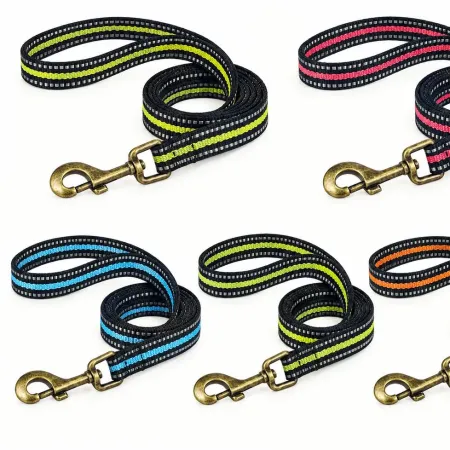
The band in these products is a nylon webbing or polyester webbing construction at 15 mm to 25 mm, and the declarations that come with it cover the yarn and the dye. The laboratory provides tensile, abrasion and fastness data and can state the batch behind each figure. Fitting specifications and the finishing options sit with the lead range, and the declarations and certificate numbers travel with the order paperwork so they can be matched to the goods.
For a puppy product the relevant exposure is not the skin but the mouth. A lead that a young dog chews is being tested against saliva and mechanical action at once, and the useful question is whether the dyed band, the thread and the print are declared for that kind of contact rather than for adult handling. It is a different question from the one a collar raises, and it changes which documents are worth requesting.
Two Reasons the Phrase Varies
There is no single pet-product standard
Unlike a toy or a food contact article, a pet lead is not governed by one global regime, so the phrase is assembled from general chemical limits, metal release rules and whatever the retailer adds. A large chain will often have its own restricted substance list that is stricter than the law, and that list is the real specification for anyone selling to them. Asking a buyer for their list, rather than offering compliance in general, is what makes a safety claim usable.
Who signs the statement
The factory can provide declarations for what it makes and controls. The brand is the one that places the product on the market, and the responsibility for the claim sits with them. That division is worth being explicit about, because it explains why a supplier will describe a material accurately and decline to certify a whole product: the second statement belongs to the party whose name is on the label.
FAQ: Pet Safe Leashes
What does pet safe actually mean?
It means whatever the three claims behind it are. Ask which one is intended: material substances, metal release or structural strength.
Do I need a test for the hook?
Yes, on the plated item as supplied. A declaration for the base metal does not cover the plating, and the plating is what touches skin and mouth.
Is a band certificate enough?
For the band, mostly. It leaves the fittings, the thread and the print undeclared, and those are the parts a buyer has not seen evidence for.
Should a lead be pull tested with the loop closed?
Yes. A bare band figure is a material result; the customer pulls on a closed loop, so the assembly is what the number should describe.
Who is responsible for the claim?
The brand placing the product on the market. The factory declares what it makes; the label carries the statement.
Pet safe leashes are three documents rather than a phrase: material declarations, a release test on each plated fitting and a pull on the closed assembly. Name the market, name the list and draft the label from the evidence.
Why Xinxiangrui for Pet Safe Leashes
A safety claim is only as good as the documents behind it, and the documents have to match the goods. Declarations for OEKO-TEX, CPSIA, REACH and RoHS are on file with certificate numbers that tie to the yarn and the dye actually used, and because weaving, dyeing and finishing share one certified site the chain behind a lead is short and traceable. Tell us your lead spec and a matched construction comes back to you.