Pet Reflective Webbing Factory: Five Rooms and One Question
A factory visit is a sequence of impressions, and the room that decides a reflective band is usually the fourth. A pet reflective webbing factory can present a busy loom shed, a tidy dye house and a full warehouse and still have nothing to say about the one process that makes the product reflective, because coating is a separate craft with its own equipment and its own failure modes. Fifteen years of narrow woven production since 2011 in Dongguan is a statement about how long a plant has been accumulating that craft, not about the size of its buildings.
This guide covers what each of the five rooms in a reflective plant tells a visitor, why the coating room is the one to insist on, the single question worth asking on the walk, six lines for a visit checklist, and the two things no tour can reveal.
Pet Reflective Webbing Factory: The Five Rooms
A narrow fabric plant that makes reflective band runs five processes that a buyer should see in order, because each one constrains the next.
| Room | What to look at | What it tells you |
|---|---|---|
| Weaving | Reed and heddle changes on the loom, and whether beams are labelled | Whether a width change is routine or a shutdown |
| Dyeing | Retained shade standards at the dye machine, not only in an office | Whether a colour is repeated from a record or from memory |
| Coating and laminating | Doctor blade, oven zones, and the bench where film is bonded | Where the reflective property is actually created |
| Cutting and stitching | How a seam is planned around a coated face | Whether the assembly knows what the coating does |
| Retention store | Labelled samples by lot, with dates | Whether the plant can investigate its own past |
Most visitors form an opinion in the first two rooms and stop paying attention in the third. That is the wrong order, because weaving and dyeing are common to every narrow fabric plant and coating is not. A trader can show a loom shed belonging to somebody else and pass it off as its own; it cannot show a coating line it does not own, and it usually will not try.
One question worth more than the tour
Ask what ran on the coating line immediately before your material, and what will run immediately after. The answer describes a schedule rather than a capability, and a schedule is much harder to invent. It also produces the useful follow-up: how the line is cleaned between a silver and a black run, which is exactly where a stray metallic particle ends up in the wrong product.
Three Details in the Coating Room
The humidity gauge
An optical coating is applied as a thin film of binder carrying beads or a prism layer, and water in the air affects how that film levels and how it cures. A room with an uncontrolled humidity produces a coating that is bright in the morning and duller after a rainstorm, with no change to any setting. A gauge on the wall, and a log beside it, is a small thing that explains a class of variation which otherwise gets blamed on the material.
The cleaning regime
The same line that coats a silver band will one day coat a black one, and residue from the previous run shows as a metallic sheen where the new colour should be uniform. What matters is not that the line is clean on the day of the visit but that cleaning has a procedure and a record. A roller pulled out and wiped in front of a visitor proves very little; a cleaning sheet with initials against each changeover proves a habit.
The dark corner
Somewhere in a plant that makes reflective goods there should be a place where the lights can be turned off and a torch pointed at a sample. It does not need to be a laboratory; a curtained corner with a fixed lamp and a marked distance on the floor does the job. Where no such place exists, the inspection of the product is being done under conditions in which the product cannot be judged, which is a statement about attention rather than about equipment.
Six Lines for a Visit Checklist
- Ask to see the coating line — named in advance, because a route that skips it has answered the question by omission.
- Follow one order through — from beam to roll, asking at each step what the lot number is, since a number that stays the same across five rooms is a real trace.
- Look at the retained samples — unlabelled samples are decoration, and dated ones with a lot number are a system.
- Turn the lights off once — with your own torch, on your own sample, at a distance you choose.
- Read the changeover sheet — the record of what ran before and after your material, which is the question from earlier answered in writing.
- Meet the person who signs the test report — a name attached to a document is worth more than a certificate on a wall.
The second line is the one that separates a tour from an audit. A lot number that appears on the beam ticket, the dye record, the coating log and the carton label is a chain a customer can be shown; a plant where each room keeps its own numbering is one where a complaint can be traced to a department but not to a cause. Following a single order for twenty minutes tells you more than an hour of watching machines run.
- A base band clears 2000N at 25 mm — a figure the plant should be able to show from its own laboratory on the day, not from a catalogue.
- The coating log has a humidity column — and it is filled in, which is different from existing.
- Rolls stand upright — a coated roll stored on its side under weight takes a set that shows in the finished collar.
- The same person answers twice — ask a technical question early and the same question at the end, and see whether the answer holds.
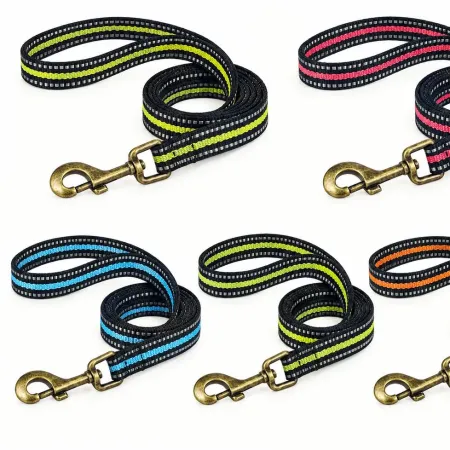
None of this is about size. A large plant can be careless and a small one exact, and the checklist above is designed to be answered by either. What it measures is whether the processes that make a band reflective are owned by the company selling it, and whether the records that describe them survive the week. The pet reflective webbing range is made on a base from the plant's own polyester webbing line, and the laboratory record for a lot is written against the lot rather than against the product name.
Two Things No Tour Can Reveal
How the plant behaves in a bad week
A visit is scheduled, and a scheduled day is a good day. What a buyer actually needs to know is what happens when a beam breaks, an inspector arrives or a container is held, and that behaviour is not on display. The closest proxy is the file: how a previous problem was recorded, whether a corrective action was written, and whether the same fault appears twice in the complaint log. A plant that can show a closed corrective action is telling you more than a plant with a spotless floor.
How old the coating line really is
A machine running is not the same as a machine running well. An old coating line with a worn doctor blade can produce a band that passes a visual check and varies across its width, and the variation shows up only when a collar cut from the edge is compared with one cut from the centre. Asking when the blade was last changed, and what the maintenance interval is, turns a machine into a process. That question is also the one a trader cannot answer, which makes it useful for reasons beyond the answer itself.
FAQ: Pet Reflective Webbing Factory
How do I tell a factory from a trader?
Ask to see the coating line and the maintenance record for its blade. A trader can show a loom shed belonging to someone else; a coating line it does not own is much harder to produce.
What should I bring to a visit?
A torch, a caliper, a sample of the band you sell now, and a printed list of six questions. The torch matters most, because the product cannot be judged in a lit room.
Is a larger plant better?
Not by itself. Size decides how much can be booked; records decide whether a lot can be repeated. The second matters more for a reflective product, where a small process change is visible.
Why does humidity matter in a coating room?
Moisture changes how a thin binder film levels and cures, so the same settings give a different result on a wet day. A log is what makes that visible instead of mysterious.
Can a visit be replaced by documents?
Partly. Test reports and certificates answer most technical questions, and a visit answers the one they cannot: whether the processes in the report belong to the company selling the goods.
A pet reflective webbing factory is judged in its fourth room, by a gauge on the wall, a cleaning sheet with initials and a corner where the lights can be turned off. Ask there, follow one lot number through, and the tour becomes an audit.
Why Xinxiangrui for Pet Reflective Webbing
Established in 2011 in Dongguan, this pet reflective webbing factory has spent fifteen years on narrow woven fabric and now runs weaving, dyeing, coating, printing and hardware assembly inside one 8,000+ m² site. The coating line a visitor asks to see is the one that makes the goods, and the lot number on the carton can be followed back through the dye record and the coating log. Send us the drawing, the width and the target market, and we reply with a construction.