
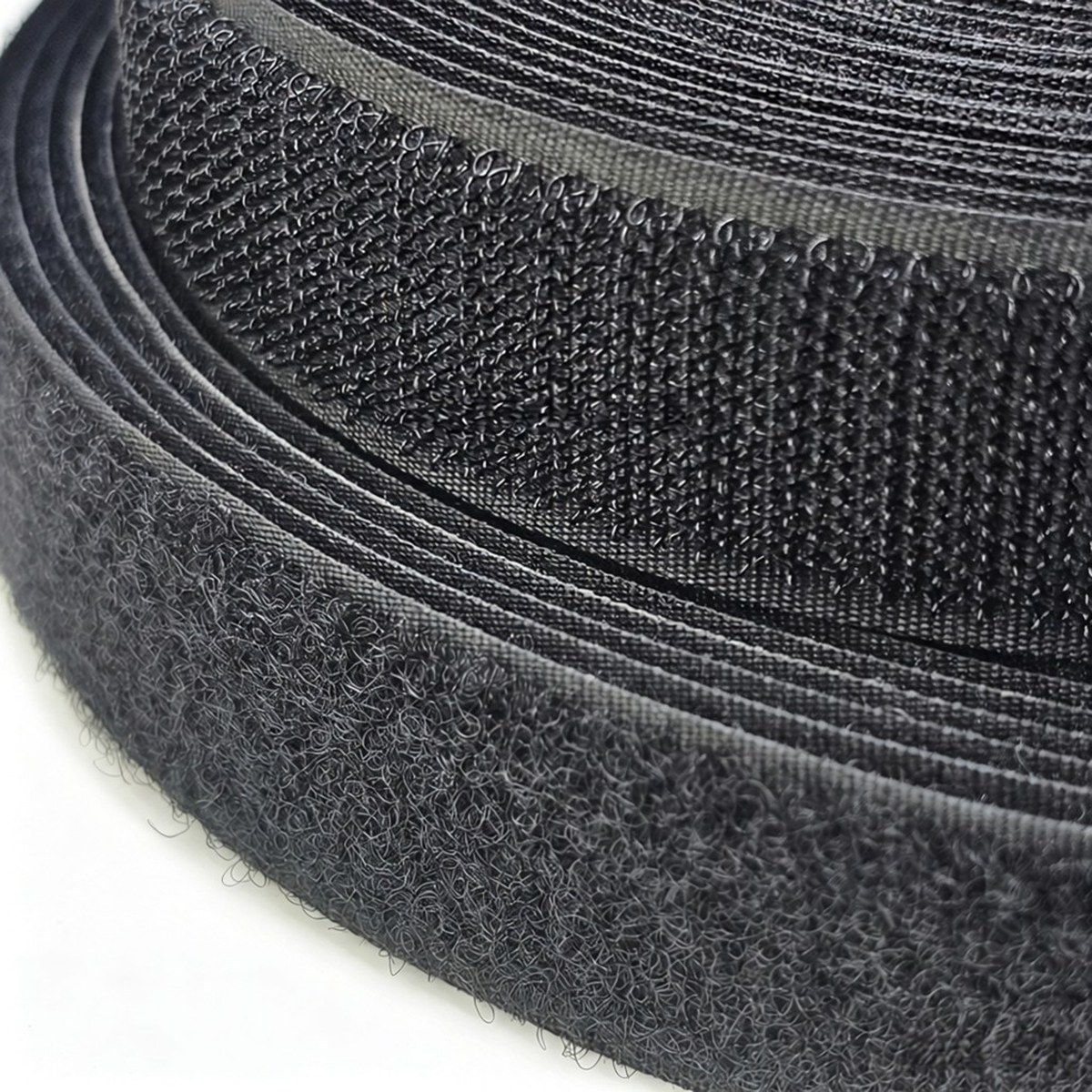
How Does Hook And Loop Fastener Work and Which Type Should You Choose?
A hook and loop fastener works by mechanical engagement rather than by chemistry: one face carries small hooks, the other carries a dense pile of loops, and the two interlock when pressed together and release when peeled apart. That mechanism is simple to describe and difficult to specify, because the four requirements it has to meet — closure force, opening force, cycle life and resistance to the environment — pull against one another. A fastener that grips hardest usually opens hardest, and one that survives ten thousand cycles usually grips less than one rated for five hundred.
For a bag maker, a garment manufacturer or a product engineer, the choice is therefore not one tape against another. Two fasteners can look identical, measure the same width and carry the same description on an invoice, and still differ in peel strength, in shear strength and in how much of that strength survives fifty washes. What separates them is the hook form, the loop density, the backing and the yarn — four variables that can be fixed in a brief before a sample is sewn.
This guide explains how the closure actually works, the types and grades that are sold, the difference between peel and shear strength and why it decides so many failures, which type suits which product, and the points at which a hook and loop fastener fails first.
How Hook And Loop Fastener Works
The closure is a pair. One tape is woven or knitted with monofilament hooks that stand up from the surface; the other is a pile of finer loops. Pressing the two together engages a fraction of the available hooks, and the number that engage is what produces the closing force. Peeling lifts the hooks progressively from one edge, which is why peel strength is far lower than shear strength and why the direction of the load decides whether a closure holds.
Why Shear Holds and Peel Does Not
In shear, the load runs along the plane of the closure and every engaged hook resists at once. In peel, the load lifts the two faces apart from one edge and the hooks disengage a row at a time, so only a small number carry the load at any moment. A closure that holds a 20 kg bag hanging from its flap may open under a few kilograms applied at the corner. This single distinction explains most of the field failures in the category, and most of the specification errors that precede them.
What Limits the Closure
Three things stop a hook and loop fastener doing its job: contamination, cycle wear and heat. Lint, sand and pet hair fill the loop and leave the hooks nothing to grip. Repeated opening flattens the loops and bends the hooks, so engagement falls gradually rather than failing at once. Heat above the softening point of the yarn deforms both faces and the closure stops engaging altogether, which is why a tumble dryer is the most damaging environment for a product closed this way.
Hook And Loop Fastener Types: Woven, Knitted, and Molded
Three constructions are sold under the same name, and they behave differently enough that the type belongs in the specification alongside the width.
Woven Hook And Loop Fastener
The traditional construction, with hooks and loops formed on a narrow-fabric loom. It is the most dimensionally stable of the three, holds its strength after washing, and is the type usually specified for garments, bags and medical products. It is also the stiffest, which matters on a curved surface.
Knitted Hook And Loop Fastener
Softer and more flexible, with a lower profile and a lighter hand. It is chosen where the closure sits against skin or against a soft fabric, and where the stiffness of a woven tape would show through. The trade is a lower peel strength and a shorter cycle life at the same width.
Molded Hook And Loop Fastener
Hooks formed by extrusion rather than weaving, usually on a polypropylene or polyethylene backing. The hooks are uniform and the closure is resistant to contamination, which is why molded types appear on outdoor gear, on hook-and-loop cable ties and on products that are opened in dirty conditions. The trade is a coarser feel and a heavier hand.
Hook And Loop Fastener Grades and Cycle Life
Commercial grades are usually sold by cycle life rather than by strength, and the two are inversely related. A standard grade opens and closes several hundred times before engagement falls noticeably. A high-cycle grade uses finer hooks and a denser loop to reach several thousand cycles, at a lower initial peel per unit area. Neither is better; the question is how often the closure will be opened in service.
| Grade | Typical cycle life | Peel character | Usual application |
|---|---|---|---|
| Standard | Several hundred openings | High initial peel, falls quickly | Packaging, displays, single-season products |
| High cycle | Several thousand openings | Lower initial peel, holds longer | Garments, bags, medical and reusable products |
| Low profile | Several hundred, thin construction | Moderate peel, minimal bulk | Slim closures, cuffs, small pouches |
| Molded | Several hundred in dirty conditions | Coarse, contamination tolerant | Outdoor gear, straps, cable management |
A product that is opened twice a day will see roughly seven hundred cycles a year, which puts it beyond a standard grade within the first season. Where the closure sits inside a bag or a pouch, the same calculation applies but the wash regime changes the answer, as set out in custom spec bags. That calculation is worth running before a grade is chosen, because the alternative — discovering it from returns — costs a season rather than a minute.
Which Hook And Loop Fastener to Choose for a Product
The matching rule runs from the opening pattern to the construction. Start with how often the closure is opened, then with what it has to hold, then with what it sits against.
- Opened daily, against skin or soft fabric. Knitted, low profile, high-cycle grade. A woven tape at this position stiffens the product and shows through the shell.
- Opened daily, holding a load. Woven, high-cycle grade, engaged across the full width of the flap rather than at the corners.
- Opened rarely, load-bearing. Woven standard grade at full width. The cycle life is not the constraint; the peel direction is.
- Opened in dirt, sand or outdoor conditions. Molded. The uniform hooks shed contamination better than a fine woven hook, and the closure still engages after a season.
- Washed frequently. Woven, with a heat tolerance stated for the drying temperature. Knitted grades recover less after repeated washing.
One structural rule applies to all five: engage the closure across the full width rather than at a strip. A 25 mm fastener engaged over 200 mm of flap carries far more than the same fastener engaged over 50 mm, and the difference is a pattern change rather than a material change.
Hook And Loop Fastener Peel Strength vs Shear Strength
The two figures are quoted separately because they differ by an order of magnitude, and a supplier that offers a single number is describing one of them without saying which. The table below gives the relationship that holds across most woven and knitted constructions at 25 mm width.
| Load direction | How it is applied | Relative strength | Where it appears |
|---|---|---|---|
| Shear | Along the plane of the closure | Highest, all hooks engaged | A bag flap hanging from its closure |
| Tension peel | Lifted from one edge at 90 degrees | Lowest, hooks release in rows | A corner lifted by a hand |
| Cleavage peel | Pulled apart from a folded edge | Low, concentrated at the fold | A closure on a thin, folded flap |
| Twist peel | Rotated about the closure plane | Moderate, uneven engagement | A closure under a shifting load |
Specifying only a peel figure understates a closure that will be used in shear and overstates one that will be opened at a corner. The practical approach is to state both, name the test method, and describe the direction the product actually loads the closure in. A fastener tested in shear and used in peel is the most common specification error in the category, and it is invisible until the first complaint.
Hook And Loop Fastener Backing and Attachment Options
The backing decides how the fastener meets the product, and it is chosen separately from the closure itself. Four options cover almost every application, and the wrong one produces a failure that looks like a weak tape.
- Sew-on. The default for anything that will be washed, used outdoors or loaded in shear. The backing is a plain woven or knitted substrate, and the attachment is a stitch line rather than an adhesive.
- Pressure-sensitive adhesive. A coated backing with a release liner. It suits flat, clean, rigid surfaces, and it creeps under sustained load or warm conditions. The adhesive is the weak layer, not the closure.
- Heat-activated adhesive. A dry film that bonds under a press. Stronger than a pressure-sensitive coating and used where a sewn line would show, but the bonding temperature has to stay below the point at which the hooks deform.
- Molded or extruded backing. A rigid plastic base that can be stapled, riveted or welded. It is chosen for outdoor and industrial closures where a stitch would pull through.
The attachment also sets the stitch margin, which is the single line most often left off a drawing. A fastener sewn 3 mm from the edge tears out at the first load; the same tape sewn 8–10 mm from the edge holds, because the stitch no longer perforates the backing where the hooks engage.
Where Hook And Loop Fastener Fails First
The failure points are consistent, and each is visible on a sample before a bulk order. They run in this order in returned product.
- The stitch line, not the closure. A sewn fastener usually tears out at the seam before the hooks give way, because the stitch perforates the backing. A wider stitch margin costs nothing and removes the problem.
- The adhesive, on a self-adhesive tape. Pressure-sensitive backing fails at the edges first, then creeps under load and at warm temperatures. Adhesive types belong on flat, clean, rigid surfaces.
- The loop face, from contamination. Lint and hair fill the pile and engagement falls without anything breaking. On a product opened outdoors, a molded type is the answer rather than a denser loop.
- The hook tips, from heat. A tumble dryer or a hot press deforms the hooks and the closure stops engaging. The heat tolerance of the yarn belongs in the brief.
- The closure area, from the pattern. A fastener engaged over a short strip carries a fraction of what the same tape carries at full width. This is a design decision, not a material one.
The first and last of those five account for most of the returns in the category, and neither can be fixed by buying a better tape. The hook and loop fastener range is specified by construction and grade for that reason, so the tape and the way it is sewn can be settled together, and peel and shear figures are measured to the same in-house testing protocol as the webbing alongside it.
FAQ: Hook And Loop Fastener
How does a hook and loop fastener actually hold?
Mechanical engagement. One face carries small hooks, the other a pile of loops, and pressing them together engages a fraction of the hooks. The number engaged sets the closing force, and the direction of the load decides whether they stay engaged.
What is the difference between peel and shear strength?
Shear runs the load along the plane of the closure so every engaged hook resists at once. Peel lifts the faces apart from one edge, so hooks release a row at a time and far fewer carry the load. Shear strength is typically several times peel strength.
How many times can a hook and loop fastener be opened?
A standard grade manages several hundred cycles before engagement falls noticeably, and a high-cycle grade several thousand. A closure opened twice a day reaches about seven hundred cycles a year, which is why cycle life belongs in the specification.
Why does my hook and loop fastener stop sticking?
Three causes, in order of frequency: the loop is contaminated with lint or hair, the hooks have been deformed by heat in a dryer, or the adhesive backing has crept. The first two are material choices; the third is an application choice.
Is hook and loop fastener washable?
Woven types are, provided the drying temperature stays below the softening point of the yarn. A tumble dryer is the damaging step rather than the wash, because heat deforms both hooks and loops.
Why Buyers Source Hook And Loop Fastener from Xinxiangrui
A hook and loop fastener is decided by four variables that a width and a color do not describe: the construction, the grade, the backing and the closure area. Name all four and the closure that arrives is the one that was approved.
Xinxiangrui Webbing has woven narrow fabric in Dongguan since 2011, with hook and loop produced alongside the webbing range and tested in-house for peel strength and cycle life. Constructions are quoted against the opening pattern and the load direction rather than against a catalogue line, and OEM and ODM work is quoted from the six lines in the specification checklist. The hook and loop fastener range covers woven, knitted and molded types.