
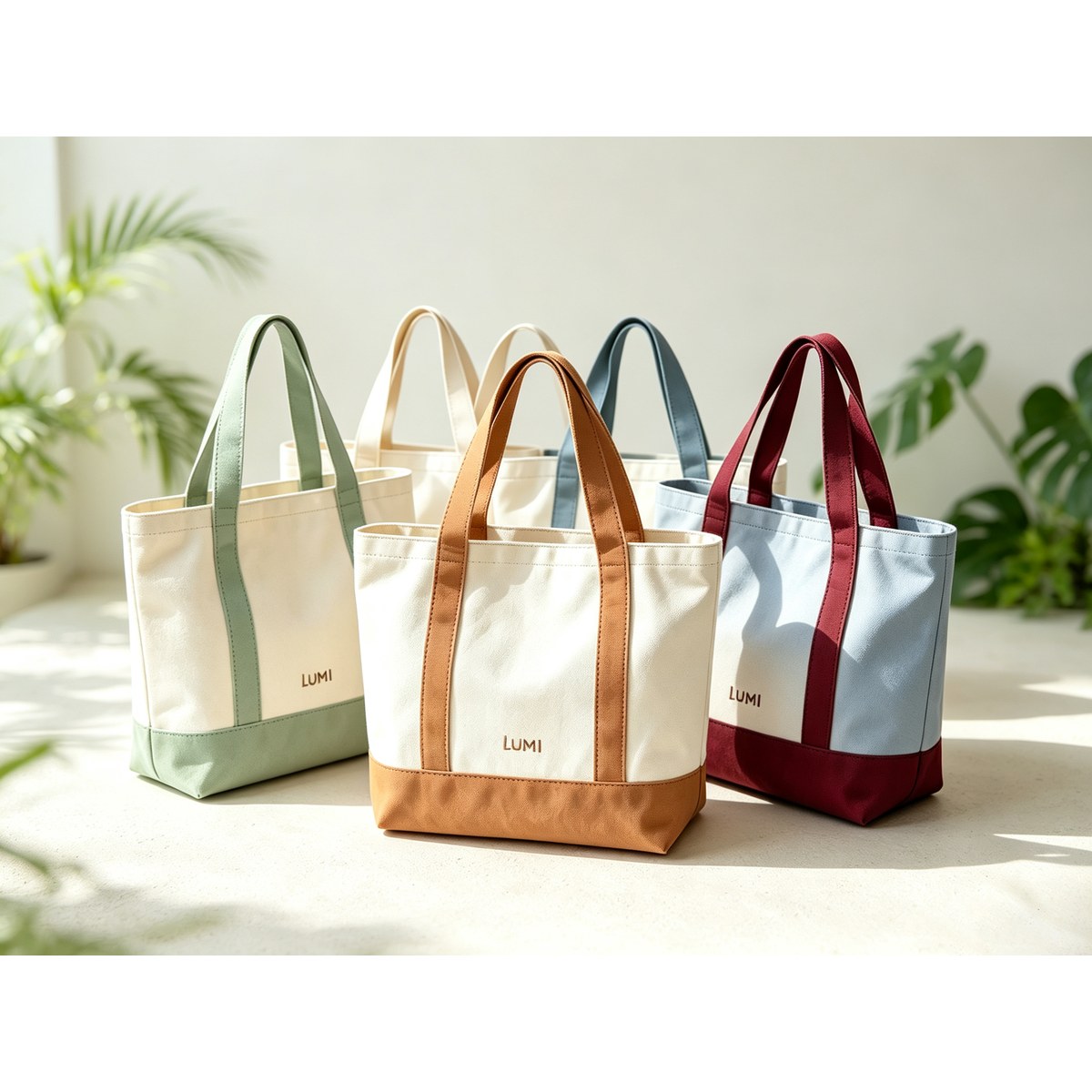
How to Choose a Canvas Tote Bag: Fabric Weight, Handles, Capacity, and Printing
Choosing a canvas tote bag looks like a fabric decision, but the bag is specified against four requirements at once: a fabric weight that holds its shape without turning the tote into luggage, handles that survive a full load, a capacity matched to how the bag is actually carried, and printing that survives the wash cycle the owner will run without reading the care label. A bag can be right on three of the four and still read as cheap, because the owner notices the fourth every time.
Fabric weight is the headline number and the least self-explanatory one. The same 12 oz canvas behaves differently depending on weave tightness and finishing, and the weight that suits a grocery tote is wrong for a book bag. Not all canvas tote bags are equally specified: yarn construction, handle anchoring, gusset depth and print method decide whether the bag ages into its best version or fails at the strap anchor in a month.
For a brand or sourcing team, the expensive path is specifying the fabric and leaving the rest to the factory. The cheaper path is a brief that fixes four things together — fabric weight, handle construction, capacity and print method — and approves them on one sample. This guide explains what the fabric weight numbers mean, how handles carry load, how to size capacity by use, which print methods survive washing, and the sample checks that catch a weak tote before bulk.
Canvas Tote Bag Fabric Weight: What the Numbers Mean
Canvas is a heavy plain weave, and its weight is quoted in ounces per square yard or in grams per square meter. The range most totes live in runs from 8 oz, a light bag that folds flat and suits giveaways, through 12 oz, the general-purpose standard that holds shape when carried, to 16 oz and above, where the panel stands on its own and the bag reads as equipment. The number describes the fabric, not the bag: two 12 oz bags can differ in stiffness because of weave density and finishing.
How Fabric Weight Changes Behavior
Weight drives three behaviors at once. Heavier fabric holds the silhouette of the bag empty, which matters on a retail shelf, and resists the sag that makes a light tote look used after a week. It also costs more to sew: a 16 oz panel needs a heavier needle, a longer stitch and more presser pressure, and seams that ignore that pucker or skip. And it changes the wash: heavier canvas dries slower and shrinks more visibly, so a heavyweight bag needs a shrinkage decision at the fabric stage rather than a care label apology afterward. The practical rule is to pick the lightest weight that holds the shape the product needs, not the heaviest the budget allows.
Canvas Tote Bag Handles and Load Paths
Handles are where a tote fails, and they fail at the anchor rather than along the strap. The load path runs from the carried weight, through the handle, into a stitch zone at the panel, and the panel edge is the weakest point in that path. A handle sewn straight onto an un-reinforced edge concentrates the whole load into a few stitches at the exact point where the fabric is already cut.
Handle Webbing and Stitching
The reference construction is a webbing handle — cotton webbing to match a natural canvas face, or a synthetic band where load leads the brief — anchored through a reinforcement: a box-and-cross stitch pattern, a patch behind the panel, or the handle wrapped into the seam binding itself. Stitch density matters as much as the pattern, because a long stitch perforates the panel without holding it. The cotton webbing range is the usual handle band for canvas totes, precisely because the hand of the strap and the hand of the panel age together.
Handle length is the other half of the specification, and it is decided by how the bag is carried. A short handle — the length that lets the bag sit at the elbow — suits retail and office use; a long shoulder handle suits markets and commuting; a two-handle layout covers both but doubles the anchor count to reinforce. Carrying position, not aesthetics, should set the length. One more line belongs beside it: handle drop measured on the loaded bag, because a strap that clears the shoulder empty can sit under the arm once the contents settle.
Canvas Tote Bag Capacity: Sizing by Use
Capacity is quoted in liters or in flat dimensions, and both descriptions hide the same question: what does the owner actually put in the bag? A bag sized from its intended contents avoids the two failures that return rates keep measuring — the bag that is too shallow for the file it was bought to carry, and the bag so large that everything shifts to the bottom.
| Use | Usual capacity | What the sizing has to fit |
|---|---|---|
| Giveaway and events | Small, flat-folding | Brochures and a bottle; folds for a drawer between uses |
| Grocery and market | Large, open top | Produce cartons; a base panel stops the load spreading |
| Books and daily carry | Medium, structured | A4 or letter format upright; gusset deep enough for a laptop sleeve |
| Beach and weekend | Extra large | Towels packed loose; internal pocket for keys and phone |
| Retail and merchandising | Medium, shaped | The silhouette on the shelf matters as much as the volume |
Gusset depth and base width are the two dimensions that turn a flat bag into a structured one, and they are also the two that most often get left to the factory. A base panel — sewn or removable — is the cheapest upgrade a grocery or book tote can take, because it moves the load off the bottom seam and onto a panel designed to hold it.
Canvas Tote Bag Printing Methods and Wash Durability
Four print methods cover the canvas tote range, and they differ mainly in how they survive the wash and how they handle detail.
| Method | Best for | Wash behavior |
|---|---|---|
| Screen print | Bold single-color marks at volume | Holds well; cracks at fold points after many hot washes |
| Water-based print | A soft hand on natural canvas | Fades gracefully; suits ranges where that aging reads as intended |
| Heat transfer | Full-color artwork and gradients | Edges lift where the panel folds repeatedly; check after five washes |
| Jacquard or woven label | Logos that must outlast the bag | Color is in the yarn; the most durable format and the slowest to change |
The decision pairs with the fabric weight: a water-based print sits beautifully on a lighter canvas and disappears into a heavy one; heat transfer needs a flat, smooth panel and struggles on textured 16 oz. Whatever the method, the sample should be washed the number of times the care label allows and then judged, because print aging is the gap between the sample room and the market, and it is the one gap a flat sample will never show.
Canvas Tote Bag Sample Checks Before Bulk
Four checks on one loaded sample catch most of what goes wrong in this category, and none of them needs equipment.
- Load it and lift by the handles. The bag should be tested at real weight — books, bottles, whatever the sizing table says it is for. The anchor zones should show no gapping at the panel after the lift.
- Wash it once at the care label cycle. Shrinkage shows at the seam lines first; print aging shows at the fold points. One wash at the specified cycle settles both.
- Set it down empty. A structured tote should stand or hold its shape; a slouching silhouette on the shelf is the detail customers read as quality before they touch anything.
- Sew a corner open. The fastest way to see construction quality: reinforcement patches, stitch density and interlining are all visible in one opened corner, and none are visible from outside.
Those four checks are the same lines a bulk inspection will run, and writing them into the sample approval makes the acceptance criteria explicit rather than remembered, and it gives the factory a standard to hold when the production run changes hands. The testing page lists the lab reports behind the fabric and handle band, for ranges where a document trail matters as much as the sample.
Canvas Tote Bag Construction Details That Decide Durability
Between the fabric and the handles sits a layer of construction decisions that never appears in a product listing but decides how the bag ages. Seam type is the first: a French seam encloses the raw edge on an unlined tote and stops the interior fraying into the contents, while a plain overlocked seam is faster and reads fine until the third wash. Stitch length is the second — canvas at 12 oz or heavier needs a longer stitch than a garment seam, because a short stitch perforates the panel and starts the tear line that handles are blamed for.
Interlining and interfacing are the third. A light fusible on the panel front keeps printed artwork flat and stops the silhouette from leaning; a base interlining turns a soft grocery tote into a structured one without moving up a fabric weight. Both are invisible in a photograph and both are the reason two bags in the same fabric can sit differently on a shelf. The specification should name them, because they are also the first line item a factory quietly removes when a quote has to come down, and the only way to notice is to open the corner on the sample.
Canvas Tote Bag Lining and Interior Organization
A lining is a positioning decision before it is a construction one. Unlined totes read as natural and washable, and they keep the fabric hand visible on both faces — the right call for market bags and merchandising. A lined tote reads as a finished product, protects printed artwork from the contents, and gives seams a second structure to hold, at the cost of drying time and a care story that changes from machine-wash to spot-clean where the lining is synthetic.
Interior organization sits on the same decision line. An internal pocket — zip or slip — is the feature owners mention in reviews, because keys and a phone are what a tote loses; a key leash and a bottle sleeve follow the same logic. On a lined bag these are sewn in before the lining closes and cost little; on an unlined bag they are the feature that justifies the lining. Either way, the pocket is part of the capacity specification rather than an afterthought, because its position decides whether the contents actually stay findable.
Thread and hardware close the construction list. A polyester thread outlasts a cotton thread on a washed tote even when the panel is cotton, because the seam is the one place where wet strength cannot be traded away; a metal base stud on a structured bag protects the panel from the ground it is set on; and riveted handle anchors, where the aesthetic allows, take the load out of the stitch line entirely. None of these is expensive; all of them are decisions rather than defaults.
FAQ: Canvas Tote Bag
What is the best fabric weight for a canvas tote bag?
Twelve ounces per square yard is the general-purpose standard: heavy enough to hold shape, light enough to sew cleanly and wash reasonably. Eight ounces suits flat-folding giveaway bags; sixteen and above suit structured, equipment-reading bags.
Which canvas tote bag handles last longest?
A webbing handle anchored through a reinforcement patch with a box-and-cross stitch pattern. The strap material matters less than the anchor: most tote failures are at the panel edge, not along the strap.
How much should a canvas tote bag hold?
Size it from the contents, not from a number: a book tote needs an A4 or letter format upright with a gusset for a sleeve, a grocery tote needs produce-carton volume with a base panel, and a giveaway bag needs to fold flat.
Which printing method survives washing on canvas?
Jacquard and yarn-dyed marks last longest because the color is in the yarn. Among surface methods, screen print holds better than heat transfer, and both should be judged after washing at the care label cycle, not from the flat sample.
How do I stop a canvas tote bag from sagging?
Fabric weight, gusset depth and a base panel together control structure. A 12 oz fabric with a sewn base panel holds a silhouette that a 16 oz flat bag cannot, at a lower fabric cost.
Why Brands Build Canvas Tote Bags with Xinxiangrui
A canvas tote bag is specified once and judged every time it is carried: fabric weight, handle anchors, capacity and print durability have to be written together, because the bag fails at whichever one was left to chance.
Xinxiangrui Webbing has woven webbing in Dongguan since 2011, supplying handle bands and trim for bag programs alongside the custom spec bags line. Handles are specified against the load path and the anchor detail rather than by width alone, and samples are approved washed, loaded and opened at a corner, so the bag that ships behaves like the one that was signed off.