
How to Choose Baby-friendly Soft Webbing for Comfort, Safety, and Durability
Specifying baby-friendly soft webbing starts from a different premise than general webbing: the band will be touched, chewed and slept on, and it will be washed more often and at higher temperatures than the product it is sewn into. Comfort, safety and durability are not three options to balance here. They are three requirements that have to be met at once, because a band that is soft but sheds dye, or safe but stiff at the edge, fails the product in the first week of use.
The band in a baby product is rarely decorative. It is the harness that holds a stroller ride together, the strap adjuster a parent works one-handed, the edge that sits against a neck or a cheek for the length of a nap. Not all soft webbing is equally suited to that job: fiber choice, weave density, edge construction and the chemical history of the dye bath decide how the band behaves against skin that cannot complain and cannot be reasoned with.
For a brand or sourcing team, the error to design out is assuming a soft hand at delivery means a safe band in service. The standard that works is a specification written in four lines — fiber, edge, chemical compliance and mechanical retention — each with a report behind it. This guide explains what makes webbing baby-friendly, which fibers and weaves suit skin contact, what the safety and testing expectations are, and where the band is used across a baby range.
What Makes Soft Webbing Baby-friendly
Baby-friendly is a construction claim before it is a marketing one, and it rests on three verifiable properties. The first is surface: a band that stays comfortable against skin when damp, because a harness strap works after a nap and a drool episode, not only in the sample room. The second is chemistry: no dye or finish residues that a mouth will find before the washing machine does. The third is mechanical: a band that holds its adjustment and its stitching under the tugging, kicking and chewing that a baby product is guaranteed to receive.
Each of the three has a failure mode that is visible in the market and preventable in the spec. Comfort fails at the edge — a heat-sealed synthetic edge turns stiff and rubs. Chemistry fails at the dye bath — residues that a standard band tolerates are not tolerated at mouth-contact level. Mechanics fail at the stitch line — a band that is soft because it is loosely woven can also be a band that slides under load. A brief that names all three, with the test behind each, is the difference between a claim and a property, and only one of the two survives contact with a regulator or a reviewer.
The order matters as well. Chemistry is checked first because it cannot be seen, felt or fixed after sewing: a band that fails the compliance report is a yarn decision, not a trimming one. Mechanics come second because they depend on the assembly rather than the band alone. Comfort comes last in the sequence but first in the market, because it is the property the buyer tests with a hand and the owner confirms with a nap.
Baby-friendly Soft Webbing Fibers: Cotton and Polyester
Two fibers carry most of the category. Cotton webbing is the natural choice for skin contact: absorbent, matte, soft at the edge without a coating, and the fiber that reads as honest on a natural-range product. Its costs are dimensional — it shrinks unless pre-shrunk, dries slowly, and loses part of its strength when wet — all manageable in a specification and all worth managing, because a harness that shrinks is a harness that no longer adjusts, and one that no longer adjusts is a product returned rather than a product forgiven. The cotton webbing range covers the pre-shrunk formats that suit this use.
Polyester webbing is the durability choice: stable through washing, strong when wet, and available in fine weaves that feel softer than its filament reputation suggests. Its surface is slicker than cotton, so the softness has to come from the weave and the edge rather than the fiber, and its dye chemistry needs a compliance report at mouth-contact level rather than a general colorfastness grade. The polyester webbing range is the usual answer where the band carries load — stroller harnesses and carrier straps — while cotton answers the ranges where the story leads, and blends sit between them for products that need a foot in both.
How Baby-friendly Soft Webbing Gets Its Softness
Softness is a construction property, not a finish that can be sprayed on afterward. Two decisions decide it.
Weave Density and Drape
A band that drapes wraps a shoulder or a neck; a band that stands does not. Drape comes from a weave with enough density to hold tensile but enough yarn freedom to bend, and from a thickness chosen for the application rather than for the spec sheet. For a harness, the band has to slide through an adjuster smoothly while staying flat under load — a balance that a looser, thicker band loses. Sampling the band on the actual adjuster, at the actual load, is the only test that settles it, and it takes less time than arguing about a datasheet.
Edge Finishes That Touch Skin
The edge is where a band earns or loses the word soft. A woven selvedge keeps the edge stable and comfortable through washing; a heat-sealed edge on a synthetic band starts stiff and softens only by wearing, which is the wrong direction for skin contact. Where a slit edge is unavoidable, the options are a bound edge, a folded-and-stitched edge, or a stitch line positioned so the sealed edge never meets skin. The edge decision also decides wash life: a sealed edge that rubs open cannot be repaired, while a bound edge can be restitched.
Baby-friendly Soft Webbing Safety and Testing
Safety in this category has two halves, chemical and mechanical, and both are documented rather than asserted. The chemical half covers what the band carries: dye and finish residues tested against the limits the target market applies to products with mouth contact, and a report requested from the actual dye lot rather than from a generic certificate. A brand does not need to know the chemistry; it needs to know which document covers the band in the carton, and the testing page sets out which reports those are, and which of them can be run before the dye lot is even chosen.
The mechanical half is about retention: the band must hold its adjustment under a child-sized load spectrum and release under a parent-sized one. Stitch retention at the buckle, adjuster slippage under cyclic load, and the tensile at the finished width are the three figures that describe it. None of them is exotic; all of them are the difference between a harness that works through two children and one that loosens quietly through a month. The reports belong with the sample approval, so the bulk comparison is against a number and not against a memory.
Where Baby-friendly Soft Webbing Is Used
The band appears across a baby range in roles that weight the three requirements differently.
| Application | Leading requirement | Band decisions that follow |
|---|---|---|
| Stroller and car seat harness | Mechanical retention | Polyester or blend, tensile at width, adjuster-compatible weave |
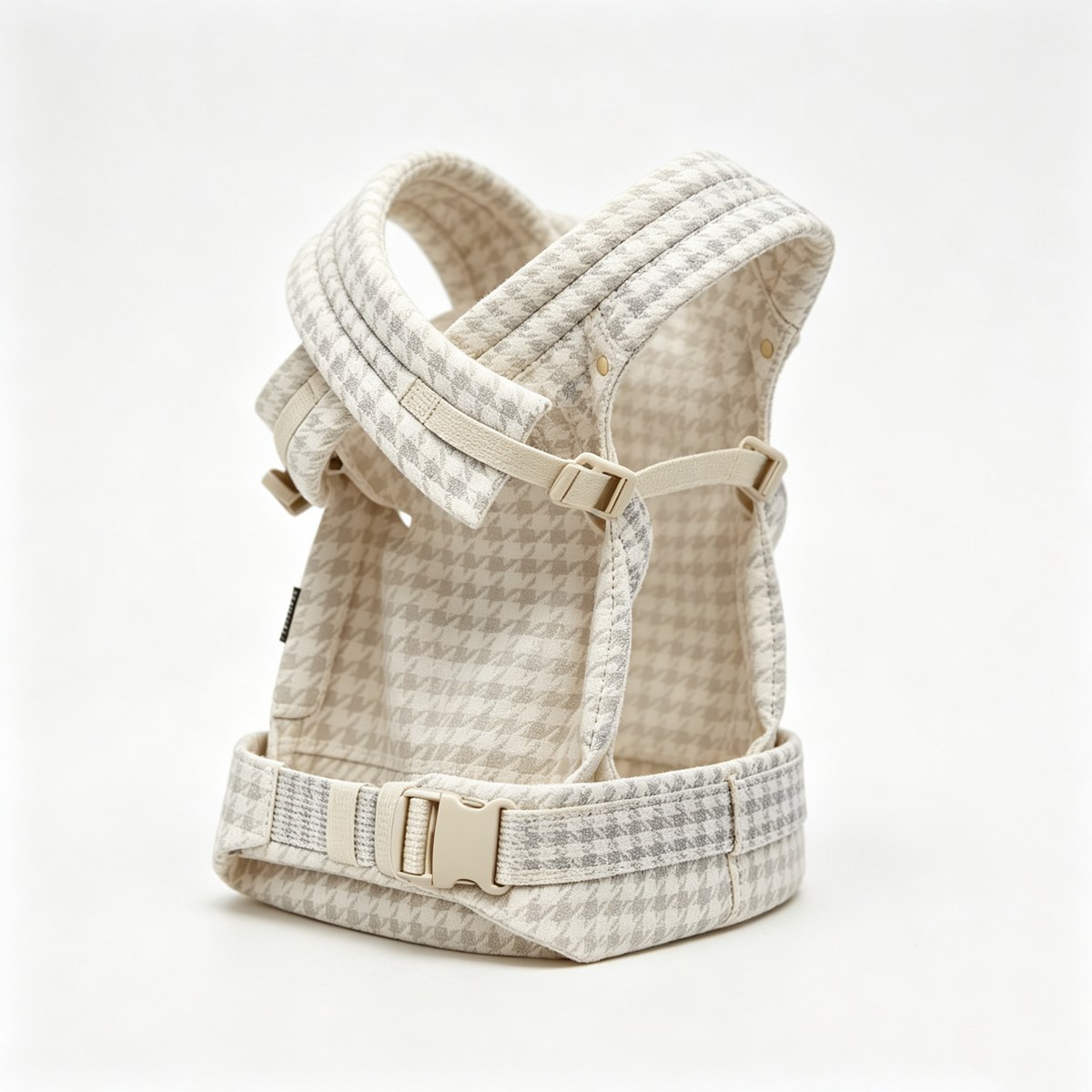
| Baby carrier straps | Comfort under load | Wider band, dense weave, padded or bound edge |
| Drool bib and apparel ties | Skin contact and wash | Cotton, pre-shrunk, bound edges, yarn-dyed shades |
| Toy and teething loops | Mouth contact | Chemistry report at the strictest level; no coatings to chew |
| Nursery and bedding trim | Appearance and softness | Cotton or blend, matte face, selvedge edges |
The table reads as three different products, which is the point: a range that treats the harness band and the bib tie as the same item gets one that is wrong at both. Separating them at specification costs nothing and matches the band to the job it actually does. The baby products line is organized around that separation.
What to Verify on a Baby-friendly Soft Webbing Sample
Four checks on a physical sample, plus the reports behind them, close the evaluation.
- Wet the band and wear-test the edge. A damp band against the inner wrist for a minute tells more about edge comfort than any dry description, because wet edges are where stiffness shows.
- Run it through the actual adjuster. Slippage under load, smoothness of travel, and whether the band twists are all adjuster-specific behaviors that no datasheet carries.
- Wash it at the product care cycle. Shrinkage, edge integrity and shade stability after one specified cycle; repeat to the cycle count the care label promises.
- Match the reports to the lot. Chemical compliance for the dye lot in hand, tensile at the finished width, and the retention figure for the assembly — three documents, three numbers.
The checks take an afternoon, and they are the same checks a market surveillance test would run later. Running them first is the cheapest quality decision available in this category, because every failure they catch is a specification line rather than a recall conversation, and every one of the four can be run in-house before the sample is even shipped.
Baby-friendly Soft Webbing Widths and Hardware Pairing
Width in this category follows the hardware and the body part it meets, in that order. A stroller harness band has to pass the adjuster slot and the buckle at nominal width, and cotton or a blend will not compress into a tight slot the way a softer synthetic can, so the hardware is measured before the band is chosen. A carrier strap runs wider for load spread; a bib tie and a toy loop run narrow, where the binding of the edge matters more than the band construction.
Hardware pairing also decides the surface. A band that runs through a slider every day needs a weave dense enough not to fuzz at the contact line, and a band that ends in a buckle needs a stitch margin specified rather than assumed. Sampling the band with its actual hardware — not a similar one from the drawer — is the only pairing test that means anything, because slippage and twist are behaviors of the pair, not of the band.
Baby-friendly Soft Webbing Versus Standard Webbing
The difference is easiest to see side by side, because the two are not interchangeable even at the same width and fiber.
| Property | Baby-friendly soft webbing | Standard webbing |
|---|---|---|
| Edge | Woven selvedge or bound edge | Heat-sealed slit edge acceptable |
| Surface | Drape and softness specified when damp | Surface judged dry, at delivery |
| Chemistry | Documented to mouth-contact limits | General textile compliance |
| Retention | Slippage specified in the assembly | Tensile figure only |
| Wash behavior | Shrinkage and shade at the care cycle | Care label as a constraint, not a spec |
None of the right-hand column is wrong for general products — a tie-down strap has no cheek against it and no mouth on it. The point of the table is that a standard band with a softer finish is not a baby-friendly band, because the properties that matter in a crib or a stroller are exactly the ones a general specification leaves out. The upgrade is a set of decisions, not a coating, and each decision is visible on a sample inside an afternoon.
FAQ: Baby-friendly Soft Webbing
What makes webbing baby-friendly?
Three verifiable properties: a surface that stays comfortable when damp, dye and finish chemistry documented to mouth-contact limits, and mechanical retention that holds adjustment under a child-sized load. Softness at delivery alone is none of these.
Is cotton or polyester webbing better for baby products?
Cotton for skin-contact and natural ranges, where comfort and appearance lead; polyester where the band carries load and washes often, such as stroller harnesses. Pre-shrinking and edge binding are what make either one work in service.
Why is the edge so important on soft webbing?
The edge is what touches skin and what washing attacks first. A woven selvedge or a bound edge stays comfortable through the product life; a heat-sealed edge starts stiff and only softens by wearing, which is the wrong direction against a neck or a cheek.
What tests should a baby-friendly webbing supplier provide?
A chemical compliance report for the actual dye lot, tensile at the finished width, and a retention or slippage figure for the band in its assembly. Three documents, matched to the batch, are the evidence that the claim is a property.
Does soft webbing lose strength when washed?
Cotton loses some strength when wet and recovers on drying, and shrinkage is the bigger service issue; polyester is stable through wash cycles. Both belong in the specification with the care cycle named, not left to the care label.
Why Brands Source Baby-friendly Soft Webbing from Xinxiangrui
Baby-friendly soft webbing is a construction claim with three parts: comfort that survives damp, chemistry documented to mouth-contact level, and retention that holds through two children. All three are specification lines, and all three have reports behind them.
Xinxiangrui Webbing has woven webbing in Dongguan since 2011, supplying the baby products line with cotton, polyester and bio-based bands. Edges are woven or bound rather than heat-sealed where skin contact leads, samples are approved wet, washed and loaded, and reports travel with the lot, so the band in bulk is the band that was signed off.