
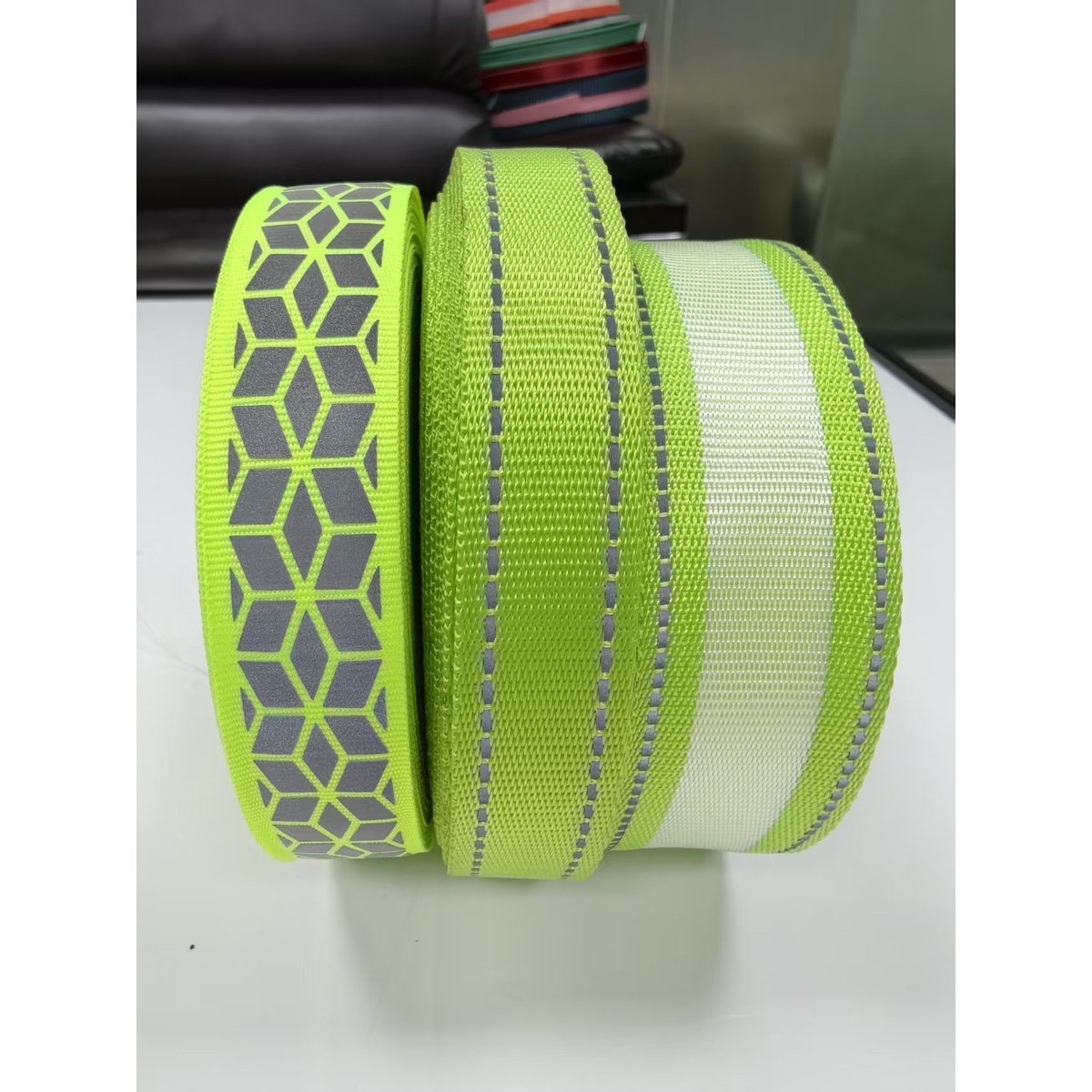
How to Choose Pet Reflective Webbing for Dog Collars, Harnesses, and Leashes
Pet products are specified against four requirements at once: safety, comfort, durability and appearance. On a dog collar, a harness or a leash, reflective webbing addresses the first of them by making the animal visible in low light — along a road shoulder, in a parking area, on an unlit path after dark. Not all reflective webbing performs that function equally. The base material, the reflective construction, the width, the flexibility, the abrasion resistance and the manufacturing quality each change what the finished product does.
For a pet brand, a wholesaler or a manufacturer, selecting the material is therefore not a comparison of swatches and quotations. The webbing has to meet the mechanical requirement of the part, remain comfortable where it contacts the dog, and hold its retroreflective reading through normal use. A construction that suits a lightweight collar is often the wrong choice for a load-bearing leash or a padded harness, and the difference is settled before the first order rather than after the first return.
This guide explains how to evaluate pet reflective webbing for each application — the width and reflective layout that suit a collar, a harness and a leash, the technical properties that decide how long the reading lasts, and the details that need to be confirmed before a bulk order is placed.
Pet Reflective Webbing by Part: Collar, Harness, or Leash
A collar, a harness and a leash load the same band in three different ways, and each fails at a different point: the collar at the buckle clearance, the harness at the chest contact patch, the leash at the handle. Before width or tape type, decide which part is being specified. The table below is the version worth carrying into a product meeting, and the three sections after it expand each row into something a mill can quote against. All five rows draw on the same pet reflective webbing family, which is why the differences below are construction choices rather than different materials.
| Part | Working width | Reflective layout | Where it fails first |
|---|---|---|---|
| Collar | 20–25 mm | One woven stripe, or tape 10–15 mm set clear of the buckle | Tape edge lifts where the band curves |
| Harness girth strap | 25–38 mm | Two continuous lines, one on each side of the chest strap | Line buried under padding; abrasion at the chest contact point |
| Harness back and chest straps | 20–25 mm | One line on the outward face | Stitch pull at the D-ring box |
| Leash | 20–25 mm medium dogs, 25 mm large dogs | Reflective on both faces, or woven through so either side reads | Handle edge wear; snap-hook stitch |
| Vest and step-in body | 15–20 mm | Continuous band along the hem | Hem fold swallows the line |
Choosing Pet Reflective Webbing for Dog Collars
A collar is the narrowest consumer of reflective band, and it is where over-specification shows up fastest. The three decisions below cover almost every collar return we have seen.
Width, and the Space the Buckle Takes
A 25 mm band on an 8 kg dog reads as heavy hardware, costs more per unit, and sits stiff against the neck. Most collars in production land at 20 mm, with 25 mm reserved for large breeds and for collars that carry an engraved plate. Below 15 mm the reflective stripe starts to compete with the weave structure itself; the band stays visible but the reflective line narrows to a hairline that reads poorly at a distance.
The buckle is the constraint nobody draws on the tech pack. A side-release buckle and its adjustment keeper consume 25 to 30 mm of band length, and the band inside that length flexes against the frame every time the collar is put on. Reflective tape running under the buckle is the single most common cause of edge lift on collar returns: the tape is bent over a hard plastic edge hundreds of times, and the adhesive or the weld fails before the fabric does. Stop the reflective 5 mm short of both buckle slots.
Woven Stripe or Applied Tape
If the design needs an unbroken reflective line around the neck, use a woven reflective stripe rather than applied tape, because the reflective yarn is carried inside the weave and cannot delaminate from an edge. Applied tape gives a brighter, cleaner line at a lower cost, which is why it still wins on flat, wide collars. On a narrow, curved collar the tape loses, and it loses at the edge first.
Where the D-Ring Goes
Collar geometry decides where the D-ring sits. A D-ring sewn through a single layer of reflective band gives the walker a pull point directly on the reflective surface, and the bartack that holds it will eventually crush the retro-reflective layer. Place the D-ring on a plain webbing tab between the reflective and the buckle, and keep the reflective line on the outward face where it faces traffic.
Pet Reflective Webbing for Dog Harnesses
A harness changes the problem because the band no longer hangs from a buckle. It wraps a moving animal, carries load across the girth, and rubs against the chest on every stride. That is why the girth strap is the widest element in most harness ranges, at 25 to 38 mm, while the back and chest straps sit at 20 to 25 mm where flexibility matters more than load. Our pet harness webbing range is built around that split, because a harness assembled from one width everywhere either rubs or looks underbuilt.
Two Lines Beat One Center Line
Two reflective lines, one on each side of the chest strap, beat one center line on almost every harness design. The reason is mechanical rather than cosmetic. A padded harness folds along its center when the dog sits or turns, and a center line sits exactly on the fold, so it creases, cracks, and collects dirt in the crease. Lines placed 8 to 10 mm apart flank the fold and stay flat. On a vest-style body, run the reflective along the hem instead of the middle of a panel; the hem is the part that stays perpendicular to oncoming light while the dog is moving.
The Line That Disappears in Assembly
The failure that catches brands by surprise is a reflective line that vanishes in the finished product. It happens when the reflective band is sewn underneath a padded layer, or when a printed panel is laminated over it. Both are invisible on a flat tech pack and obvious on the first assembled sample. Check the assembled harness, not the band: put it on a form, walk 20 meters away, and look at it under a phone torch. If the line is not continuous from chest to shoulder, the layout is wrong regardless of what the roll tested at.
Abrasion at the Chest Contact Point
Abrasion at the chest contact point is the second harness-specific issue. That patch sees the most cycles of any webbing surface in pet gear, and the reflective layer is the softest thing on it. We treat 50,000+ Martindale cycles as the working reference for harness-facing reflective band, tested on the reflective face rather than the reverse, otherwise the number describes the wrong surface.
Pet Reflective Webbing for Dog Leashes
A leash is the longest cut, the most handled, and the only part where the reflective surface must survive being wound around a hand. Three decisions shape it: the width, the number of reflective faces, and the handle.
Width Follows the Dog
Width follows the dog rather than the fashion: 20 mm for small and medium dogs, 25 mm for large and strong pullers, and 25 mm with a reinforced handle for anything over roughly 30 kg. A reflective polyester leash webbing in 25 mm is the workhorse of that last category, because polyester holds its length when wet and does not stretch into a slack line. If the leash is one line inside a wider pet leash range, spec it first and build the rest of the range around its handle construction.
One Reflective Face or Two
Because a leash twists in the hand, single-face reflective is a design compromise. The band rotates as the dog circles, and half the time the reflective face points at the ground. Woven-through reflective, or tape applied to both faces, keeps the product visible through a full rotation. It costs more per meter and it is the difference between a leash that reads at 50 meters on every walk and one that reads only when the dog happens to hold still.
The Handle and the Strength Figure
The handle is where the product is judged. A folded or padded handle adds two layers of webbing and a stitch line through the reflective face, and that stitch line is the first thing to fray. Keep the reflective clear of the handle fold by 10 mm, and put the reinforcement on the inside where the palm loads it. The same logic applies at the snap hook: a 25 mm reflective band of heavy-tenacity polyester clears 2000N+ break strength as a material figure, but the finished leash is rated by its assembly, and the assembly will fail at the hook stitch long before the band reaches that load. Quote the band number as material evidence, then test the sewn leash on its own.
Pet Reflective Webbing Numbers to Write Into the Brief
Most revision cycles come from a brief that describes the look and skips the numbers. These four lines do more work than a page of adjectives, and every one of them can be checked on a sample.
- Width with a tolerance — write 25 mm ± 1 mm, not "about an inch". A half-millimeter drift changes how the band sits in a buckle and how it feeds a folder.
- Reflectivity at stated angles — a coefficient in cd/lx·m² means little without the observation and entrance angles it was measured at, because the value collapses as the viewing angle widens. Fix both angles in the brief.
- Wash durability in cycles — AATCC 61 home-laundry cycles with the retained reflectance recorded after each block. Pet gear gets washed more than the category assumes, and the reflective edge is the first place water and detergent attack.
- Abrasion cycles on the reflective face — Martindale cycles, tested on the side that faces out. A number measured on the reverse is a number about a surface the customer never touches.
Pet Reflective Webbing Failures That Start at the Part
After enough seasons, the same three complaints recur across pet brands, and none of them is a tape quality issue.
- Reflective running under hardware — buckles, keepers, and D-rings bend the tape over a hard edge. The tape loses its edge before the fabric shows any wear, and the customer sees a white flap on a black collar.
- One construction across the whole range — a band built for a leash handle is too stiff for a 20 mm collar and too narrow for a girth strap. The range looks consistent in a catalogue and behaves inconsistently in the field.
- Color matched to the plain webbing, not the reflective band — the reflective layer shifts the apparent color of the dyed band, so a Pantone match approved on plain webbing drifts once the reflective is applied. Approve the Pantone on the finished reflective band.
FAQ: Pet Reflective Webbing for Dog Collars, Harnesses and Leashes
What width of pet reflective webbing do I need for a collar versus a leash?
Start at 20 mm for a collar and 20–25 mm for a leash, moving to 25 mm on both for large or strong dogs. A collar rarely benefits from going wider, because the buckle clearance and the bend radius punish a stiff band more than a narrow one.
Is heat-transfer reflective or woven reflective better for pet gear?
Woven reflective survives tight curves and repeated flexing better, which suits collars and harness straps. Heat-transfer tape gives a higher initial reflectance and a cleaner silver line, which suits flat panels and leashes where the band does not bend over hardware. Many ranges use both, on different parts.
Will the reflective still work after the product has been washed?
It will, if the wash durability is specified in cycles rather than described as washable. Ask for retained reflectance after a defined number of AATCC 61 cycles, and check the tape edge, because delamination usually appears before the reflective face stops working.
Can the reflective be produced in a color other than silver?
Yes, in a limited range, and the trade-off is measurable. Colored reflective films return less light than silver at the same angles, so a colored line needs a wider band or a brighter grade to read at the same distance. Approve the color on the finished reflective band under a torch, not on a swatch.
How do I test a sample before committing to a bulk order?
Test the assembled part, not the roll. Flex the band over the actual buckle or D-ring fifty times, wash the sample, then check the reflective line from 20 meters with a torch. If the line is still continuous and the tape edge is flat, the construction is sound.
Why Buyers Source Pet Reflective Webbing from Xinxiangrui
Pet reflective webbing is a small line item that decides whether a product is seen on an evening walk, and it is decided by part-level choices long before the tape is chosen. The width follows the load, the reflective element stays clear of every hard edge, and the sample is approved as an assembly rather than as a band.
Xinxiangrui Webbing has woven band for collars, harnesses and leashes from one plant in Dongguan since 2011, which is also why the same Pantone can be held across three different constructions.