
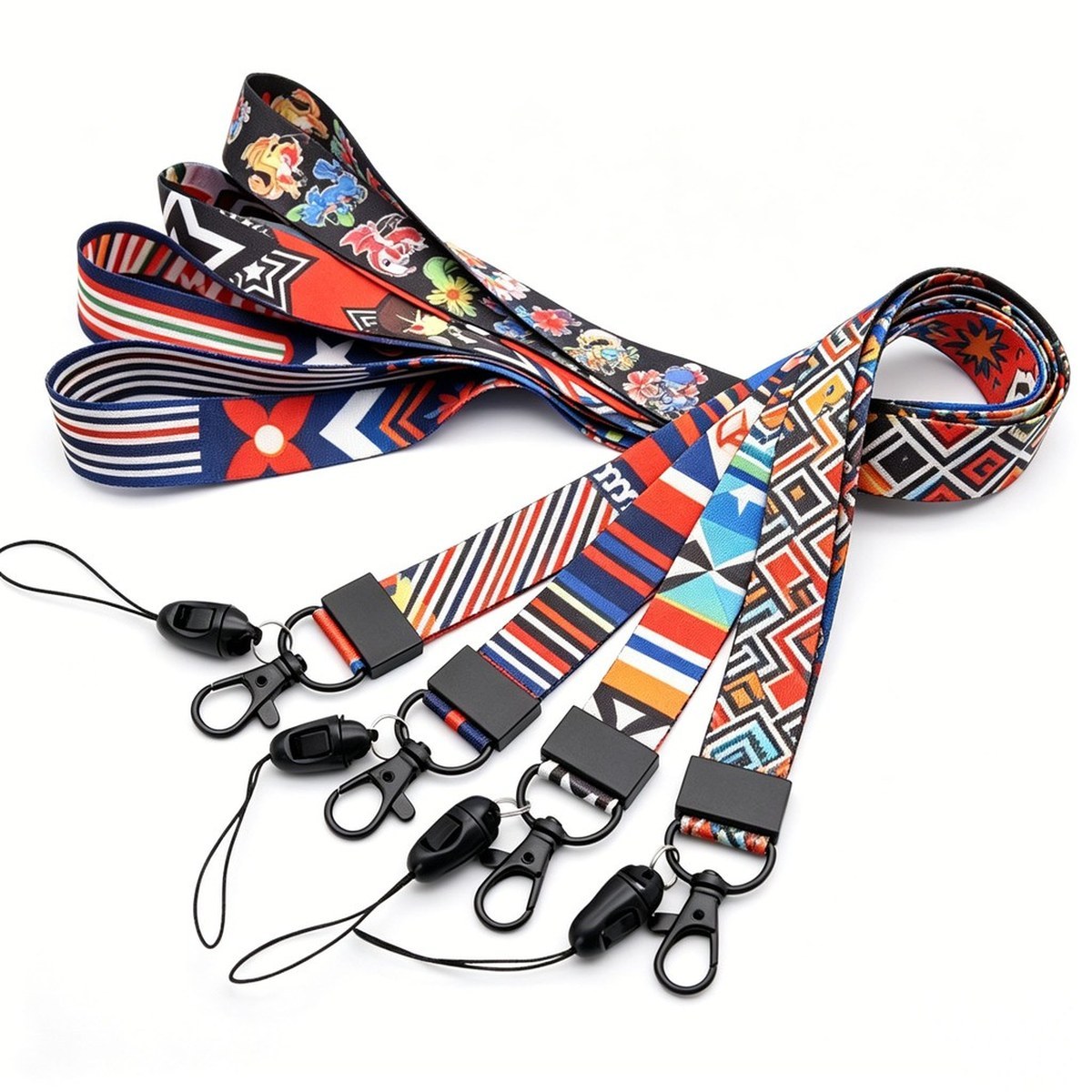
How to Order a Custom Lanyard: Materials, Printing, Attachments, and Sizing
Ordering a custom lanyard is a decision taken against four requirements at once: the badge weight the band has to carry, the print the artwork needs, the attachment that suits the wearer, and the drop at which the badge has to hang. The four constrain one another, so the order they are fixed in decides how many sample rounds the project costs. A print method chosen before the fiber is known will not hold the artwork. An attachment chosen before the badge weight is known will sag or scratch. A length taken from a catalogue will hang wrong on half the people who wear it.
For a program, an event organizer or a distributor placing a repeat order, the comparison is therefore not one quotation against another at the same width. Two lanyards can match on color, logo and length and still differ in whether the print cracks at the fold, whether the clip swings against the badge, and whether the second run matches the first. What separates them is the band construction, the print process, the attachment specification and the color approval method — and the fourth is the one most often left entirely to the factory.
This guide takes the four in the order that avoids rework: what the lanyard has to carry, how fiber and width affect print quality, which print method holds which artwork, how badge weight decides the attachment, how drop is measured on a body rather than on a drawing, and the approval sequence that keeps a repeat order identical to the first.
Start With What the Custom Lanyard Has to Carry
Before material and before print, establish the load and the environment. A lanyard holding a plastic badge in an office is a different product from one holding a phone, a radio or a set of keys on a factory floor, and the difference shows up in three places: the attachment, the seam that closes the loop, and whether the band needs to break away under load.
Three questions settle most of it. What hangs on the end, and how much does it weigh? Where will it be worn — indoors, outdoors, near machinery, around children? And how long does it have to look new, because a three-day trade show and a two-year staff uniform are not the same specification even when the artwork is identical.
- Light load, short life: a badge at a conference. Print quality and unit cost dominate; abrasion resistance barely matters.
- Light load, long life: staff ID worn daily for years. Color retention after washing and the durability of the attachment become the specification.
- Heavy load: keys, a radio, a tool. The seam moves to the center of the design, and a standard swivel hook stops being adequate.
The environment adds the safety question. Any lanyard worn where it could be caught — around machinery, on a site, in a school — should be specified with a breakaway or a separable fastening, and that requirement has to be stated at the brief stage because it changes the hardware and the seam, not just the trim.
Choosing the Material and Width for a Custom Lanyard
Polyester webbing is the default for a reason: it takes dye sublimation better than any other common fiber, it does not stretch under a hanging load, it resists ultraviolet light, and it stays flat against a shirt. Nylon is softer and stronger but absorbs water and prints less crisply. Cotton feels best against skin and holds color poorly through washing. The fiber decision is therefore made by the print method as much as by the hand feel.
Width follows the artwork and the load. Twenty millimeters is the workhorse for a badge, fifteen for a lighter or more formal look, twenty-five where the print has detail to carry or the lanyard holds something heavier than a card. Narrower than fifteen and a detailed logo loses its counters; wider than twenty-five and the band starts to look like a bag strap.
Construction matters as much as fiber. A flat woven band prints on one face and shows a plain reverse; a tubular construction gives a softer, rounder band that can be printed on both faces and sits differently on the neck. The choice is visible in the finished product and almost invisible on a specification sheet, which is why it belongs in the sample stage rather than in the purchase order.
Custom Lanyard Printing Methods and What Each One Can Hold
Four methods cover nearly every custom lanyard on the market, and they are not interchangeable. The right choice depends on how many colors the artwork has, how much detail it carries, how the lanyard will be washed, and how large the run is. The table below sets them against each other on the attributes that decide a reorder.
| Method | Best for | Where it fails | Watch at approval |
|---|---|---|---|
| Dye sublimation | Full-color artwork, gradients, photographs, all-over print | Needs polyester; pale colors on dark grounds | Color shift against the Pantone reference |
| Screen print | One to three spot colors, bold logos, high volume | Thick ink cracks at a fold; fine detail fills in | Ink thickness and edge sharpness |
| Heat transfer | Short runs, multi-color artwork, fast turnaround | Film edge lifts; hand feel stiffens | Edge adhesion after a wash cycle |
| Woven jacquard | Logos that must outlast the band, limited palette | Small text below the weave resolution; color count | Legibility of the smallest letter |
Two practical notes. Sublimation moves color: the ink turns to gas and bonds into the fiber, so the printed result drifts from the on-screen value and has to be approved against a physical dip rather than a PDF. Screen print keeps color far more literally but adds a layer to the band, which changes both the hand feel and how the lanyard slides through a clip.
Custom Lanyard Attachments: Clips, Hooks, and Breakaways
The attachment is the part that gets handled, and the part that generates complaints. Five formats cover most of the market, and each one signals something different to the person wearing it.
- Swivel hook: rotates freely, so the badge stays face forward. The default for ID programs, and the one to specify when the band is printed on both faces.
- Bulldog clip: grips a card or a folder directly, no slot needed. Cheapest, and the first to lose tension.
- Lobster claw: opens wide enough for a key ring or a D-ring. The right choice when the lanyard is sold as an accessory rather than issued as equipment, which is why the webbing lanyards sold at retail almost always carry one.
- Badge strap clip: a flat metal or plastic strip that threads through a card slot. Sits flat, carries almost no load.
- Breakaway fastening: a plastic or magnetic coupling that separates under a sharp pull. Mandatory thinking for schools, hospitals, and any site where a lanyard could be caught.
Hardware finish deserves a line in the brief. Plated hooks corrode at the gate spring in humid climates and on coastal sites; a powder-coated or stainless option costs more and prevents the brown mark that appears on a white shirt after a month. Ask for salt spray hours on the finished part when the lanyard will be worn outdoors or in a kitchen.
Custom Lanyard Sizing: Length, Drop, and How to Measure It
Most sizing disputes come from quoting the wrong dimension. Total length is the full loop, measured flat from clip to clip. Drop is half of that minus the attachment, and it is the number that decides where the badge sits on the chest. A lanyard sold as 900 millimeters total gives a drop of roughly 420 to 430 millimeters once the hook and the seam are accounted for — which on an average adult puts a badge at mid-chest rather than at the waist.
Write both numbers into the specification, with a tolerance. A seam allowance that varies by ten millimeters changes the drop by five, and on a product photographed on a model that difference is visible. It is also worth deciding early whether the length is fixed or adjustable: an adjustable slider solves the fit problem across a workforce and adds a hardware item that can slip.
Custom Lanyard Artwork and Color: From Pantone Reference to Bulk
Textile color is not graphic color. A Pantone number chosen from a coated paper swatch does not translate directly to dyed yarn or sublimated polyester, which is why a lab dip exists: a small piece of the actual band, in the actual color, made the actual way. Approve the dip, not the screen, and state the light source under which approval is given.
Artwork needs three things beyond a logo file. A vector version, because a jacquard or a screen cannot reproduce a raster edge. A clear zone, because a logo placed hard against the selvedge gets clipped by the seam. And a decision about the reverse face: a lanyard printed one side will show a blank back every time it turns, which is fine for an ID program and wrong for a retail product.
For pattern work, remember that the print has to fit the repeat rather than the other way around. A design built on a fifteen-millimeter grid cannot be run on a twenty-millimeter band without either scaling or accepting an uneven margin. Band, print and artwork have to be agreed as a set — which is the practical reason to keep weaving, printing and assembly with one supplier rather than across three. OEM and ODM development under one roof keeps the artwork, the band and the sample in the same conversation.
The Custom Lanyard Approval Sequence That Prevents Rework
Four approvals, in order, and no skipping. Each one locks a variable so that the next stage cannot silently change it.
- Band and color: approve the weave, the width and the lab dip before any print is mentioned. Changing the band after the print is approved resets both.
- Print proof: approve placement, scale and the colors achieved by the chosen method, on the approved band.
- Sewn sample: approve the finished lanyard — length, drop, seam, attachment, and how it hangs on a person.
- Sealed standard: keep the approved sample. Reorders are matched against it, not against a photograph in an email thread.
Most late-stage problems in this category come from a buyer approving a print on a plain band, then changing the band color before production. The proof was correct and the product is wrong, and nobody is at fault in a way that a written sequence would not have prevented.
Custom Lanyard Order Structure and Repeat Runs
A custom lanyard program usually starts with one design and grows into twelve — several colors, two widths, three attachment options. How the quantity tiers are structured across those variants decides whether the program is easy or impossible: a tier counted per color behaves very differently from one counted across the whole order, and mixing widths within a color may or may not count toward the same tier.
Ask about repeat runs at the same time. What stays fixed — the band, the weave, the attachment — and what has to be re-approved — the color dip, the print proof? A supplier who can answer that in one sentence has done reorders before. A supplier who cannot will re-quote the whole product and reset a sampling cycle already paid for in time.
FAQ: Custom Lanyard Ordering Questions
What is the best material for a custom lanyard?
Polyester webbing for most programs. It takes dye sublimation better than any other common fiber, does not stretch under a hanging badge, and resists fading. Nylon feels softer and is stronger but absorbs water and prints less crisply. Cotton suits a natural look and holds color poorly through repeated washing.
What length should a custom lanyard be?
Specify the drop, not just the total length. A 900 mm loop gives roughly a 420–430 mm drop once the hook and seam are counted, which puts a badge at mid-chest on an average adult. Write both numbers with a tolerance, and decide early whether the length is fixed or adjustable.
Is sublimation or screen printing better for a logo lanyard?
Sublimation for full-color artwork, gradients and all-over designs, because the ink bonds into the fiber and adds no thickness. Screen print for one to three spot colors at volume, with a crisper solid and a thicker hand. Screen ink can crack at a fold; sublimation shifts color, so it needs a physical dip at approval.
When does a custom lanyard need a breakaway fitting?
Whenever the wearer could be caught or pulled — schools, hospitals, warehouses, sites with machinery or moving equipment. A breakaway separates under a sharp pull instead of resisting it. Specify it at the brief stage, because it changes the hardware and the seam rather than being added as a trim option later.
How do I keep a repeat order identical to the first one?
Keep a sealed approval sample and a written spec with the band, width, print method, attachment and drop. Reorders should be matched against that sample rather than a photograph. The same question establishes which elements stay fixed and which need a new dip or proof before the second order rather than after it.
Why Programs Build Their Custom Lanyard Range with Xinxiangrui
A custom lanyard is only as good as the brief behind it. The fiber sets what the print can hold, the print method sets the artwork, the attachment sets how the badge hangs, and the drop sets where it hangs. A brief that answers all four samples once, approves against a physical standard, and repeats to the same standard.
Xinxiangrui Webbing has woven narrow fabric in Dongguan since 2011, and the lanyard line runs on the same looms and dye house as the industrial webbing: polyester and nylon bands woven to width, colored by continuous high-temperature dyeing, printed by sublimation, and assembled with hardware in the same plant. That matters most at the artwork stage, where a band, a print and a clip have to agree before a sample can be sewn, and it is why a brief stating the badge weight, the wearer, the artwork and the drop returns as a sewn sample with the color dip approved against a physical standard.