
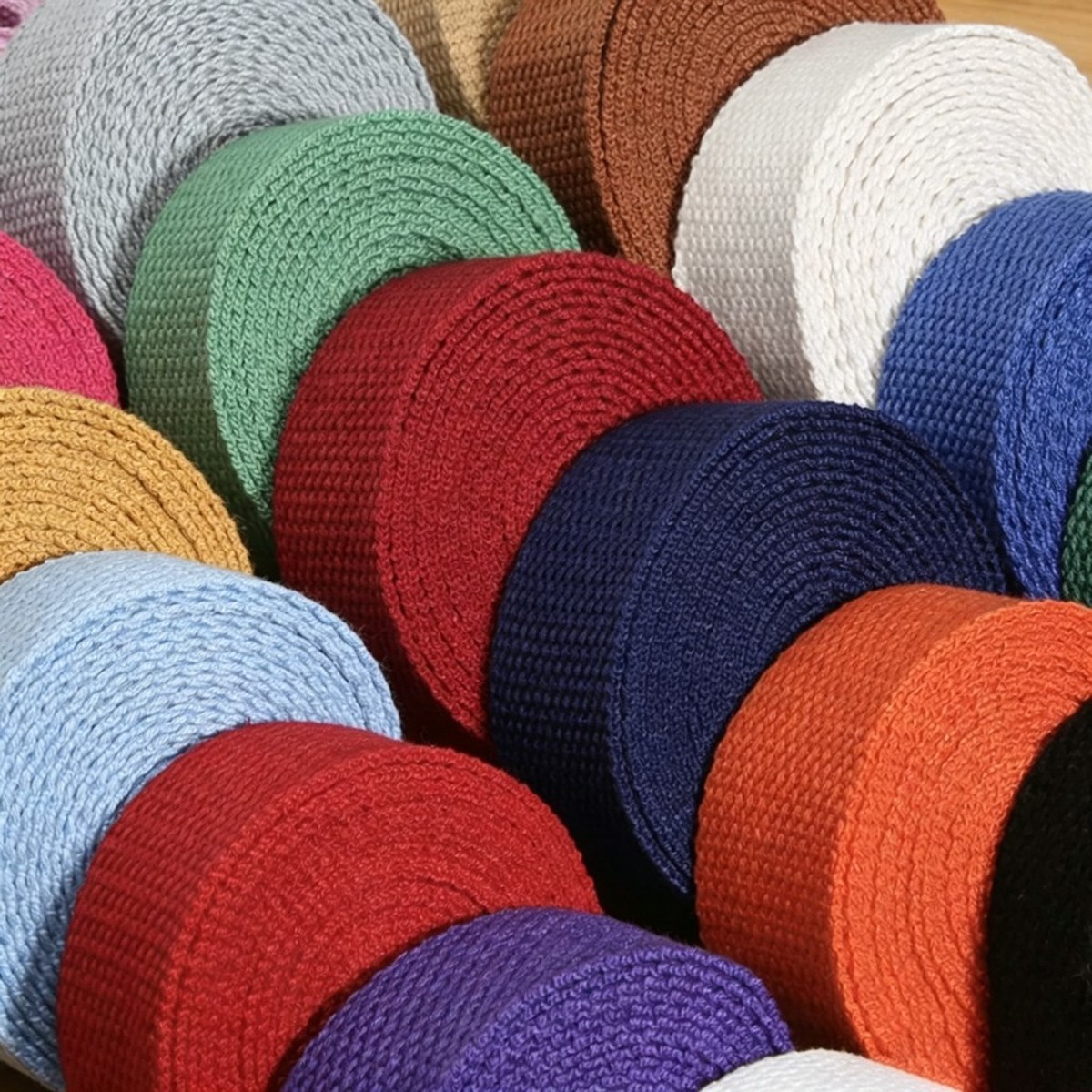
What Is Cotton Webbing and How Do You Choose the Right Type for Your Product?
Cotton webbing carries four requirements at once: a surface that stays comfortable against skin and bag contents, a color that survives the wash cycle the product will actually run, a strength level matched to the hardware it threads through, and a hand feel that reads as natural rather than coated. It is the one webbing fiber specified for comfort and appearance first, with tensile verified afterward rather than leading the decision.
That order matters because cotton sits in products where the band is touched constantly: bag handles, apparel belts, pet collars in natural-tone ranges, apron ties, and binding where a synthetic sheen would look wrong. Not all cotton webbing delivers the same hand or the same wash behavior. Yarn count, weave density, dye method and finish decide whether a band stays flat and colorfast or turns board-stiff, shrinks a band-width, or sheds color onto a light garment.
For a brand or sourcing team, choosing by width and color alone is the expensive path: the width can be right and the band can still misbehave in the wash. The standard that works is three numbers and one finish decision — tensile at the finished width, shrinkage after the specified wash, colorfastness grade, and whether the surface leaves the loom, is dyed or is waxed. This guide explains what cotton webbing is made of, the properties that decide behavior, the grades on offer, and how to specify one against a product.
What Cotton Webbing Is Made Of
Cotton webbing is woven from spun staple yarn, not from the continuous filament used in nylon or polyester. The staple surface is what gives the band its matte, fabric-like face and its absorbency, and it is also why strength per unit weight is lower than a synthetic band of the same thickness. Two construction decisions dominate the result. The cotton webbing range is built on that construction, in widths from narrow binding to 50 mm handles.
- Yarn. Ring-spun cotton in counts chosen for the band weight. A coarser yarn gives a heavier, more textured band; a finer yarn allows a denser weave at the same width and a smoother surface for printing.
- Weave. Plain weave is the default for straps and handles; a twill line is added where the band has to bend around a buckle without going board-stiff. A denser weave raises tensile and edge integrity at the same yarn count.
The selvedge is part of the construction. A woven selvedge keeps the edge stable through washing; a slit edge on a cotton band frays faster than the same edge on a synthetic one, because the staple yarns pull out of the weave rather than melting closed. Where a slit edge is unavoidable, the stitch line should sit far enough from the edge to hold the yarns it releases.
Key Properties of Cotton Webbing
Three properties decide most of the specification: absorbency, shrinkage and strength. Each is a property of the staple fiber, and each has a matching line in a brief.
Absorbency and Comfort
Cotton absorbs a large share of its own weight in moisture, which is why the band feels cool against skin and does not chafe the way a coated synthetic can. The same absorbency is the property to manage: a wet cotton band loses some strength, dries slowly, and holds water against a bag seam. For handles and belts the absorbency is an advantage; for a band that will sit wet for hours, polyester webbing is the more honest choice.
Shrinkage and Washing
Un-treated cotton webbing shrinks on first washing, visibly in length and less in width. A band specified without a shrinkage value returns from the wash shorter than the product it was sewn into, and the product puckers around it. The specification that prevents this is a shrinkage limit after the wash cycle the product will run, plus pre-shrinking at the mill where the limit is tight. Colorfastness belongs in the same line: a yarn-dyed band holds its shade through repeated washing, while a weak reactive dye crocks onto light fabrics at the first rub.
Dye Method and Colorfastness
Three dye routes reach a cotton band: piece dyeing, where the woven band goes through the bath as a whole; yarn dyeing, where the color is in the yarn before weaving; and printing, where color sits on the surface. The order above is also the order of wash durability. Yarn-dyed shades survive the most wash cycles and take patterns without registration risk; piece dyeing is the economic route for solid shades in short runs; printing carries the finest detail but is the first to show wear, which is why a printed band should be tested against the actual care label cycle before it is approved.
Strength and Elongation
Cotton webbing stretches very little under load and does not recover elastically, which makes it predictable in a belt or a handle but unsuited to a load path that needs energy absorption. Tensile is lower than nylon webbing of the same width and thickness, and it drops further when wet. The figure that matters is tensile at the finished width, tested on the assembly, with the wet figure included wherever the product will be washed or used outdoors.
Common Uses for Cotton Webbing
Cotton earns its place where the band is part of what the customer touches, not just what the product is held together with. Five uses account for most of the range.
| Use | Why cotton fits | What to watch |
|---|---|---|
| Bag and tote handles | Comfortable under a loaded bag; matte surface reads as natural | Handle stitch margin; shrinkage against the bag body |
| Apparel belts and ties | Low stretch keeps length true; dyes to deep, even shades | Buckle slot width; edge fray |
| Pet collars in natural ranges | Soft edge against the coat; takes jacquard and woven patterns well | Wet-strength loss; drying time |
| Apron, home and utility ties | Colorfast yarn-dyed shades; comfortable knot | Shrinkage against pre-washed panels |
| Binding and trim on natural-fiber goods | Matches fabric hand; no synthetic sheen | Selvedge stability through washing |
Two of those uses — handles and collars — are also the two where a cotton band meets hardware most often. The band has to seat in the buckle and slide once, not stretch into the frame over the first month, which is another reason elongation is specified low on purpose.
Cotton also pairs with hardware differently from synthetics. Because the band does not stretch into the frame, a slot that fits at delivery still fits in month six; because the fiber does not melt, a hot-cut edge is not available, and ends are sewn, whipped or bound instead. Both points belong in the design conversation before the quote, since they decide the hardware family and the finishing step rather than adapting to them later.
Cotton Webbing Grades and Finishes
The same weave is supplied in four states, and the state decides wash behavior more than the yarn does.
- Loom-state. Undyed and unfinished, the reference condition for shrinkage and strength figures. Suits products the maker will dye or wash themselves.
- Yarn-dyed. Color applied to the yarn before weaving. The most stable shade under repeated washing, and the format for stripes and jacquard lettering.
- Waxed. A wax finish adds water resistance and a firmer hand at the cost of breathability. It relaxes with use and re-sets under heat, so the feel at delivery is not the feel at week six.
- Pre-shrunk. Compacted at the mill so the band arrives at final dimension. The format that pairs with pre-washed garment and bag panels, where any residual shrinkage would show as puckering.
Waxed Cotton Webbing in Service
Wax is a surface decision, not a strength one. It suits tote handles and outdoor-leaning ranges where a bead of water should sit on the surface, and it misfits bands that run through sliders, because the wax migrates and the friction changes. A waxed band is also the one format where the hand at delivery differs most from the hand after a month, which is worth stating on the sample approval rather than discovering in the market.
The same caution applies in the other direction: an unwaxed band is the reference for how the weave itself behaves, and a first sample in loom-state is the cleanest way to see the weave density and the selvedge before any finish sits on top of them. Once the base construction is agreed, moving to yarn-dyed, waxed or pre-shrunk formats is a finishing decision that can be sampled quickly, because the weave underneath has already been signed off.
How to Choose the Right Cotton Webbing
The decision runs in a fixed order, and each step narrows the next.
- Width from the hardware. Measure the buckle and slider slot first. Cotton does not compress the way a softer synthetic can, so the band has to pass the slot at nominal width, not after wear.
- Weave from the bend. Plain weave where the band runs straight; a twill line or a lighter construction where it wraps a ring, a D-ring or a shoulder.
- Dye from the wash. Yarn-dyed for anything washed repeatedly; reserve piece-dyed or printed surfaces for products with a gentle care story.
- Finish from the feel. Pre-shrunk against pre-washed panels, waxed for water beading and structure, loom-state where the maker controls the finishing.
Each of those four steps ends in a number or a named finish, and the sample should be approved against all four at once. A band that passes three and fails the fourth — usually the shrinkage line — still fails the product. The testing page lists the reports that carry those figures, and they are the same reports a sample approval should reference.
Cotton Webbing Specification: Numbers for a Brief
A cotton webbing line is specified in five lines, and each line maps to a property in this guide. A brief that carries all five can be quoted and sampled without a round of clarifications, and the bulk delivery can be checked against the same five.
| Specification line | What it fixes | Why it matters |
|---|---|---|
| Width and tolerance | Band width against the hardware slot | Cotton does not compress into a tight slot the way a softer synthetic can |
| Tensile at finished width | The load rating of the band as woven | Spun yarn, not filament: the figure cannot be inferred from thickness |
| Shrinkage after wash cycle | The dimension the band holds after the care label cycle | The property that decides whether the product puckers around the band |
| Colorfastness grade | Shade stability to washing, rubbing and light | A weak dye crocks onto light fabrics at the first rub |
| Finish state | Loom-state, yarn-dyed, waxed or pre-shrunk | The finish decides wash behavior and hand more than the yarn count does |
One habit keeps the specification honest: ask for the shrinkage and colorfastness figures from the same batch as the tensile report, and keep those reports with the sample approval. Cotton is the fiber where batch variation is largest, because staple yarn and dye uptake both move between lots, and a report from a different lot answers a different band.
FAQ: Cotton Webbing
What is cotton webbing made of?
Spun cotton staple yarn woven into a flat band, usually in plain weave with a woven selvedge. The staple fiber is what gives the band its matte face, its absorbency and its lower tensile compared with a synthetic band of the same thickness.
Does cotton webbing shrink when washed?
Un-treated cotton shrinks on first washing, visibly in length. The fix is a shrinkage limit written into the specification plus pre-shrinking at the mill, so the band arrives at its final dimension before it is sewn into the product.
Is cotton webbing strong enough for handles?
For bag handles, belts and ties, yes, when the tensile is verified at the finished width. It is not the fiber for a high-load or energy-absorbing path; that is where nylon or polyester webbing takes over.
Why does cotton webbing feel better than synthetic?
The staple yarn surface absorbs moisture and holds no coating, so it stays cool against skin and does not chafe. A denser weave and a woven selvedge keep that feel without letting the edge fray.
Can cotton webbing be printed or woven with a logo?
Jacquard weaving puts the logo into the structure and survives washing; yarn-dyed stripes are the other durable format. Surface prints on cotton depend on the dye method and should be checked against the wash cycle in the care label.
Why Buyers Source Cotton Webbing from Xinxiangrui
Cotton webbing is a comfort and appearance fiber with a wash-behavior problem to manage, and both sides of that sentence belong in the specification: tensile and shrinkage at the finished width, colorfastness at the wash cycle, and a finish chosen for the hand the product needs.
Xinxiangrui Webbing has woven webbing in Dongguan since 2011, supplying cotton webbing alongside nylon, polyester and bio-based grades, with yarn-dyed and pre-shrunk formats held against approved dips. Samples are approved against tensile, shrinkage and colorfastness together, so the band that arrives in bulk behaves like the one that was signed off. The cotton webbing range covers binding through 50 mm handles.