
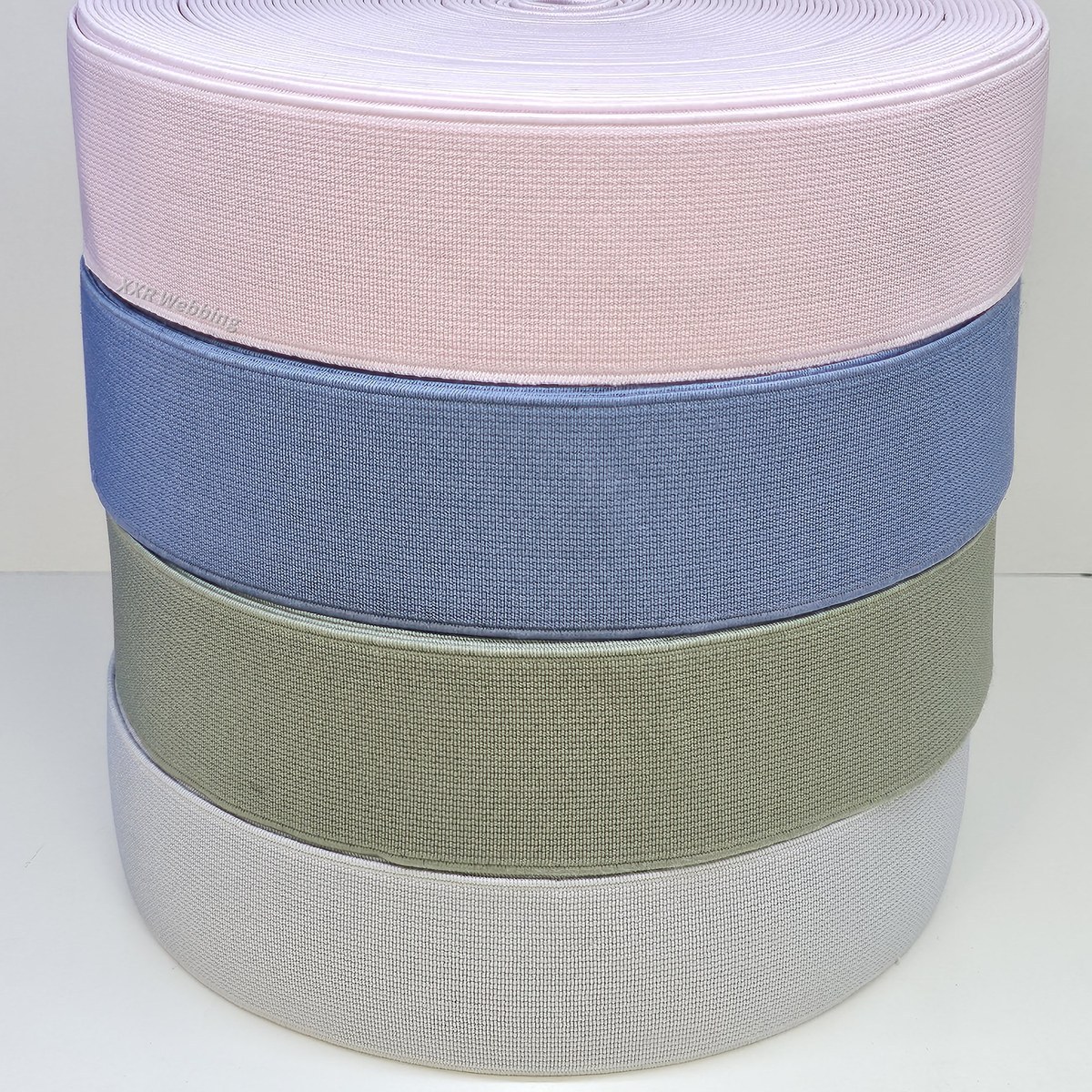
What Is Elastic Webbing and How Do You Choose the Right Stretch and Recovery?
Elastic webbing is a woven or knitted band built to return to its original length after extension, and it is bought against four requirements at once: the extension the product needs, the recovery it has to hold, the number of cycles it will see, and the wash or heat exposure it must survive. Strength is rarely the deciding figure. A band can be strong and still be wrong for the part, because what is being purchased is behavior under repeated stretch — how far it gives, how completely it returns, and how much of that return is lost after a thousand cycles.
For a garment maker, a furniture producer or an orthopaedic brand, the choice is therefore not a comparison of width and hand. A waistband, a seat suspension and a joint support can take the same construction and ask it for three different numbers, and a band approved for one will sag, roll or pinch in another. What separates the three cases is the core yarn, the weave or knit structure, the extension at a stated load, and the permanent set measured after cycling — four values a supplier can declare and a buyer can verify on a table.
This guide explains how elastic webbing is built and what the two core materials give it, separates stretch from recovery, works through the extension each common application actually needs, sets out the four lines an elastic webbing brief has to carry, and answers the questions buyers raise most often.
What Is Elastic Webbing?
Elastic webbing is a narrow fabric built around one or more elastic cores running lengthwise, held in place by a ground structure of harder yarn. The core supplies the stretch; the ground supplies the width, the surface and the strength. That division of labor is the whole design: neither component could do the job alone, and the balance between them is what a buyer is specifying.
The Core and the Cover
Two materials dominate the core. Elastane — spandex — stretches to several times its length and recovers almost completely, and it is usually core-spun with a covering of nylon or polyester so that it can be woven and so that it does not degrade from skin oils and chlorine. Natural rubber stretches further and pulls harder, but it perishes faster, dislikes heat and cannot be dyed. The choice between them is a choice between a long soft life and a strong short one.
The cover does more than protect. Nylon cover gives a softer hand and better abrasion, polyester cover gives better UV and chlorine resistance, and the density of that cover sets how the band feels against skin. This is why two bands with identical stretch can feel completely different in a waistband.
Woven, Knitted or Braided
Woven elastic interlaces the cover yarns around tensioned cores, producing a firm, flat, dimensionally stable band with modest stretch — the classic waistband and suspender material. Knitted elastic loops the yarns, allowing much greater stretch and a softer, thicker hand, which suits underwear, medical and sportswear. Braided elastic crosses the yarns diagonally around the core and is the most forgiving to sew, which is why it turns up in garment assembly rather than in load-bearing work. The structure sets the achievable stretch before any choice of core is made.
Elastic Webbing Stretch and Recovery: Two Numbers, Not One
Stretch is how far a band extends under a stated load. It is easy to measure, easy to quote and, on its own, misleading. Recovery is what the band returns to when the load comes off. A band that stretches 120% and returns to 105% of its original length has lost 5% on the first pull, and at a thousand pulls the loss compounds into the sag that customers describe as "worn out".
The number that ties the two together is permanent set: the residual elongation left after a specified stretch is held and released. It is the single most useful figure in an elastic specification, and it is the one most often missing, because it requires a dwell and a re-measure rather than a single pull. Ask for stretch, recovery and permanent set together; a quote that offers only the first is a quote for half a product.
How Much Elastic Webbing Stretch Does Your Product Need?
The right stretch is not a preference — it comes from how far the product must open to be used, and how much tension it should apply once closed. The table below is a working starting point for common applications.
| Application | Working stretch | Structure | What fails first |
|---|---|---|---|
| Trouser and skirt waistband | Moderate | Woven, firm | Permanent set, felt as looseness |
| Underwear and sportswear | High | Knitted, soft | Cover abrasion where it rubs the body |
| Furniture and upholstery suspension | Low to moderate, but held for years | Woven, heavy | Creep under constant load |
| Orthopaedic and medical bracing | Moderate, controlled | Woven or knitted, skin-safe | Tension loss, then a brace that no longer supports |
| Footwear and gaiters | Moderate, repeated | Woven, firm edge | Edge fray where it is stitched |
| Pet harness and utility straps | Low, safety-limited | Woven with strong cover | Core failure after UV and abrasion |
Apparel Waistbands: Recovery Beats Stretch
A waistband has one job: apply steady, modest pressure for years. That makes permanent set the only number that matters. A band with generous stretch and poor recovery feels comfortable in the shop and loose after a month. Specify a woven structure with a firm hand, ask for permanent set after a held stretch, and resist the temptation to buy extra stretch for comfort — the comfort comes from width and cover softness, not from elongation.
Orthopaedic and Medical: Tension That Has to Stay Put
A brace that compresses correctly on day one and stops compressing by week three is not doing its job, and the mechanism is the same creep that loosens a waistband. Medical work adds two constraints that garment work does not: the cover must be safe against prolonged skin contact, including for sensitive skin, and the band must tolerate repeated washing without losing tension or shedding dye. Specify skin-contact compliance, fastness to washing and permanent set together, and test them on the finished band rather than on the yarn.
Furniture: The Longest Load in the Catalogue
Seat suspension is the most brutal elastic application there is, not because the stretch is large but because the load never comes off. A band held at a fraction of its stretch for eight years will creep, and creep is what a customer sees as a sagging seat. Heavy woven constructions with low stretch and high cover density last; soft high-stretch bands feel good in a showroom and fail in the field. This is also where natural rubber still earns a place, because its elastic pull is stronger at low extension.
Pet and Utility: Stretch Is Not the Feature
Where an elastic band sits in a pet harness or a utility strap, the stretch is usually there to take up slack rather than to move. That means a low-stretch construction with a strong abrasion-resistant cover, and a clear decision about whether the elastic element is load-bearing at all — because an elastic core in a load path is a single point of failure with no backup. For structural webbing, a nylon webbing band with a mechanical adjuster is the safer pattern. Here the cover decides wear life rather than the core: a dense woven cover outlasts a thicker elastic core at the same overall width.
Four Lines an Elastic Webbing Brief Needs
- Stretch at a stated load, given as a percentage, with the load named. "Stretchy" is not a specification and two mills will read it differently.
- Permanent set after a held stretch, with the extension and the dwell time defined. This is the number that predicts whether the product will still fit next year.
- Core and cover, named separately. Elastane or rubber, nylon or polyester cover, and the cover density that sets the hand.
- Wash and exposure regime, since both heat and chlorine attack the core and both are routine in apparel, medical and poolside use.
Elastic Webbing Stretch Ranges by Application
The three figures below travel together, and a brief that states one without the others leaves the supplier free to meet it in a way the product cannot use. The ranges are indicative rather than universal: they describe what most approved constructions achieve at the width and thickness the application normally takes, and they are the starting point for a discussion rather than a substitute for a sample.
| Application | Extension at working load | Recovery to hold | Permanent set after cycling |
|---|---|---|---|
| Garment waistband | 25–35% | 95% or more at one minute | 5% or less after five cycles |
| Furniture seat suspension | 15–25% | 90% or more | 8% or less |
| Orthopaedic and joint support | 30–45% | 92% or more | 6% or less |
| Bag and luggage trim | 10–20% | 90% or more | 8% or less |
| Pet harness gusset | 15–25% | 90% or more | 8% or less |
Read the extension figure first. A waistband that needs 25–35% to sit flat on the body is asking for a different core yarn from a seat suspension that needs 15–25% under a fixed static load, and the two are not interchangeable even at the same width. Read recovery second, because it is the figure that decides whether the band still holds in the second year. Read permanent set last, and read it as a loss rather than a property: it is the share of the original length that does not come back, and it accumulates with every cycle.
The narrowest specification that works is usually the right one. A band specified at 40% extension for a garment waistband will be sewn with more slack than the pattern allows, and it will gather the seam. A band specified at 12% for a joint support will not compress far enough to do its job at all. Where the application sits between two rows, the deciding question is which failure the product can tolerate: a band that has gone slack, or a band that has become tight. That question is easier to answer than a target percentage, and it usually settles the figure in one exchange.
All three figures should be measured on the finished width rather than cut from a wider roll, because weaving and finishing change both the extension and the recovery at the edge. The test methods for elastic webbing set out how each of the three is measured with a ruler and a weight, and the elastic webbing range covers both woven and knitted constructions in the two core materials, so the same figures can be compared across a construction change without re-opening the brief.
FAQ: Elastic Webbing
What is elastic webbing made of?
An elastic core of elastane or natural rubber, held by a woven, knitted or braided ground of nylon or polyester yarn. The core provides the stretch and the ground provides width, surface and abrasion resistance. The properties of the finished band come from the balance between the two.
What is the difference between stretch and recovery?
Stretch is how far the band extends under load; recovery is how much of that it gives back when the load is removed. A band can stretch a great deal and recover poorly, which is why a garment that fits in the shop can be loose a month later. The figure that combines both is permanent set.
Is elastane better than rubber?
Elastane lasts longer, tolerates washing and chlorine better and can be dyed, which makes it the default for apparel and medical use. Natural rubber stretches further and pulls harder at low extension, so it survives in furniture suspension and heavy utility work where long-term elastic pull matters more than appearance.
Why does elastic webbing lose its stretch?
Three reasons, in order of frequency: the core was damaged by heat or chlorine, the cover abraded and stopped protecting it, or the band simply crept under a load that never came off. The first two are process and specification issues; the third is a design issue, and it is the one a permanent-set figure would have predicted.
Can elastic webbing be sewn like ordinary webbing?
Only with care. The band must be sewn under slight tension rather than relaxed, otherwise the seam takes the stretch and pops. A stretch stitch or a narrow zigzag is normal, and the seam should be tested by stretching the finished join rather than by pulling the band on either side of it.
Why Buyers Source Elastic Webbing from Xinxiangrui
Elastic webbing is decided by two numbers, not one. The extension sets how much movement the product allows, and the permanent set sets how long it keeps that movement. A brief that states both, with the wash regime and the load the band will carry, can be sampled once and approved on figures.
Xinxiangrui Webbing has woven narrow fabric in Dongguan since 2011, supplies elastic and non-elastic constructions from the same plant, and tests stretch, recovery and colorfastness in-house. A brief that states the application and the extension returns a band with the permanent-set figure attached, and the elastic webbing range covers woven and knitted constructions with stretch data measured in-house rather than quoted from a catalogue.