
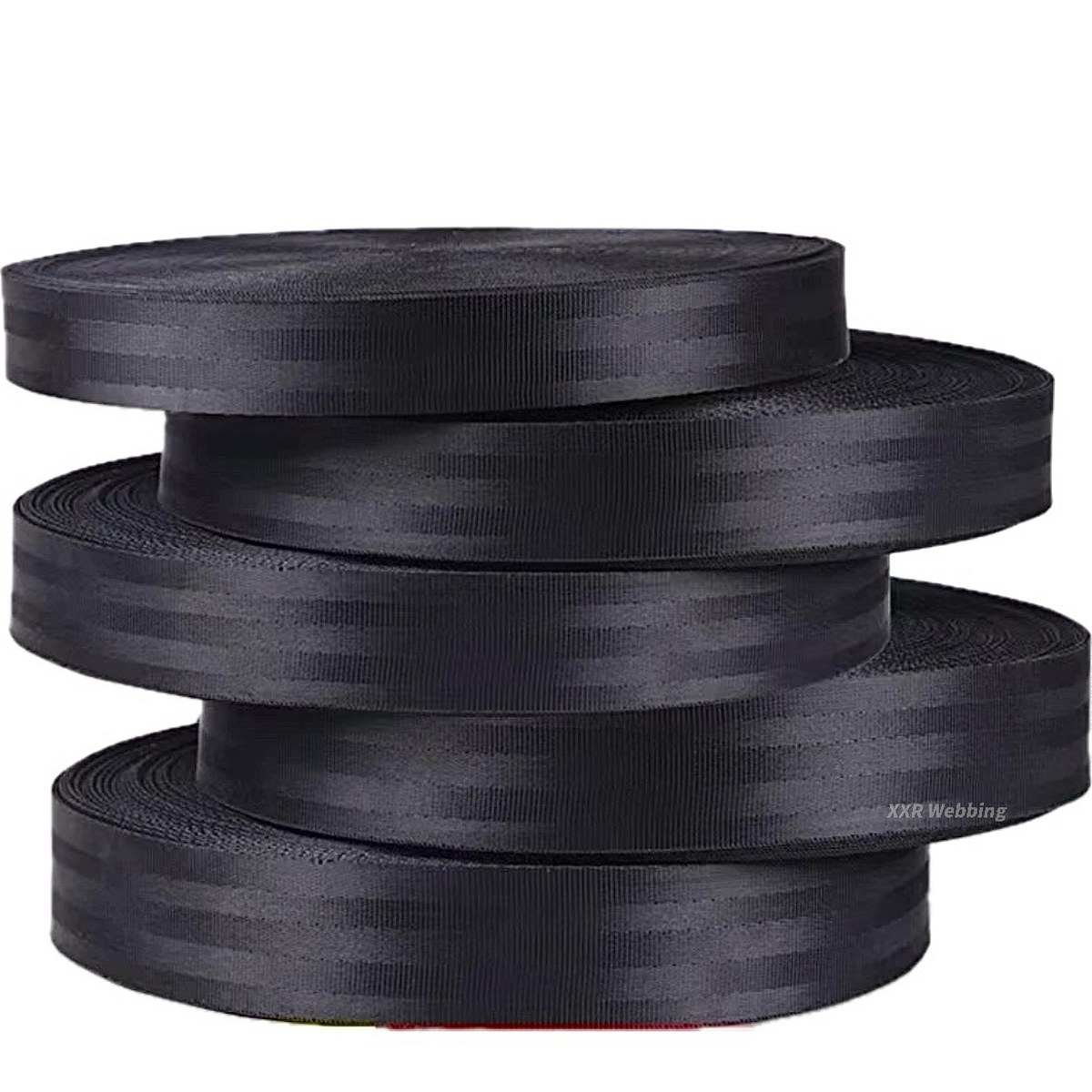
What Is Nylon Webbing? Key Properties, Common Uses, and Limitations
Nylon webbing is a flat woven strip of polyamide yarn, bought against four requirements at once: load per unit width, abrasion life at the rub point, elastic recovery under repeated load, and a hand soft enough for the part it is sewn into. No other common webbing fiber meets all four as far into the load range, which is why nylon appears on shoulder straps, pet gear, slings and luggage rather than on awnings or boat covers. Not every nylon band meets that brief equally. The polymer grade, the warp density, the edge type, the finish and the seam each change what the finished band does after a season in service.
For a brand, a converter or a product engineer writing a specification, the comparison is therefore not one roll against another at the same width. A 25 mm band can be rated well beyond the working range of the hardware it feeds and still fuzz through at the adjuster inside a year, because strength is carried by the yarn while durability in service is decided at the face, the edge and the stitch line. A supplier that can name its polymer grade, its ends per centimeter and its edge construction is describing a product; one that answers with a width and a color is describing a warehouse line.
This guide explains what nylon webbing is made of and how it is woven, the difference between nylon 6 and nylon 6.6, which properties govern service life and how each is measured, the applications that account for most of its consumption, the four limitations that make another polymer the better answer, and the six lines a mill can quote without further questions.
What Is Nylon Webbing Made Of?
Nylon webbing is a woven textile in which polyamide multifilament yarns form both the lengthwise warp and the crosswise weft. The warp carries the load, which is why warp density — ends per inch — sits behind every strength figure a mill quotes. The weft holds those warp yarns into a flat ribbon and determines how the band behaves mechanically: a dense weft produces a firm, self-supporting strap, while a loose weft produces one that folds and drapes. Neither is preferable in principle. A luggage strap normally requires the first; a dog collar requires the second, because a stiff band abrades coat hair at the neck.
The material itself is a polyamide, and polyamides are what give the category its identity: high tenacity, good elastic recovery, excellent abrasion resistance, and a melting point low enough to be shaped with heat. Those four facts explain most of what follows, including the limitations.
How Nylon Webbing Is Manufactured
Two production routes produce two different edges, and the edge is more consequential than most specifications acknowledge. A needle loom weaves the tape at its final width, so both selvedges are woven and cannot unravel. Widths are limited to roughly 10–50 mm, and the woven edge is the most abrasion-resistant part of the band — which is also the point where a buckle, a ring or ground contact concentrates wear. A wide shuttle loom weaves a broad sheet that is then slit into tapes. One warp yields many widths and the cost falls, but every slit edge must be heat-sealed, and that sealed line is the thinnest and most brittle feature on the product.
After weaving comes finishing: scouring, dyeing, calendering, and any performance treatment the buyer has asked for. Finishing is where a commodity band becomes a specific product, and it is also where a large share of complaints originate, because each treatment buys one property by spending another.
Finishes and Their Effect on Performance
- Stiffening and resin: turns a soft tape into a self-supporting handle. It also shortens flex life, so a resin-loaded strap creases permanently where it is folded around a D-ring.
- Calendering: heat and pressure close the weave, giving a smooth face, sharper print and far less fray. The trade is a slightly slicker surface, which changes how the band grips an adjuster.
- Water repellent: useful outdoors, but it also slows drying from the inside and can leave a visible edge where the treatment stops.
- Anti-microbial and flame retardant: both are chemistry added to the fiber surface. Both need to be declared on the finished product, and the flame-retardant version usually loses a measurable amount of tensile strength.
- Softening: the route for baby carriers, skin-contact straps and pet collars. Softener reduces abrasion resistance in exchange for a softer hand, so it is appropriate where the band contacts skin or hair rather than hard surfaces.
Nylon 6 and Nylon 6.6 Are Not Interchangeable
Both polymers are polyamides and both are sold as "nylon webbing", but they behave differently. Nylon 6.6 melts around 255 °C and is stiffer and more dimensionally stable, which is why load-bearing slings and high-heat uses specify it. Nylon 6 melts around 220 °C, dyes more levelly and gives a softer hand, so most soft trim — bag binding, pet collars, garment straps — is nylon 6. A quotation that names only "nylon", without the polymer grade, leaves both the temperature ceiling and the stiffness undetermined.
Key Properties of Nylon Webbing
The table below summarizes service behavior rather than laboratory values. A datasheet reports one figure per property, measured under conditions the finished product rarely encounters; the columns here describe how the material performs in use, and which figure a specification should require instead.
| Property | How nylon behaves | Where it shows up | What to ask for |
|---|---|---|---|
| Tensile strength | High for its weight, set by warp density and yarn tenacity | The load path in slings, straps and pet gear | Break strength at the finished width, on the sewn assembly |
| Elongation | Stretches well into double figures before breaking, then recovers most of it | Shock absorption in a fall; a band that feels alive under load | Elongation at working load, not only at break |
| Recovery and creep | Recovers quickly from a pull, less completely from sustained tension | Straps that hang longer at the end of a season | Permanent set after 24 hours held at rated load |
| Abrasion | Very good, and better than most fibers when wet | Rub points at buckles, ground contact, lashing edges | Cycles to visible yarn break, tested at the edge |
| Heat | Softens well below its melting point, and melts rather than burns | Hot cutting, ironing, interior trim near an engine or a heater | Continuous service temperature, and shrinkage at that temperature |
| Moisture | Absorbs roughly 4% of its weight and swells, then dries slowly | Length growth, dye bleed, mildew in closed storage | Dimensional change after wetting and drying |
| UV resistance | Moderate, and the loss is cumulative and irreversible | Outdoor gear, garden furniture, anything stored on a balcony | Hours under xenon arc to 50% strength retention |
| Dye uptake | Takes color deeply, including dark shades that polyester struggles with | Brand colors and Pantone matching | Fastness to light and to washing, and the light source for approval |
Strength, and Where It Gets Spent
The figure on the roll is not the figure on the product. A 25 mm nylon webbing in a standard construction is commonly quoted at 2000N+ break strength, and that number describes a clean strip pulled between two grips. Put the same band into a bag handle and the load path runs through a seam and a metal ring, both of which concentrate stress. In practice the seam decides the rating, which is why a band that passes on the roll can fail on a loaded shoulder strap without anything being wrong with the weaving.
Stitching is the second place strength leaks. Every needle punch through a woven tape cuts warp yarns, and a row of stitches across the full width is a line of reduced cross-section. Bar-tack, box-X and short rows outside the load line all exist to keep that line from becoming a tear line. The weave provides the strength; the seam determines how much of it reaches the hardware.
Elongation, Recovery and the Shock Problem
Two applications can require opposite behavior from the same property. Fall protection requires elongation, because stretch is how a band absorbs energy without passing the peak to a body. A luggage strap requires the opposite, because a strap that has grown is a bag that drags. Nylon sits at the elastic end of the range: it stretches through a double-digit percentage before breaking, then recovers most of that extension when the load is removed. This is advantageous in a shock-loading application and problematic where dimensions are critical.
Recovery is the second component of the property, and the one less often specified. Under a sustained load — a ratchet strap left tight over a pallet, a tote handle carrying books for a year — nylon creeps, and a measurable part of the creep does not come back. If a finished length has a tolerance, specify it after a dwell at the working load rather than straight off the loom.
Abrasion Resistance and Edge Durability
Abrasion resistance in webbing is not uniform across the width. A woven selvedge is a folded, interlocked structure and is the most durable part of a needle-loom tape. A heat-sealed slit edge is a thin fused line, brittle by nature, and it sits precisely where an adjuster slides, a ring rotates or the ground makes contact. Testing the face of the band and approving on that result is one of the most common quality errors in the category, because the face is the part that rarely fails first.
Moisture, Heat and Sunlight
These three compound rather than simply add. Wet nylon is roughly a tenth to a fifth weaker than dry nylon and slightly longer, because water molecules push between polymer chains. Dry it and most of the length returns, but not all, and the strength that comes back depends on how hot it got while drying. Leave the same band in sun for a season and the loss stops being reversible at all. A product used wet, dried in sun and stored damp meets all three mechanisms simultaneously, which is why marine covers and pet leashes deteriorate faster than datasheet values suggest.
Common Uses for Nylon Webbing
The same band appears in six industries, and each one pulls a different property to the front of the specification. That is the useful way to read the category: not as a list of products but as a list of requirements that happen to share a material.
| Application | Typical width | Property that matters most | Where it fails first |
|---|---|---|---|
| Luggage, bags and shoulder straps | 25–50 mm | Abrasion, thickness for hardware, color fastness | Fray at the adjuster, then at the seam |
| Pet collars, leashes and harnesses | 15–38 mm | Soft hand plus strength, dye safety | Stiffening or shrinkage after washing |
| Safety harnesses and slings | 45–50 mm | Controlled elongation, certified construction | The seam and the hardware, rarely the band |
| Outdoor, camping and tactical gear | 20–50 mm | UV and moisture behavior, weave regularity | Sun degradation along the exposed face |
| Cargo ties and automotive | 25–50 mm | Strength per width, heat tolerance, creep | Creep under sustained tension |
| Furniture, medical and orthopaedic straps | 20–40 mm | Soft edge, washability, skin-contact safety | Color bleed and curl in repeated washing |
Luggage, Bags and Straps
This is the largest single application and the most demanding on consistency, because the band remains visible in the finished product. Color is evaluated on a shoulder strap before any other property, so fastness to light and to rubbing carry as much weight as tensile strength. Thickness becomes a hardware issue: a strap that finishes at 2 mm feeds an adjuster that a 2.5 mm strap jams, and the difference is often a finishing step rather than a different weave.
Pet Products
Pet products place the two sides of nylon in direct conflict. The strength is necessary — a strong dog can transmit several times its body weight through a collar — and the same high tenacity that provides that strength also produces a firm edge that abrades coat hair at the neck. Softening, a rounder selvedge and a slightly lower warp density resolve this without significant loss of strength. Products that pair nylon with reflective webbing usually keep the same base construction and change only the yarn in the stripe.
Safety and Load-Bearing Gear
Load-bearing work is a different discipline. Every figure has to be traceable to a test method, elongation has to be controlled rather than merely reported, and the construction is usually fixed by a standard rather than chosen by a designer. This is also the segment where nylon's stretch is an asset: energy absorbed by the band is energy not passed to the wearer. Buyers in this category should expect batch traceability and in-house tensile testing to be part of the offer, not an optional extra.
Limitations of Nylon Webbing
None of the limitations below constitutes a defect. Each is a documented trade that accompanies the polymer, and each is predictable enough to be designed around once it is identified. Difficulties arise when nylon and polyester are compared on a single quotation line and all other factors are assumed equal.
It Grows When Wet and Does Not Fully Come Back
Nylon absorbs water into the fiber, the fiber swells, and the tape lengthens. Dry it and most of that length returns, but a residual set stays, and repeated wet–dry cycles accumulate it. Anything with a cut length tolerance — a strap sold as 1200 mm, a leash cut to a standard — needs that allowance written into the specification. Polyester, which absorbs almost nothing, does not have this problem, and it is the usual reason a wet-use product switches material.
It Degrades in Sunlight Faster Than Polyester
Ultraviolet light attacks the polyamide chain directly, and the damage does not recover. A band left outdoors for a season can lose a large share of its strength while appearing almost unchanged, so the loss is difficult to detect visually. For awnings, boat covers, garden furniture and anything that lives outside, polyester is the safer default; for products that are used outside and stored inside, nylon's other advantages usually win.
It Is Difficult to Print On
The weave is a topography, not a surface. Ink sits on the crowns of the yarns and disappears into the valleys between them, so fine detail and small text break up. Calendering flattens the weave and helps, and a coated or laminated face helps more, but the practical limit stays coarse: bold shapes, generous stroke weights, no hairlines. If a design depends on a sharp logo, the answer is usually a woven or printed label, or a jacquard construction rather than a print.
Heat and Chemicals Set a Hard Ceiling
Nylon softens well below its melting point, so a band that is dimensionally stable at room temperature can shrink or glaze at the temperature of a hot iron or a poorly controlled drying tunnel. It is also sensitive to strong acids and to some phenols, and it will not tolerate prolonged contact with bleach. These are not exotic conditions — they occur in laundry, on a finishing line, and in a warehouse where a spilled drum is cleaned with an unspecified agent.
It Is Not the Lowest-Cost Option
Polypropylene costs less and polyester sits close to nylon while offering better UV and moisture behavior. Nylon justifies its position on abrasion resistance, on softness at high strength, on dye depth and on elastic recovery rather than on cost. Where a product will be washed, dried, printed and folded, polypropylene is often the more appropriate answer; where it will be dragged, the calculation changes. Matching the material to the abuse profile is the entire decision.
Nylon Webbing Specification: Six Numbers for a Brief
A brief containing these six items can be quoted without further clarification, and a sample produced against it can be assessed objectively rather than debated.
- Width and thickness, both with a tolerance. State the hardware the band must pass through, because that fixes the ceiling more tightly than any preference does.
- Polymer: nylon 6 or nylon 6.6, with the reason. The reason matters, because it tells the mill which end of the finish range to work from.
- Break strength at the finished width, measured on the sewn assembly where the product is loaded through a seam.
- Elongation at working load, not only at break, plus the permanent set allowed after a dwell at that load.
- Color reference and fastness: a Pantone or a physical standard, the light source for approval, and the fastness ratings to washing and to light.
- Finish and edge: woven selvedge or sealed slit edge, calendered or not, and any performance treatment with its effect on hand stated.
FAQ: Nylon Webbing
Is nylon webbing stronger than polyester webbing?
Per unit weight, nylon is generally the stronger of the two, and it is also the tougher — it absorbs more energy before it breaks and resists abrasion slightly better. Polyester is stiffer, holds its length when wet and resists UV for longer. So "stronger" depends on whether the load is a sudden shock or a long steady pull, and on whether the product lives in the sun.
Does nylon webbing stretch?
Yes, and by a larger margin than is commonly assumed. It stretches through a double-digit percentage before breaking and recovers most of that when the load is removed, which is why it suits shock-absorbing applications and complicates dimension-critical ones. Under sustained tension it also creeps, and part of that creep is permanent.
What width should I order?
Width follows the hardware and the load, in that order. Measure the slot the band must pass through and subtract the clearance the adjuster needs, then check the resulting width against the load it will carry. For pet and bag trim the working range is usually 20–38 mm; for load-bearing straps it is usually 45–50 mm.
Can nylon webbing be matched to a Pantone color?
Yes, and nylon takes deep shades more easily than polyester. What needs agreeing in advance is the light source for approval and the fastness standard, because a shade that matches in a workshop can shift under daylight, and two constructions with the same dye recipe will not necessarily land on the same shade.
What are the main limitations of nylon webbing?
Four matter in practice: it lengthens when wet and keeps part of that length, it degrades under prolonged UV exposure with no recovery, it does not hold fine printed detail, and it softens at temperatures that occur in ordinary ironing and drying. All four are predictable, and all four can be designed around once they are written into the specification.
Why Buyers Source Nylon Webbing from Xinxiangrui
Nylon webbing performs as its specification defines it. The grade sets the temperature ceiling, the warp density sets the strength, the edge determines where abrasion starts, and the seam decides how much of the rated load reaches the hardware. A brief that names all four can be quoted without further questions, sampled once, and repeated without drift.
Xinxiangrui Webbing has woven webbing in Dongguan since 2011, with needle looms that produce a woven selvedge and a dye line that holds one Pantone across different constructions. Nylon 6 and 6.6 are both available, tensile and colorfastness are tested in-house, and OEM and ODM work is quoted from the six-line brief above rather than from a photograph.