
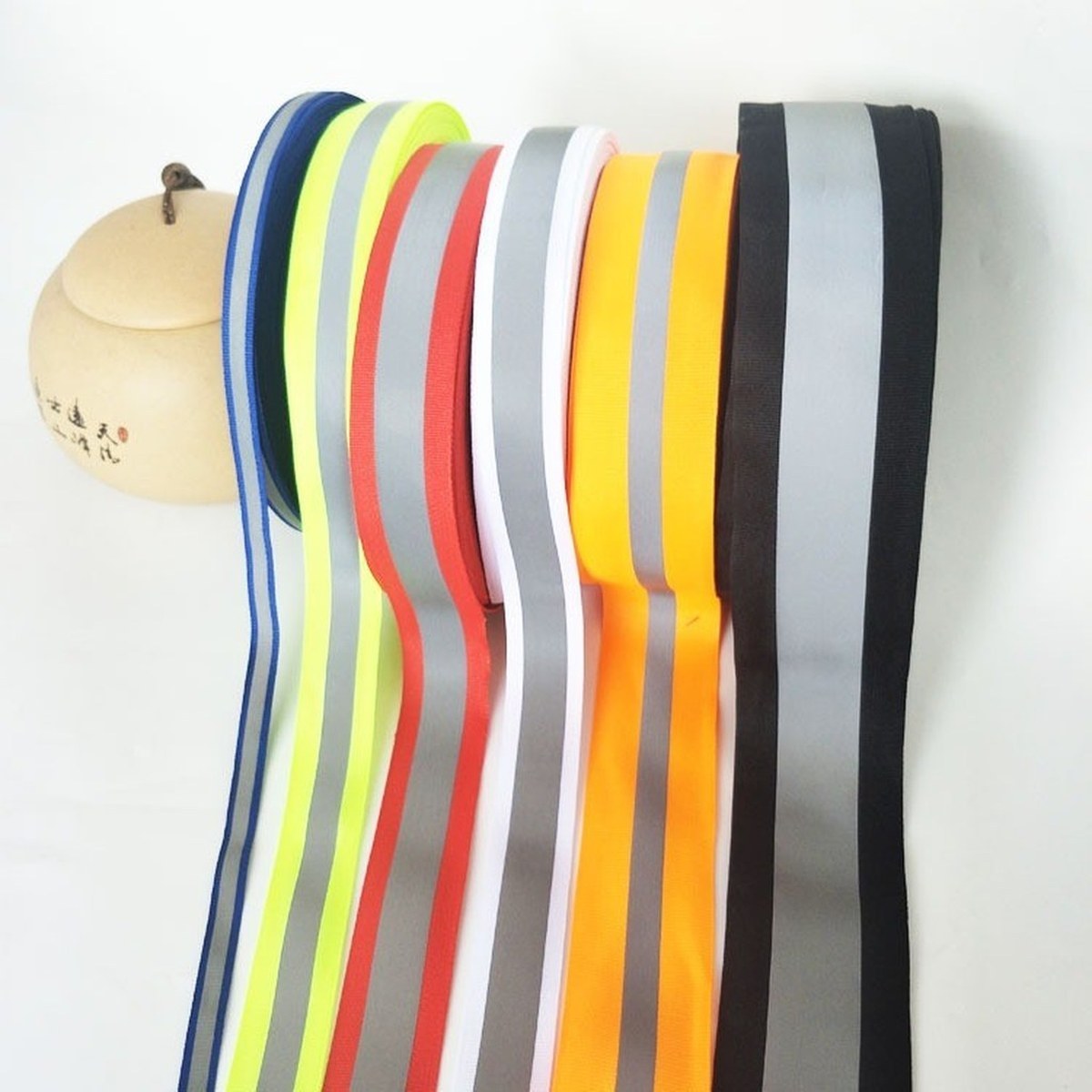
What Is Pet Reflective Webbing and How Does It Improve Pet Safety?
Pet reflective webbing is a woven band with a retroreflective element built into it — glass-bead yarn placed during weaving, or a reflective tape bonded to the surface — and it is bought against four requirements at once: visibility at the distance a driver needs to react, retention of that visibility through washing and abrasion, comfort where the band contacts the dog, and a base construction strong enough for the part it is sewn into. The mechanism is retroreflection. Light returns toward its source instead of scattering, which is why the band reads bright in a headlight and stays dark in ambient light.
For a pet brand, a wholesaler or a manufacturer, the choice is therefore not a comparison of how bright a sample looks on a card. Brightness depends on the observation angle, on where the element sits relative to the light source, and on how much of it survives the first twenty washes. Two bands that read the same under a phone camera can differ by a factor of three in measured retroreflection, and only one of them still reads at forty meters on a wet road.
This guide explains what pet reflective webbing is, how the optics work, where the element belongs on a collar, a harness and a leash, how to judge a sample without a photometer, and the checks a sourcing decision should rest on.
What Is Pet Reflective Webbing?
Structurally, pet reflective webbing is ordinary narrow fabric with one substitution: part of the yarn, or part of the surface, is replaced by a retroreflective material. Everything else — the weave, the width, the tensile behavior, the dyeing — follows the same rules as any other webbing. That is why a reflective band can be specified to the same strength and hand feel as its plain equivalent, and why the reflective element is a design decision rather than a separate product category.
The reflective component itself is either a yarn carrying retroreflective material, or a film tape laminated or sewn to the face of the band — which is why pet reflective webbing is specified as a construction rather than a single material. Both return light to its source; they do it with different optics, different durability and different cost structures, which is the subject of the comparison further down.
What Materials Are Used in Pet Reflective Webbing?
Three layers make up the product, and each one can be specified separately. The carrier band is nylon or polyester, occasionally cotton or polypropylene: nylon for strength and a soft hand, polyester for stability in wet conditions and better color retention in sunlight. The reflective element is glass microspheres or a microprismatic film. The finish is either nothing, a dye that leaves the reflective zones clear, or a coating that adds water resistance at the cost of some flexibility.
The two families of reflective material behave differently enough that the choice should be made early. Glass-bead reflective uses millions of tiny spheres with a mirror backing; the light enters, bounces off the backing and exits back toward the source. It is flexible, forgiving of curvature, and broad in the angles it answers from. Microprismatic reflective uses molded cube-corner geometry instead of beads; it returns more light in a narrow cone, which makes it visibly brighter at distance but stiffer and less tolerant of tight folds.
For a collar that bends around a neck or a harness strap that folds through a buckle, that flexibility difference decides more than the brightness figure does. A stiffer film that cracks at a fold line stops being reflective exactly where the product flexes most.
How Is Reflective Webbing Different from Standard Pet Webbing?
The difference is smaller than buyers expect and larger than suppliers admit. Mechanically, the reflective version is the same band with an addition: the weave density is close, the tensile strength is close, the hand feel is close. Optically, it is a completely different product, because the band now has a surface whose behavior depends on angle, cleanliness and wear.
Three practical differences matter in production. First, the reflective zone cannot be dyed like the rest of the band, so color and reflectivity have to be planned together rather than in sequence. Second, the reflective element adds thickness, which changes how the band feeds through a buckle and how it sits under a stitch line. Third, the reflective surface is the most abrasion-sensitive part of the product, so it needs protection at the points where the band rubs against hardware.
The one property that does not change is the load path. A reflective band still has to carry the load, hold a stitch, and survive the wash — which is why a reflective product that fails usually fails for ordinary reasons, not for optical ones.
What Are the Common Types of Reflective Webbing?
Most of the market sits in five constructions, and each one exists because it solves a different manufacturing problem:
- Woven reflective yarn: a reflective yarn is woven in as a weft stripe during the weaving. Nothing is added afterwards, so it cannot peel, and the stripe is as old as the band itself.
- Bonded reflective tape: a retroreflective film laminated to one face. The brightest option and the most design-flexible, with edges that need to be protected.
- Reflective edge binding: reflective tape folded over the selvedge or the seam. Cheap in material, strong in side visibility, and the first thing to wear at a contact point.
- Two-tone or segmented weave: reflective zones interrupted by plain zones, usually to form a pattern, a logo or a repeat. Good for design-led ranges, harder to keep consistent across a long run.
- Reflective jacquard and printed combinations: a woven or printed base with reflective yarn placed inside the pattern. This is the construction that lets a brand treat visibility as part of the artwork rather than as an add-on.
How Does Pet Reflective Webbing Work?
The mechanism is retroreflection, and it is worth understanding properly because almost every quality argument in this category comes back to it. Ordinary surfaces scatter light in all directions. A white band is visible because it scatters a lot of light; it is not bright in the sense that matters at night, because the fraction returning to the driver is tiny. A retroreflective surface sends a large share of the incoming light back along the path it came from — which is exactly the path to the driver's eye.
How Retroreflective Materials Reflect Light Toward Its Source
In a glass-bead construction, light passes through the front of a transparent microsphere, hits a reflective layer behind it, and is returned through the same sphere roughly back along its incoming direction. The bead acts as a lens; the backing acts as a mirror. The precision of that pair determines how much light comes back and how wide the cone of useful return is.
In a microprismatic construction, three mutually perpendicular faces form a corner that bounces light back through two reflections instead of one. The geometry is more efficient in a narrow cone, which is why prismatic films dominate road signs and high-visibility workwear where the light source and the viewer are close together and roughly aligned.
One consequence follows for pet products: the useful measure is not total light returned but light returned within the geometry of a real encounter — headlights at some distance, driver's eye offset from the lamp. That quantity has a name, the coefficient of retroreflection, measured in candela per lux per square meter, and it is what a test report should quote.
Reflective Yarn vs Reflective Tape: What Is the Difference?
This is the decision that shapes the rest of the specification, so it is worth setting out side by side rather than in prose. The table compares the two on the attributes that show up in a complaint six months after launch.
| Attribute | Woven reflective yarn | Bonded reflective tape | What it decides |
|---|---|---|---|
| Peak brightness | Moderate | High | Distance at which the product first reads |
| Angular range | Wide, forgiving | Narrow, direction-sensitive | Whether it works off-axis and on a twist |
| Edge behavior | No edge to lift | Edges lift first | Service life after repeated washing |
| Flexibility | Follows the weave | Stiffens the band | Performance at tight folds and buckle returns |
| Stitching | Can be sewn through | Needles perforate the film | Where seams may cross the reflective zone |
| Design freedom | Stripes, patterns, jacquard | Any shape, logos, curves | How much the design has to bend to the material |
The short version: yarn wins on durability and angular range, tape wins on peak brightness and design freedom. A product that will be washed weekly and used in the rain leans yarn; a product sold on a dramatic night-time photograph leans tape, provided the tape is edge-sealed and placed where it does not fold.
How Do Viewing Angle, Light Source, and Webbing Placement Affect Visibility?
Three variables decide whether a reflective band does anything at the moment it matters. The entrance angle is how far the light arrives from straight-on; a headlight further down the road hits the band at a steeper angle than one ten meters away. The observation angle is the separation between the lamp and the driver's eye, and it grows as the car gets closer. Both push the material out of its best geometry, and both are why a band that looks brilliant in a photograph looks ordinary at forty meters.
Placement is the variable the designer actually controls, and it matters more than the grade of material. A reflective stripe on the outer face of a collar is visible from the side, which is where a vehicle approaching at an intersection will be. The same stripe disappears when the leash rotates through ninety degrees, which is why a single center stripe on a leash gives intermittent visibility rather than continuous visibility.
The practical rule that follows: place reflectivity where the product faces outward on three sides rather than one — two selvedge stripes plus a center element, or a wrap that covers a fold. And keep it out of the zones that are covered by a buckle, a ring or a padded panel, because a hidden reflective zone is indistinguishable from no reflective zone.
How Does Pet Reflective Webbing Improve Pet Safety?
The safety case is narrower than marketing usually claims and stronger than sceptics allow. Reflective webbing does not stop a car, does not make a dog visible in fog at close range, and does not replace a lead. What it does is buy time: it extends the distance at which a driver registers that something is there, and time-to-react is the variable that decides most low-light incidents.
Improving Visibility During Nighttime Walks
A dark dog on a dark sidewalk is a shape without contrast. Most of what makes it visible during the day — color difference, texture, movement — collapses once the light drops, and what remains is silhouette against whatever is behind it. A reflective band inserts a high-contrast element that appears only when a light source is present, which is exactly when the contrast is needed.
The effect is strongest at the moment of a headlight sweep and weakest in ambient light. That is not a defect; it is the mechanism. The band is passive, requires no battery, and never needs switching on, which is why it outperforms a light that runs out of charge in a drawer.
Helping Drivers and Cyclists Notice Pets in Low-Light Conditions
Drivers and cyclists scan for familiar signals: lamps, reflectors, the retroreflective patches on a jacket, the white lines on the road. A dog wearing retroreflective webbing enters that visual vocabulary, because it returns light in the same way the objects a driver is already trained to notice do. That familiarity is worth more than raw brightness — a signal that looks like road furniture gets processed faster than an unfamiliar glow.
Cyclists benefit from a different geometry, since their lamp sits low and their eye is close to it. A low-mounted reflective element on a leash or a harness girth answers a bicycle lamp better than a high collar stripe, which is one reason coverage across the product matters more than a single bright patch.
Supporting Safer Walking in Urban Areas and Outdoor Environments
In a city, the risk is lateral: a dog stepping off a curb between parked cars, or emerging from a doorway into a turning vehicle's path. Side-facing reflectivity addresses that directly, and it is the direction most products under-serve because a center stripe reads better in a product photo than an edge stripe reads on a street.
Outdoors, the risk profile changes to oncoming traffic on an unlit road and to losing sight of the dog off-lead. A reflective band helps with the first and only marginally with the second, where an active light is the better answer. Being honest about that boundary is part of selling the product well: reflective webbing is a passive visibility layer, not a tracking device.
What Are the Limitations of Reflective Webbing?
Four limits are worth stating plainly, because a product that overclaims invites the complaint that follows.
- It needs a light source: no lamp, no return. On an unlit path with no traffic, the band is simply dark.
- It degrades with surface wear: abrasion, dirt and repeated washing all reduce return. The band does not fail suddenly; it fades out of usefulness.
- It is directional: a twisted leash or a covered panel can present a non-reflective face at the worst moment.
- It is not a standard: high-visibility garment standards are written for clothing, not for pet products, and citing them on a leash is a claim that will not survive scrutiny.
Where Pet Reflective Webbing Goes on a Walking Kit
The same band turns up in five or six places, and in each one the reflective element has to survive a different stress. Read the list as a set of conditions rather than a set of products, because the condition is what decides whether a woven yarn or a bonded tape belongs there.
- Collars: a closed loop under light, constant load with a buckle sitting on the band. Keep the reflective zone in the flat runs between buckle and D-ring and let the bend take plain webbing.
- Harnesses: the highest-value application and the hardest test, because the girth strap takes the full pull and rubs on the ground whenever the dog lies down. On a padded pet harness, reflective zones belong on the straps that stay exposed, never under the panel.
- Leashes: the longest run and the only part that rotates freely in the hand, which makes a single center stripe a half-time feature. A reflective pet leash therefore needs its stripes at both selvedges, so the band answers at any rotation.
- Accessories: coats, bandanas, car seat belts and treat pouches, washed more often and worn less hard. The balance shifts towards wash retention, and the tolerance for stiffness drops sharply.
One pattern runs through all four: the reflective element should sit where the product faces a road, and away from where the product is gripped, buckled or folded. Most disappointing products get that backwards — a bright stripe across the handle of a leash, a reflective panel under a harness pad — and the material gets blamed for a placement decision.
How to Evaluate the Quality of Pet Reflective Webbing
Four properties decide whether a reflective band is worth its cost, and all four can be measured rather than argued about. Ask for them on the finished product rather than on the roll, and most complaints in this category never happen.
Reflective Brightness and Visibility Performance
Brightness should be quoted as a coefficient of retroreflection at stated angles, never as an adjective. The figure only means something alongside the geometry it was measured at: a measurement at a small observation angle describes long-distance performance, a measurement at a larger angle describes what a driver sees up close. A band can be excellent at one and mediocre at the other, so ask for both.
Then compare like with like. A woven yarn stripe and a bonded tape are not competing on the same measurement, and a supplier who quotes one against the other is either confused or hoping the buyer is.
Tensile Strength, Abrasion Resistance, and Flexibility
Tensile is the easiest of the three to quote and the least informative alone. A band at 2000N+ break strength says nothing about the assembly it becomes: the seam reaches its limit long before the band does, and a reflective zone crossed by a needle creates a perforation line that fails first of all.
Run abrasion to a fixed cycle count and inspect the reflective surface rather than the face of the band, because the failure that matters is optical, not structural. Then test flexibility, which buyers routinely skip and which produces the most returns: bend the band through the radius it will see in service, hold it, release it, and look for cracking or a permanent crease at the reflective layer.
Washability, Colorfastness, and Long-Term Reflective Performance
Washing is the quiet killer here. Detergent, agitation and heat attack a bonded tape from the edges inward, and they dull a woven yarn gradually across the whole stripe. The number that matters is retention: how much retroreflective performance survives a stated count of wash cycles, tested to a recognized method rather than a house rule.
Colorfastness belongs in the same test because the two interact. A dye that bleeds onto the reflective zone during the first wash permanently reduces its return, and a black band fading to grey changes the contrast the design was built around. Specify fastness to laundering and to light, and name the light source the color will be approved under.
Webbing Width, Thickness, and Stitching Compatibility
Width is a product decision and thickness is a manufacturing one. The reflective element adds both, and the addition shows up at the buckle: a band that gained half a millimeter may no longer feed through the adjuster it was designed for, and a band that gained stiffness may not lie flat after the return. Approve the hardware against the reflective version of the band, not the plain sample.
Stitching compatibility separates suppliers who understand the material from those who do not. A needle through a bonded film leaves a row of perforations that becomes a tear line under load; a needle through woven reflective yarn passes between filaments. Where a seam has to cross a reflective zone, change the construction — a bar tack outside the zone, or a yarn-based band in that area — instead of running the stitch through the film and hoping.
What Buyers Should Check When Sourcing Pet Reflective Webbing
Sourcing is where a sound specification meets a factory's real capability. Three checks cover most of the risk: a sample set with data attached, a clear view of what can be customized, and evidence that production matches the approved sample rather than the sample matching a good day.
What Samples and Test Reports to Request
Ask for three things separately: a hand sample of the band, a sewn sample of the assembly, and a data set. The hand sample answers whether the band feels right and how it behaves at a fold. The sewn sample answers whether the construction survives the reflective zone. The data answers whether the claims on the packaging will hold when a customer challenges them.
For this product the relevant tests are tensile on the finished assembly, abrasion with the reflective face inspected, colorfastness to laundering, and retroreflective retention after a stated number of washes. Compliance follows the destination market — REACH and OEKO-TEX for Europe, CPSIA for the United States — and should be current rather than archived.
How to Evaluate Custom Colors, Widths, Patterns, and Reflective Designs
Customization should be judged by how many variables move at once. A new color on an existing band is a different risk from a new weave, and both are different from new reflective geometry plus a new width plus a new label. Ask which of those reset the sampling stage, because the answer predicts how the schedule behaves when the range grows.
For color, insist on a physical standard and a stated light source. For width, confirm that the reflective zone scales with the band rather than staying fixed while the band narrows, which is how a 10 mm product ends up almost entirely reflective and a 38 mm product almost entirely plain. For pattern work, ask whether the reflective yarn is placed during weaving or applied after, since the two have different minimum repeat lengths and different failure modes. Programs that weave, dye, print and assemble in one plant shorten every one of those loops, which is the practical argument for OEM and ODM development under one roof.
How to Assess Supplier Consistency and Bulk Production Quality
Consistency in this category means three things: the reflective stripe sits in the same place on every roll, the color matches the approved standard across lots, and the retroreflective reading does not drift from the first shipment to the third. A supplier who can show a retained sample from a previous order, and a reading taken from it, answers all three at once.
Ask how the reflective element is inspected on the line — visually, or with a meter at a defined geometry — and what happens when a roll reads low. A process that only catches problems at final inspection ships the problem and hopes. One that measures during production can re-set the line while the roll is still on it.
Choosing Pet Reflective Webbing for Visibility and Product Performance
The whole subject reduces to four decisions made in order: whether the product needs woven yarn, bonded tape or a combination; where on the product the reflective zone will face a road; how much performance has to survive washing; and which of those three the budget can carry without weakening the first two.
Get those right and the band does what it was bought to do — return a headlight to a driver a fraction of a second earlier than a dark shape would. Get them wrong and the product still looks reflective in a photograph while doing very little on a street, which is the failure mode this category produces most often.
FAQ: Pet Reflective Webbing Questions
What is pet reflective webbing made of?
A nylon or polyester carrier band with a retroreflective element added — either glass-bead yarn woven into the structure or a microprismatic film bonded to one face. The band itself follows the same weaving, dyeing and finishing rules as plain webbing; only the reflective zone is different.
Does pet reflective webbing glow in the dark?
No. It has no stored energy and emits no light of its own. It returns light that reaches it, which means it is dark until a lamp, a headlight or a torch is pointed at it. Products that glow without a light source use photoluminescent material, which is a different technology with a much shorter useful duration.
Is pet reflective webbing effective in daytime?
Only as a color and pattern element. Retroreflection needs a dominant light source aimed at the band, which daylight is not. In daylight the product competes on ordinary contrast, so a reflective band in a bright color and with a visible stripe still reads well — but the mechanism that makes it work at night is inactive.
Does washing affect pet reflective webbing performance?
Yes, and it is the main cause of gradual loss. Agitation abrades the reflective layer, detergent residue dulls it, and heat can lift the edges of a bonded tape. Woven yarn survives more cycles than tape but still dulls. Specify retention after a stated number of washes rather than assuming performance is permanent.
How do you choose pet reflective webbing for collars, harnesses and leashes?
Match the construction to the stress. Collars need flexibility across a permanent bend, so keep the reflective zone flat. Harnesses need coverage on exposed straps and abrasion resistance at the girth. Leashes need reflective zones at both selvedges because the band rotates, and none inside the handle. Woven yarn suits all three where washing is frequent; tape suits design-led work where brightness matters most.
Why Buyers Source Pet Reflective Webbing from Xinxiangrui
Pet reflective webbing works when the optics and the construction are specified together. The reading at both observation angles sets how bright the band appears to a driver, the placement sets whether that brightness survives a fold, and the retention after washing sets how long it lasts. A brief that states all three can be judged on measurements rather than on how a sample looks in a dark room.
Xinxiangrui Webbing has woven narrow fabric in Dongguan since 2011, and reflective yarn is placed during weaving rather than added afterwards — the stripe is as old as the band, so there is no edge to lift and no film to crack at a fold. Widths, reflective geometry and base colors are matched across a collar, harness and leash range, which matters when the three are photographed together and sold as a set.
A brief stating the application, the dog size and the wash regime returns as samples with the measurements attached: retroreflective reading at both observation angles, tensile on the finished assembly, and retention after washing.