
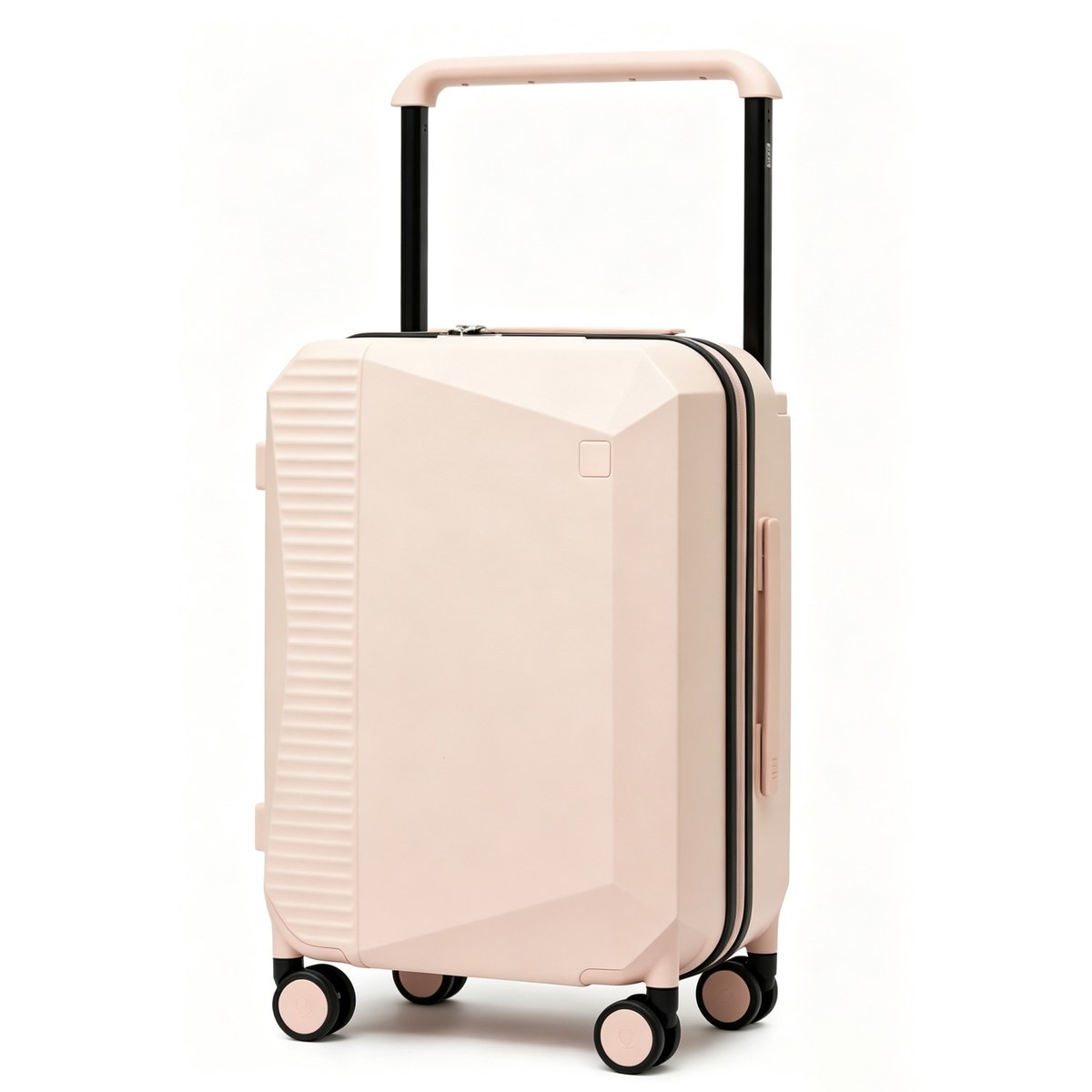
What Makes a High-end Luggage Case Durable and Worth the Investment?
A high-end luggage case earns its category in four places, and none of them is the shell alone: the corner that takes the first impact, the wheel assembly that carries the load, the grip that transfers it to a hand, and the trim that decides how the case looks after twenty trips. Durability in this product is not a single property but a sequence of load paths, and the case fails at whichever path is weakest rather than at whichever material is cheapest. That is why two cases made from the same shell can have very different service lives.
For a brand, a manufacturer or a sourcing team, the question of value is therefore not answered by the shell grade. Two cases can share a polycarbonate shell and a spinner layout, and one returns to shape after a drop while the other develops a crack at the grip anchor. What separates them is the reinforcement at four points, the trim construction and the serviceability of the wheel assembly — three decisions that cost little at the specification stage and a great deal after the first season.
This guide sets out the four failure points that decide whether a case lasts, what the shell and frame actually have to do, how wheels, handles and trim carry load, what the extra specification buys in service terms, and the care and repair details that extend a case’s working life.
What Makes a High-end Luggage Case Durable: Four Failure Points
Returns in this category cluster around four locations, in a consistent order. Each is a load path rather than a material, which is why upgrading the shell rarely fixes any of them.
- The corner. Every case is dropped on a corner first. A single layer of piping deforms and then delaminates; a bonded reinforcement or a separate corner cap distributes the impact into the shell wall.
- The grip anchor. The top grip transfers the loaded weight into the shell through two stitch zones. A grip sewn through a thin panel tears the panel before the band fails.
- The wheel housing. A housing that flexes allows the axle to wear its seat, and the wheel begins to wobble long before the tread is worn. This is the failure that cannot be repaired without a replaceable assembly.
- The zip end. A packed case pushes outward along the whole zip, and the two ends take the highest stress. A zip that ends in a fabric tunnel without reinforcement separates at the end.
All four are structural, and all four are visible on a sample under load. That is the practical argument for approving a case as a loaded assembly rather than as a shell with a trim list.
High-end Luggage Case Shell and Frame Durability
The shell has two jobs and they conflict. It has to resist impact without cracking, and it has to return to shape after deformation without leaving a permanent dent. Polycarbonate does the first well and the second reasonably; polypropylene is more flexible and recovers from deformation but scuffs more visibly; aluminum holds a shape and shows every impact; ballistic nylon absorbs energy and abrades slowly but offers no structural rigidity of its own.
Wall Thickness and Ribbing
Thickness is quoted less often than material and matters as much. A thin wall in a strong polymer will crack at a corner that a thicker wall in a weaker polymer survives, because the impact energy has to go somewhere. Ribbing and molded reinforcement at the corners achieve the same result at lower weight, and the pattern of that ribbing is the part of the shell design that is hardest to copy.
Frame and Handle Tubes
On a soft-sided case, the frame carries the load that the shell cannot. On a hard case, the handle tubes act as a partial frame and transfer load into the shell at two mounting plates. Those plates are a common failure point: a plate riveted through a thin panel concentrates stress at four points, and the panel cracks between them. A bonded plate with a larger footprint distributes the same load.
High-end Luggage Case Wheels, Handles, and Load Paths
The load path runs from the ground, through the wheels, into the shell or frame, up the handle tubes and into a hand. Every joint in that path is a place where the case can develop play, and play is what owners describe as the case feeling cheap.
Wheel Assemblies
Two specifications decide whether a wheel lasts: the housing rigidity and whether the assembly is replaceable. A rigid housing keeps the axle seated; a replaceable unit means a worn wheel does not condemn the case. Both are decisions taken at the design stage and neither is visible in a photograph.
Telescopic Handles
Handle durability is about play rather than strength. Tube wall thickness, the number of locking stops and the material of the lock determine how the handle feels after a year. A two-stop handle with a plastic lock develops rattle; a multi-stop handle with a metal lock does not, at a weight and cost that the high-end tier can carry.
Grips and Straps
The grip is where the load meets the body, and it is the part most often specified by appearance. A folded webbing grip at 25–38 mm with a woven selvedge under the stitch, anchored through a reinforcement plate, is the reference construction. The high-end luggage case trim range is specified against that load path rather than by width.
High-end Luggage Case Trim Durability
Trim is where a case ages visibly, and it ages faster than any other component because it is what hands and conveyors touch. Three trim elements decide how the case looks in year three.
Grip and Handle Webbing
A woven selvedge under the stitch resists fraying; a heat-sealed slit edge does not, and the sealed line sits exactly where the stitch perforates it. Nylon is the usual choice for abrasion, polyester where the case will be stored damp or used in strong sunlight, because nylon loses strength when wet and degrades under ultraviolet light. The nylon webbing and polyester webbing ranges are both used for case trim for that reason.
Binding and Corner Reinforcement
Binding holds the edge of the shell or the fabric and takes the abrasion at the corner. A binding that delaminates leaves a white line that cannot be repaired invisibly. Bonded or stitched-and-sealed binding survives; a single row of stitching through a thin tape does not.
Zip Tape and Sliders
The zip tape is a woven band in its own right, and it abrades at the corners where the case is dragged. A metal slider sized one above the nominal coil is the specification that keeps a packed case closable, and it is the cheapest upgrade in the whole product.
High-end Luggage Case Value: What the Extra Cost Buys
The premium in this category buys four things, and only one of them is the shell. Understanding which is which makes the value argument concrete rather than aesthetic.
| What the premium buys | Effect in service | Visible to the buyer |
|---|---|---|
| Reinforcement at corners and anchors | Survives the first drop without delamination | Only after a trip |
| Replaceable wheel assembly | A worn wheel is renewed rather than ending the case | At repair, or in the listing |
| Trim construction and stitch margin | No fraying at the grip; no white line at the binding | Immediately, in the hand |
| Handle and lock quality | No rattle at full extension after a year | Immediately, on the first lift |
Two of those four are visible in a shop and two are not, which is why a high-end case has to be specified for both. A product that is only better where it can be seen will be judged as expensive rather than as good, and a product that is only better where it cannot be seen gives the owner no reason to pay for it.
The service life argument follows from the same table. The components that end a case’s working life early are the wheel assembly, the grip anchor and the zip end — all three repairable if the design allows it. A case built so that those three can be renewed has a working life set by the shell rather than by the trim, and that is the definition of durability in this category.
Where the Premium Stops Paying
Extra material stops earning its cost at the point where it no longer changes a failure mode. A shell taken from 1.2 mm to 1.4 mm adds weight and cost without raising the drop height at which a corner fails, because the corner reinforcement is what absorbs that load. The same holds for feature count: a fourth external pocket adds a seam, a zip and two anchors, each a new place to fail and none of them a longer life.
Warranty length is a commercial term rather than a durability measure. Repair access is the measure that matters: whether the wheel assembly, the grip anchor and the zip can be replaced with parts still in production. That question has a specific answer, and it sits in the spare parts list rather than on the product page.
Two cases at the same cost should therefore be compared on which failure modes each one addresses and which of those can be repaired. The case that answers both is worth the premium; the case that answers only the first is charging for appearance.
High-end Luggage Case Care and Repair That Extend Life
Most of what shortens a case’s life is handling rather than material, and a short care instruction in the packaging returns more goodwill than another trim upgrade.
- Storing it empty and open. A case stored closed with residual compression in the zip takes a set in the tape, and the zip becomes the first failure.
- Keeping the wheels clean. Grit in a wheel housing wears the axle seat faster than any road surface. A wipe after a trip is the whole maintenance schedule.
- Not overpacking. A case packed past its designed volume loads the zip, the hinge and the corner reinforcements at once. Every one of those is a repair rather than a replacement.
- Renewing the wheel assembly when it first wobbles. A wobbling wheel has already worn its seat. Replacing it at that point preserves the housing; waiting wears the housing out of tolerance.
- Keeping a spare set of trim parts with the range. Grips and zip pullers are cheap to hold and impossible to match later, because dye lots move. A trim program should include a service quantity.
A range that offers a repair path also needs a trim supply that can be repeated, which is a specification question rather than a service one. The OEM and ODM program holds approved dips for that reason, so a replacement grip matches the case it was sewn onto.
FAQ: High-end Luggage Case Durability
What makes a high-end luggage case durable?
Four things, in order of how often they fail: corner reinforcement, the grip anchor through the shell, a rigid and replaceable wheel assembly, and a reinforced zip end. The shell material matters, but it is rarely what ends a case’s life.
Is polycarbonate better than aluminum for a luggage case?
Polycarbonate is lighter and resists impact without permanent deformation; aluminum is stiffer, holds its shape and shows every impact. Neither is more durable in the abstract: the choice depends on whether weight or appearance over time matters more to the product.
Why do luggage wheels fail before the shell?
The wheel assembly carries the full loaded weight through a small housing, and any flex in that housing wears the axle seat. A rigid, replaceable assembly outlives the case; a flexible one fails within a few seasons.
Does webbing quality matter on a luggage case?
It decides how the case looks in year three. The grip is what a hand touches every time the case is lifted, and a grip that frays at the stitch line reads as wear even when the shell is sound.
How can a luggage case be made to last longer?
Store it empty and open, keep grit out of the wheel housings, do not pack past the designed volume, and replace the wheel assembly as soon as it wobbles rather than when it stops turning. All four address the parts that actually fail.
Why Buyers Source High-end Luggage Case Trim from Xinxiangrui
Durability in a high-end luggage case is a sequence of load paths, not a shell grade. The corner, the grip anchor, the wheel housing and the zip end decide how long the case works, and three of the four are trim and hardware decisions that can be written into a brief.
Xinxiangrui Webbing has woven webbing in Dongguan since 2011, supplying case trim in nylon, polyester and bio-based grades, with abrasion, tensile and colorfastness tested in-house. Trim is specified against the load path, the edge and the stitch margin rather than by width alone, and approved dips are held so a replacement grip matches the case it was sewn onto. The high-end luggage case range covers grip, binding and reinforcement constructions.