
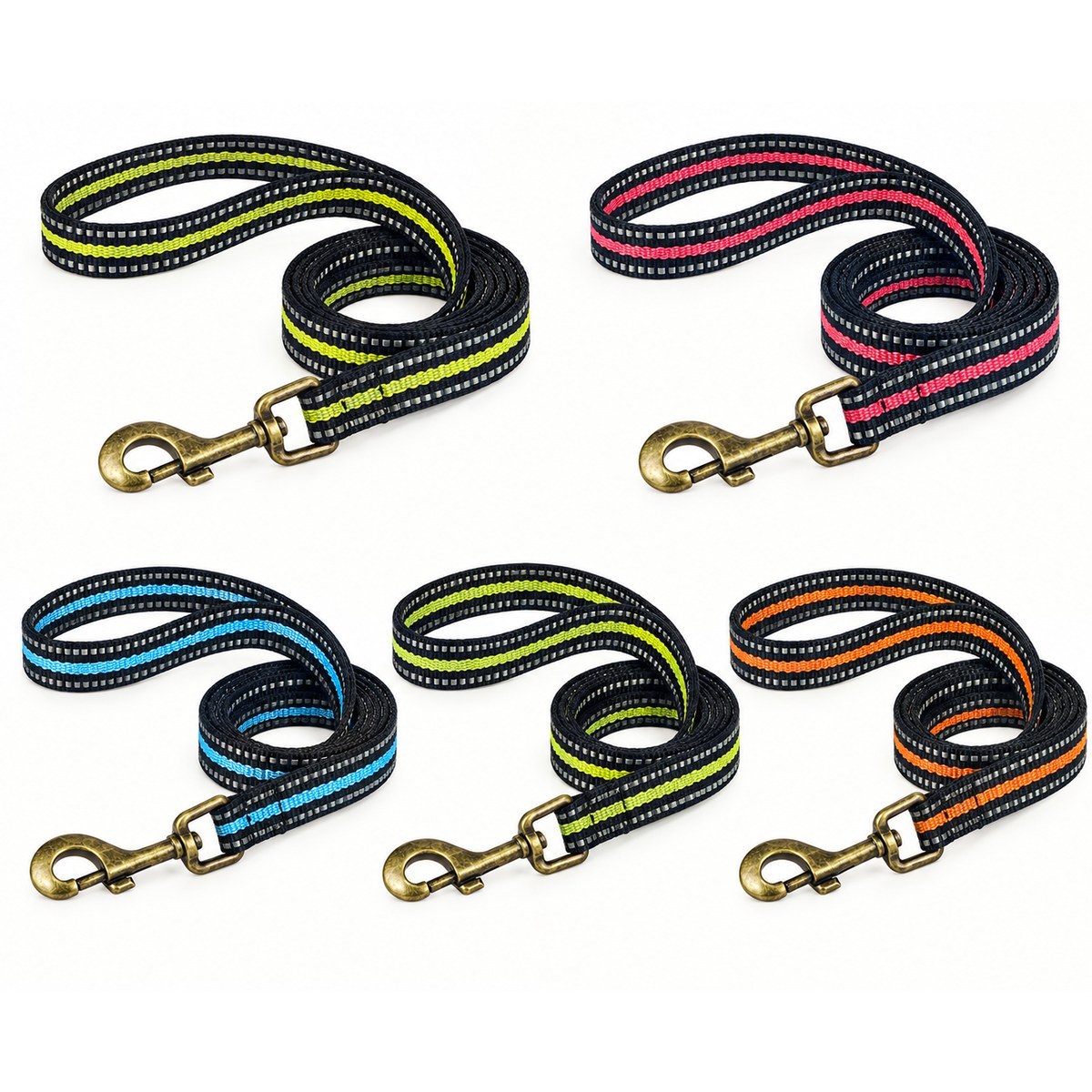
What Materials Are Best for Pet Leashes? A Practical Comparison for Buyers
Choosing a material for pet leashes is a decision taken against four requirements at once: the load the band has to carry, the abrasion it will meet, the hand it will have where a person holds it, and the wet or dirty conditions it will be stored in. No single material leads on all four. Nylon wins on abrasion and strength per width, polyester wins on water and sunlight, polypropylene wins on weight and resistance to rot, and leather wins on feel at the cost of maintenance. The right answer is therefore not a fiber but a match between the failure the product cannot tolerate and the property that prevents it.
For a pet brand, a wholesaler or a manufacturer building a range, the comparison is not one swatch against another. Two leashes can look identical in width and shade and behave differently within a season: one stiffens in cold weather, one grows in the rain, one fades on a car dashboard. What separates them is measurable before the order — moisture regain, elongation at break, ultraviolet stabilization and abrasion loss at the edge — and those four values are what a specification should ask for.
This guide compares the materials used for pet leashes side by side, explains what each one does better than the others, sets out where rope, leather and chain still beat webbing, and closes with the matching rule that turns the comparison into a decision for a specific dog and a specific route.
Pet Leashes: Materials Compared at a Glance
The table below condenses the comparison into the form a range meeting actually uses. Each row names what the material is bought for and what it costs in exchange. Where two materials tie on strength, the decision moves to the property in the last column.
| Material | Bought for | Weak point | Typical width |
|---|---|---|---|
| Nylon webbing | Abrasion life and strength per width | Gains length when wet; fades in strong sun | 20–25 mm |
| Polyester webbing | Holding length and shade when wet or sunny | Lower elongation, so less shock absorption | 20–25 mm |
| Polypropylene webbing | Light weight and resistance to rot and mildew | Low melting point; abrades faster than nylon | 20–25 mm |
| Cotton webbing | Soft hand and a natural look | Absorbs water, weakens when wet, mildews | 25–30 mm |
| Rope | Round profile that resists kinking and dragging | No flat surface, so hardware and handles differ | 8–12 mm diameter |
| Leather | Feel in the hand and appearance over time | Needs care; inconsistent from hide to hide | 15–25 mm |
| Chain | Chew resistance on a determined dog | Weight, noise, and no shock absorption at all | 2–4 mm link |
Read the weak column rather than the strong one. Every material on that list is strong enough for a 25 kg dog on a 25 mm band; what separates them is which condition they handle badly, and whether that condition appears on the route the product is sold for.
Nylon Webbing for Pet Leashes
Nylon is the default for load-bearing pet leashes, and the reason is abrasion rather than tensile. A nylon band dragged along a wall, a curb or a rough trail loses material slowly because the fiber is tough at the surface as well as strong along its length. That combination is why the same material appears on climbing slings and on dog leashes, and why it is the wrong material for an awning.
What Nylon Does Well
Strength per unit width is the highest of the common webbing fibers, so a 20 mm band can carry what a 25 mm polypropylene band carries. Elastic recovery is high, which absorbs the peak of a lunge and returns the band to length afterwards. Dye uptake is deep, so a dark shade stays dark through washing better than on polyester at the same depth.
Where Nylon Underperforms
Nylon absorbs water — several percent of its own weight — and a wet nylon band loses a measurable share of its dry strength while it is wet. It also degrades under ultraviolet light: a band left outdoors for a season can lose strength while looking almost unchanged. For a leash that lives by the door and walks in the rain, neither matters much. For one stored on a balcony or used on a boat, both do.
The comparison against polyester is set out in full in nylon webbing vs polyester webbing, and the difference that matters most on a leash is the one least often discussed: nylon recovers, polyester holds.
Polyester Webbing for Pet Leashes
Polyester is the choice where the product will be wet, sunny or stored outdoors. It absorbs under one percent of its own weight in water, so a soaked band dries without changing length or losing strength, and it resists ultraviolet degradation far better than nylon. A leash that lives in a car or on a hook beside a door in a hot climate will outlast the same product in nylon.
What Polyester Gives Up
Elongation. A polyester band has less stretch to offer, so a lunging dog transmits more of the peak to the handler’s wrist and to the clip. On a calm dog that difference is invisible; on a 35 kg dog that hits the end at speed it is the difference between a jolt and a pull. Polyester also takes dye slightly less deeply, which shows up on saturated reds and blacks after a season of sun.
Where Polyester Wins on a Leash
Long lines used near water, leashes for dogs that swim, products sold in coastal or tropical markets, and any leash specified with a reflective element that must survive washing. In each case the material is being chosen for what it does not do — absorb, grow, fade — rather than for a figure on a datasheet. The polyester webbing range covers the widths used for leashes and for the matching collar.
Polypropylene and Cotton Pet Leash Materials
Both of these are sold as budget or lifestyle options, and both have a specific place that is not simply a cheaper nylon.
Polypropylene
The lightest of the common webbing fibers, and the only one that does not rot or mildew when stored damp. It floats, which matters for water work, and it takes bright colors cheaply. Its limits are heat and abrasion: the melting point is low enough that a hot car or a tumble dryer can distort a band, and it abrades faster than nylon at a rub point. A polypropylene leash suits a small dog on a dry route and disappoints on a large dog on a rough one.
Cotton
Chosen for hand and appearance rather than performance. Cotton is soft, takes print well, and gives a natural look that suits a fashion-led range. It also absorbs water, weakens when wet, and mildews if stored damp, which is why it appears on leashes sold with matching accessories rather than on working products. Where cotton is specified, the width usually goes up to compensate for the lower wet strength.
Rope, Leather, and Chain as Pet Leash Materials
These three are not substitutes for webbing, and each solves a problem webbing handles badly.
- Rope. A round profile does not kink, does not cut into a hand under load, and survives being dragged. Climbing-grade rope is the reference for a long line. The trade is that hardware attachment and handle construction change completely, and a rope leash cannot carry a printed reflective element in the same way a woven band can.
- Leather. The only material on the list that improves in appearance with use. It is chosen for a premium range where the feel in the hand is the product. The trade is consistency: two hides differ in thickness and stretch, and a batch that mixes them produces leashes that feel different at the same nominal width.
- Chain. The answer to a dog that chews through everything else. A chain upper section with a webbing handle—the combination sold as a chew-proof leash—keeps the strength of metal where the teeth are and the comfort of webbing where the hand is. The trade is weight, noise and no shock absorption at all.
A range that covers all three needs three different bills of material, which is why most brands treat them as separate lines rather than as variants of one product.
Pet Leash Material: What the Specification Should Name
A material named in a brief is not a specification until four values sit beside it. Without them the supplier is free to meet the word with any construction in its range, and the sample will pass on appearance while differing in the properties the product was bought for.
- Fiber and grade. Not “nylon” but the polymer and the tenacity class, because two grades sold as nylon differ in stiffness and in temperature ceiling.
- Width and thickness at the finished edge. Both with tolerances, stated on the finished band rather than on the roll it was slit from.
- Elongation at a stated load. This is the figure that separates a leash that absorbs a lunge from one that transmits it, and it is not predictable from the fiber name.
- Colorfastness to light and to rubbing. Each on a named scale, with the wash regime the product will meet. Rubbing matters more than light on a leash, because the band folds and rubs at the hand.
Add the edge construction and the hardware, and the brief covers every failure point in the product. Seven lines in total, all of them checkable on a single sample.
How to Match Pet Leash Material to the Dog and the Route
The matching rule is short enough to apply in a meeting. Start from the condition the product will meet, choose the material that handles that condition badly the least, then adjust width and hardware to the dog.
- Wet, coastal or outdoor storage. Polyester. The band will not grow, will not lose strength wet, and will hold shade through a season of sun.
- Rough ground and continuous dragging. Nylon, at the widest width the hardware allows, with a woven selvedge rather than a sealed slit edge.
- Small dog, dry route, bright colors. Polypropylene, provided the product is not stored in a hot car and the dog does not pull hard.
- Premium retail range. Leather for the handle and the visible section, with the load path either leather through-and-through or a webbing core.
- Dog that chews. Chain at the upper section, webbing at the handle, and hardware rated above the dog’s weight band.
Two adjustments follow the material choice rather than precede it. Width should be re-checked against the fitting once the fiber is fixed, because the same 2000N+ figure is reached at a different width in nylon and in polypropylene. Color should be approved on a dip cut from the production band rather than on a pantone chip, because dye depth differs by fiber and a range built across materials will drift in shade if the approval is done once for all of them.
Where a brand wants one look across a collar, a harness and a leash, the pet webbing line is woven in the same widths and shades across the three parts, so the material decision can be made once per range rather than once per product.
FAQ: Pet Leash Materials
Is nylon or polyester better for a dog leash?
Nylon for abrasion and shock absorption, polyester for wet conditions and sun exposure. A leash that walks in the rain and dries indoors is normally nylon; a leash stored outdoors, used near water or sold in a hot climate is normally polyester.
Is a rope leash better than a webbing leash?
A rope leash resists kinking and dragging better and does not cut into a hand, which suits long lines and large dogs. A webbing leash takes hardware, printing and reflective elements more easily and is the better base for a branded range.
Can a cotton leash be used for a strong dog?
It can be made strong enough at a wider band, but cotton loses strength when wet and mildews if stored damp. It suits a small or medium dog on a dry route, and it is usually sold for appearance rather than for working use.
What is the strongest material for pet leashes?
Per unit width, nylon webbing carries the highest load of the common materials, and a chain upper section is stronger still against chewing. Strength is rarely the limiting factor; the clip, the seam and the handle usually fail before the band does.
Does the material affect how a leash feels in the hand?
It does. Nylon is firmer and slightly slicker, polyester is similar but holds its shape when wet, polypropylene is lighter and softer, cotton is the softest and leather the most conforming. For a leash held under load, handle construction matters more than the fiber.
Why Buyers Source Pet Leash Materials from Xinxiangrui
Pet leash material is a match rather than a ranking. Nylon where the band is dragged, polyester where it is wet or sunlit, polypropylene where weight matters more than abrasion, and leather where the hand is the product. A specification that names the fiber, the width at the finished edge, the elongation and the colorfastness can be sampled once and repeated without drift.
Xinxiangrui Webbing has woven webbing in Dongguan since 2011, running nylon and polyester on the same needle looms in the same width range, with tensile and colorfastness tested in-house. Materials are compared at the same width, edge and finish rather than across catalogues, and OEM and ODM work is quoted from the four values above. The pet leashes range is available in both fibers.