
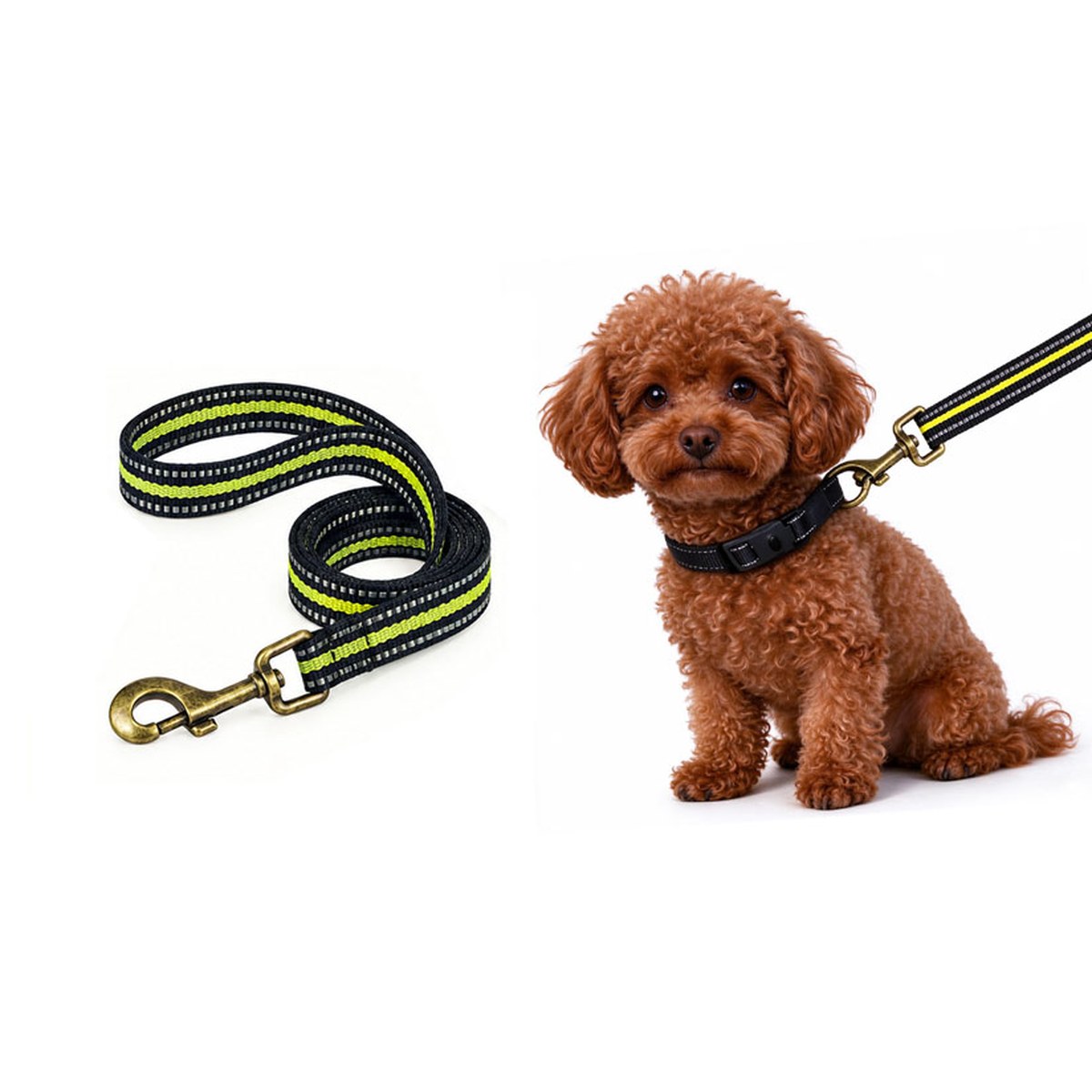
How to Choose Pet Leashes for Different Dog Sizes, Temperaments, and Walking Habits
Choosing pet leashes is a decision taken against four requirements at once: the load the dog can generate in a single lunge, the control the handler needs at that load, the distance the walk allows, and the abrasion the route applies to the band. A leash is the one part of the walking kit that stays under tension for the whole walk, and it is the part that receives the shock when a dog hits the end of it. Width, webbing construction, hardware and length each change how the product behaves at that moment, and a specification written for one dog is usually the wrong specification for the next.
For a pet brand, a wholesaler or a manufacturer building a range, the comparison is therefore not one width against another. A 15 kg dog on a long line and a 40 kg dog on a training lead put very different loads through the same 25 mm band, and the same band will fail in different places: the handle loop on the first, the clip attachment on the second. What separates the two cases is breaking strength at the finished width, the edge construction at the rub point, the attachment method and the length under load — four values that can be fixed before the first sample rather than after the first return.
This guide sets out how to size pet leashes by dog weight, how temperament changes the specification, how walking habits and routes decide length and hardware, where the product fails first, and the six lines worth writing into a brief before a bulk order is placed.
Pet Leashes Sized by Dog Weight
Weight is the crudest input and the only one every buyer has on the first call, so it is where a specification usually starts. It is not the load figure that matters in service. A dog that weighs 30 kg can put several times that through a leash in a single lunge, and the peak arrives in under a second. The table below gives the widths and hardware that most approved products use at each weight band; the strength column is the figure to write into the brief, measured at the finished width rather than on a slit roll.
| Dog weight | Webbing width | Fitting | Strength to specify |
|---|---|---|---|
| Under 8 kg | 15–20 mm | Light snap hook, 12–15 mm opening | 600N+ |
| 8–15 kg | 20–25 mm | Snap hook, 15–20 mm opening | 1000N+ |
| 15–30 kg | 25 mm | Snap hook or trigger clip, 20 mm opening | 2000N+ |
| 30–45 kg | 25–32 mm | Trigger clip, 25 mm opening | 2000N+ |
| Over 45 kg | 32–38 mm | Trigger clip or screw gate, 25 mm opening | 2000N+ |
Two conventions sit behind those numbers. The first is that width follows the fitting rather than the strength: a clip with a 20 mm opening will not take a 32 mm band without a sewn taper, and a taper is a seam in the load path. The second is that strength is specified at the finished width, because a 38 mm band slit down to 25 mm does not carry 25 mm of strength at the cut edge — the sealed line is the first thing to go.
Load a Dog Can Generate
A static pull and a lunging pull are different events. A dog leaning into a leash applies a steady load that most 25 mm bands carry without complaint. A dog that hits the end at speed applies a peak several times higher for a fraction of a second, and that peak is what breaks hardware rather than webbing. This is why the fitting, the attachment and the seam are specified with more margin than the band itself.
Where a Pet Leash Fails First
The band is rarely the first part to fail. The order is consistent across returns: the stitching at the clip attachment, then the clip gate, then the handle loop where it folds into the hand, and only then the webbing. A leash specified on webbing strength alone leaves the three earlier failure points undetermined.
Pet Leashes for Different Temperaments
Temperament changes the specification more than weight does, because it changes the frequency of peak load rather than its size. Three temperaments account for most of the range a brand has to cover, and each asks for a different construction rather than a different width.
Dogs That Pull Continuously
A steady puller loads the leash for the whole walk, which is a fatigue problem rather than a peak problem. The band needs a denser weave and a firmer hand so it does not stretch into a rope, and the handle needs padding or a wider fold, because a 25 mm band under constant tension cuts into a hand within twenty minutes. A bungee section is often added here, and it moves the peak away from the handler’s wrist at the cost of control.
Reactive Dogs
A reactive dog produces short, violent peaks and needs to be held at a fixed distance. That combination argues against any elastic element and against a long line. The specification is a short, low-elongation band, a fixed handle, and a second attachment point so the leash can be held close without wrapping it around a hand. Hardware should be a trigger clip rather than a snap hook, because the gate is loaded along its axis rather than across it.
Puppies and Senior Dogs
The load is low and the requirement moves to weight and comfort. A lighter band with a softer finish reduces the pull on a small neck, and the hardware should be small enough not to swing against the chest. The same products are usually sold with a matching collar and harness, which puts a premium on holding one shade across three constructions.
Pet Leashes for Walking Habits and Routes
The route decides abrasion and the habit decides length. A leash used on sidewalk and in a park meets a different wear pattern from one used on trails, and a leash used for training meets a different one again. Three route types cover most of the category.
- Street and sidewalk. The band rubs against curbs, railings and the dog’s own coat. A woven selvedge survives this better than a sealed slit edge, and a dark shade hides the scuffing that shows on light colors within a month.
- Trail and rough ground. Abrasion comes from vegetation and rock rather than from concrete, and the leash is often dropped or dragged. A wider band with a rounder edge distributes the wear, and a second handle near the clip is worth having for lifting the dog over an obstacle.
- Training and close control. Length is short, the leash is handled constantly, and the band folds repeatedly at the same point in the hand. Flex fatigue at that fold, not abrasion, is the failure to design against.
None of the three changes the width much. All three change the edge, the finish and the number of handles, which is why a range built on one construction tends to look uniform and perform unevenly.
Pet Leash Length and Handle Configuration
Length is the specification most often copied from a competitor and least often measured against the walk. The table below gives the ranges that correspond to the common uses, measured from the handle to the clip with the leash under a light load rather than laid flat on a table.
| Use | Length range | Handle configuration | Notes |
|---|---|---|---|
| Obedience and heel work | 0.9–1.2 m | Single fixed handle | Short enough to keep the dog inside a meter of the handler |
| Everyday walking | 1.2–1.8 m | Single handle, optional traffic handle | The traffic handle sits 30–40 cm from the clip |
| Long line and recall training | 3–10 m | No handle loop, or a very loose one | Handle loops on long lines cause hand injuries |
| Two-dog walking | 1.2–1.5 m per dog | Coupler with swivel | A swivel at the coupler prevents the bands twisting together |
| Running and cycling | 1.5–2.2 m | Waist belt with bungee | Hands stay free; the bungee absorbs the stride |
A length measured flat is shorter in use than on the table, because a loaded band follows a catenary between hand and dog and because a sewn handle consumes 12–20 cm at the fold. A brand that specifies finished length from the drawing rather than from a sewn sample will find the product hangs shorter than the listing claims, and the correction is a change to the pattern rather than to the webbing.
Pet Leash Webbing and Hardware That Fail First
Most of the failure modes in this category are structural, and each is visible on a sample before a bulk order. The list below runs in the order the failures actually appear in returned product.
- The stitch line at the clip. Box-X stitching through a sealed edge concentrates stress at the last stitch. A woven selvedge under the same stitch distributes it. Ask which edge the sample was sewn through.
- The clip gate. A die-cast zinc snap hook opens under a side load that a trigger clip survives. The gate is the cheapest component to upgrade and the most common cause of a dog getting loose.
- The handle fold. A single-layer fold under continuous tension becomes a cutting edge. Two layers with an interlining, or a padded handle, removes the problem without changing the band.
- The heat-sealed slit edge. A fused line of filament ends is brittle and sits exactly where a hand or a curb rubs. Where the width allows, a woven selvedge is the better answer.
- Dye loss at the fold. A band dyed at the surface loses color at the fold long before the face fades. Colorfastness to rubbing matters more than fastness to light on a leash.
Each item on that list can be checked on a single sample in an afternoon: flex the handle, load the clip sideways, rub the edge against a rough surface twenty times, and look at the fold. None of it requires equipment, and together the five checks predict most of what a datasheet does not describe. The same logic governs reflective pet webbing specified for the same walking kit, where the reflective element adds a failure mode of its own.
What to Write into a Pet Leash Specification
A brief that carries the following six lines can be quoted without a round of questions, sampled once, and repeated without drift. Each line corresponds to one of the failure points above.
- Webbing. Fiber, width in millimeters, and finished thickness with a tolerance rather than a nominal figure.
- Strength. Newtons at the finished width, the test method named, and whether the figure applies to the band or to the sewn assembly.
- Edge. Woven selvedge or sealed slit edge, stated explicitly. This is the single line most often omitted and the first to decide service life.
- Hardware. Clip type, gate opening, material and finish, with the gate load direction stated.
- Length. Finished length from the clip to the end of the handle, measured on a sewn sample under light load.
- Colorfastness. Light and rub, each on a named scale, with the wash regime the product will meet.
Where a range has to share one construction across sizes, the pet webbing range can be matched across collar, harness and leash so the shade holds, and where the product is being developed rather than selected, the construction is quoted from the six lines above through the OEM and ODM program rather than from a photograph.
FAQ: Pet Leashes
What width of webbing should a pet leash use?
20–25 mm covers most dogs from 8 to 30 kg, and 25 mm is the default for anything that pulls. Below 8 kg a 15–20 mm band keeps the hardware proportioned to the dog; above 30 kg the width usually stays at 25 mm and the fitting, seam and edge are upgraded instead.
Is a bungee leash better for a strong dog?
It depends on which problem is being solved. A bungee reduces the peak the handler feels and the shock the dog feels, which helps on a dog that lunges at speed. It also adds length under load and reduces the handler’s control at close range, so it suits running and casual walking rather than training or a reactive dog.
Should a pet leash handle be padded?
A padded or double-layer handle matters as soon as the dog pulls steadily, because a single-layer fold under constant tension becomes a cutting edge. For a small dog on a loose leash the padding is a comfort feature; for a 30 kg puller it is a structural one.
What is a traffic handle and when is it needed?
A second, short handle 30–40 cm from the clip, used to hold the dog close at a road crossing or in a crowd without wrapping the leash around a hand. It adds a seam and a fold, so it belongs on leashes for dogs that walk in traffic rather than on training lines.
How is pet leash length measured?
From the inside of the handle to the clip, with the leash under light tension. Measured flat, the same leash reads longer, and the difference is large enough to matter: a sewn handle consumes 12–20 cm at the fold alone.
Why Buyers Source Pet Leashes from Xinxiangrui
A pet leash performs as its specification defines it. The width sets the hardware that will fit, the edge sets where abrasion starts, the attachment decides which seam fails first, and the length decides whether the product hangs the way the listing claims. A brief that names all four can be sampled once and repeated without drift.
Xinxiangrui Webbing has woven webbing in Dongguan since 2011, with needle looms that produce a woven selvedge and a dye line that holds one Pantone across a collar, a harness and a leash. Tensile and colorfastness are tested in-house, and OEM and ODM work is quoted from the six-line brief above rather than from a photograph. The pet leashes range covers widths from 15 mm to 38 mm.